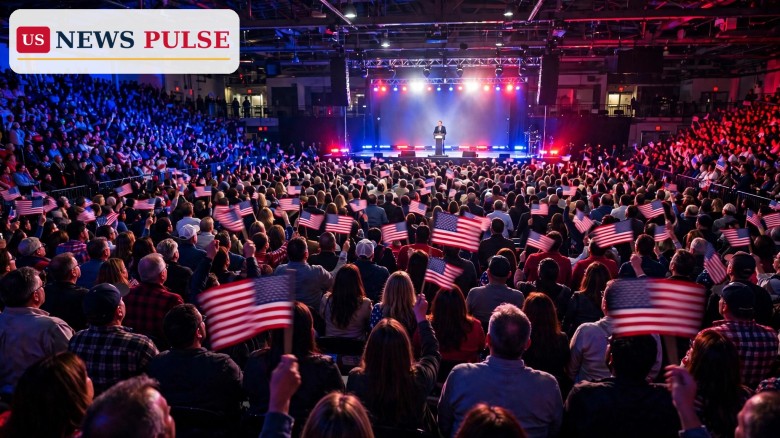
The Trump Daytona rally on Friday night, October 30, 2026, became the president's loudest closing argument of the midterm campaign: a packed Ocean Center arena in Daytona Beach, Florida, a repeated promise of $5,000 for every adult citizen if Republicans hold Congress, and a warning that losing would bring a third impeachment. With voting ending on Tuesday, November 3, the rally also landed on the day early voting passed a record 47.9 million ballots, a surge that is reshaping the final days of the race.
Doors at the Ocean Center opened at 3:30 p.m., and supporters had been lining up for hours, some since before dawn. The arena holds about 9,300 people. Trump was scheduled to speak at 7 p.m. but arrived later, with his motorcade reaching the venue shortly before 8 p.m. and his remarks running into the evening, including the $5,000 promise reported at 9:15 p.m. Eastern time.
Before Trump spoke, Florida Republicans took the stage. Byron Donalds, the Republican candidate for governor, told the crowd, "In four short days, I'm going to be your next governor," and attacked his Democratic opponent, David Jolly, as a former Republican who had changed parties and policies. Senator Ashley Moody, who was appointed to the seat in 2025 after Marco Rubio left it, criticised her opponent, Angie Nixon, calling her a communist and pointing to her affiliation with the Democratic Socialists of America. Representative Randy Fine also spoke, attacking Democrats in Congress in sharp terms.
Trump was interrupted at least three times by protesters, according to live reporting from the arena. One man wearing a red shirt reading "Release the Files," a reference to the Epstein files, was escorted out. Trump quipped that another protester was "Paid by Soros," referring to Democratic financier George Soros, and complained that a further interruption had cut off a punchline.
The speech ranged widely, as Trump's closing rallies often do. He moved from his television career on "The Apprentice," recalling a first-season finale audience of 47 million, to the war with Iran, to Venezuela, where he said, "We love the Venezuelan people. We won the war with Venezuela," after the arrest of Venezuelan president Nicolas Maduro in January. On Iran, he said the United States had not started the war, arguing that Iran had been waging war against America since 1979, and claimed American strikes had removed Iran's nuclear capabilities. Those are Trump's characterisations of the conflicts, and they were delivered as part of a campaign speech, not as a military briefing.
The Daytona rally came at the end of an unusually intense closing schedule. One fact-check of the campaign noted Trump had spoken at 27 events in 19 states over the previous 30 days, more midterm rallies than any previous president in such a stretch. The pace itself became a story in the final week. On Thursday, October 29, Trump cancelled planned rallies in Kansas and Iowa, saying he would hold virtual rallies instead, a move that prompted questions about his health and energy.
On Friday he reversed course. Speaking in the Oval Office while hosting Stephen Hubbard, an American detainee recently freed by Russia, Trump said Republicans in Iowa and Kansas had called and said an in-person visit "would be better than a tele-rally." The Kansas rally, originally set for Saturday, October 31 in Salina, was moved to Sunday, November 1, and the Dubuque, Iowa rally stayed on Sunday. Both states voted comfortably for Trump in 2024 but have become unexpected battlegrounds: in Kansas, Republican Senator Roger Marshall faces a competitive challenge from Democrat Adam Hamilton in a state that has not elected a Democratic senator since 1932, while in Iowa, Republican congresswoman Ashley Hinson faces a close race against Democrat Josh Turek.
Trump, 80, had complained earlier in the week about losing his voice. Asked on Thursday whether he was cancelling the Kansas trip because he was tired of travelling, he snapped, "I feel perfect," and said he no longer needed to visit Kansas because Marshall was "doing very well." Political strategist Mike Fahey told AFP he suspected the about-face was aimed at killing the narrative about the president's energy, saying, "My suspicion is that Trump didn't particularly like that narrative, and putting the events back on the calendar was the fastest way to kill it."
Republicans are defending a 53-47 majority in the Senate. Democrats need to capture at least one chamber of Congress to curb Trump's legislative agenda in the final two years of his presidency. Trump has made himself the centre of the Republican midterm strategy, betting that his personal appeal to the Make America Great Again base can overcome the usual pattern in which the president's party loses seats in a midterm.
The clearest policy promise of the night was also the simplest to explain, and the hardest to pin down in detail. At Daytona Beach, Trump repeated his promise to give $5,000 to every adult citizen in the United States if Republicans win control of the House and the Senate. He has described the payment as a "dividend," linked in his speeches to economic growth, investment and tariff revenue. No legislation enacting such payments was cited at the rally, and the promise is conditional: it applies, in Trump's telling, only if Republicans hold both chambers.
That conditionality is the point, politically. Trump has urged Republicans to "pretend I'm on the ballot," pointing to his presidential victories in 2016 and 2024. He has also repeatedly warned that he will face a third impeachment if Republicans lose, although analysts note Democrats may be more likely to focus on the 2028 presidential election than on another impeachment fight. The $5,000 pledge and the impeachment warning work together as a turnout device: a reward for winning, and a threat for losing.
Trump also stepped up harsh rhetoric against migrants, Muslims and transgender people during the closing campaign, according to AFP's account of the final days, and showed the Daytona audience a video of Democratic candidates and politicians, including James Talarico and Ilhan Omar, making statements on police funding, transgender rights and immigration. The rally's other speakers echoed that tone, with Moody and Fine both attacking their Democratic opponents in personal and ideological terms.
For voters, the practical question is what the pledge would mean in practice. The rally did not set out a payment mechanism, a timetable or a funding law. That absence matters because a promise made on a stage is not a programme, and any such payment would require Congress to pass it and the president to sign it. The story of the pledge, for now, is therefore a campaign story: a vivid, easily repeated offer, made four days before voting ends, in a race where turnout, not persuasion alone, may decide the result.
Trump's own assessment of Republican chances was notably restrained for a closing rally. "Typically, a president, whether he's good or bad, Republican or Democrat, loses the midterms," he told reporters in the Oval Office on Friday. "I think we have a shot at doing well. Maybe very well, but you know, pretty well." The remark, reported by AFP, was far from a confident prediction of victory.
On his health and schedule, Trump was sharper. "I feel perfect," he said on Thursday when asked about the cancelled Kansas trip. Fahey, the strategist, offered a different reading of the reversal, telling AFP: "My suspicion is that Trump didn't particularly like that narrative, and putting the events back on the calendar was the fastest way to kill it."
From the stage, Donalds framed the Florida governor's race as already decided in his favour: "In four short days, I'm going to be your next governor." Moody drew a stark contrast with her opponent: "We have an actual communist on the ballot," she said of Nixon, citing her affiliation with the Democratic Socialists of America. And Trump, interrupted by protesters, reached for a familiar line, calling one protester "Paid by Soros."
Democrats, meanwhile, fear Trump will not accept a Republican loss in the midterms, as he did not accept his 2020 presidential defeat, after he ramped up claims of voter fraud in recent days. In an interview with the KCMO radio station in Kansas City, Trump said: "We had a rigged election in 2020. We cannot ever let that happen again." That claim about 2020, which courts and election officials have repeatedly rejected, remains a central and contested part of his closing message.
The Daytona rally matters less for any single line than for what it reveals about the final shape of the campaign. First, Trump himself is the message. With dismal approval ratings and public anger over the Iran war and the cost of living weighing on Republicans, according to AFP's analysis, the party's closing strategy rests on turning out voters who support Trump personally, even when they are unhappy about prices. The $5,000 pledge is designed for that audience: concrete, personal and conditional on Republican victory.
Second, the early-vote numbers suggest that strategy is being tested in real time. A record 47.9 million Americans had already voted by midday Friday, according to figures reported by the University of Florida's Election Lab, surpassing the 45.9 million early votes cast ahead of Election Day in 2022. Participation surged in key battleground states, and registered Democrats were outpacing Republicans in the early vote, at least in the analysis available on Friday. That does not predict the final result, since Republicans have in past cycles voted more heavily on Election Day itself, but it does mean the closing rallies are speaking to an electorate that is already, in large part, voting.
Third, the Pope Leo episode, while symbolic, captures how wide the election's reach has become. The Vatican said the first United States-born pontiff, the head of the world's 1.4 billion Catholics, submitted a mail-in ballot in Chicago. It is believed to be the first time a pope has voted in a political election. Leo has clashed with Trump, and a rift earlier this year drew global headlines. His vote is a reminder that the midterms are being watched, and participated in, far beyond the usual political class.
The calendar now does most of the work. Trump is due to hold the reinstated rallies in Kansas and Iowa on Sunday, November 1, after the Salina event was moved from Saturday. Those are the last in-person stops of a marathon closing schedule, and they will test whether the Daytona energy, and the $5,000 promise, can move voters in two states where Republican incumbents are facing unexpectedly close races.
Election Day itself is Tuesday, November 3. Early voting continues in many states through the weekend, and the record early total will keep growing. The key questions for Tuesday night are whether Election Day turnout narrows the Democratic edge in the early vote, whether the Senate battlegrounds in Kansas, Iowa and elsewhere break for incumbents or challengers, and whether either party captures a chamber outright. If Republicans hold both chambers, the $5,000 pledge will move from rally rhetoric to a legislative test. If they lose one, the impeachment warning, and the fight over Trump's final two years, will dominate Washington instead.
For Florida, the results will also settle the races Trump campaigned for in Daytona: Donalds against Jolly for governor, and Moody against Nixon for the Senate, alongside the House contests in a state where Republicans hold 20 of 28 seats. The Ocean Center crowd heard the closing pitch. On Tuesday, the rest of Florida, and the country, will answer.
He repeated his promise to give $5,000 to every adult citizen if Republicans win control of both the House and the Senate. The payment is conditional on a Republican victory and was not accompanied at the rally by legislation or a payment timetable.
Election Day is Tuesday, November 3, 2026. Early voting was already at a record 47.9 million ballots by midday on Friday, October 30.
He cancelled them on Thursday, October 29, saying he would hold virtual rallies instead, then reinstated them on Friday after Republicans in both states said an in-person visit would be better than a tele-rally. The Kansas rally moved from Saturday to Sunday, November 1.
He campaigned chiefly for Byron Donalds, the Republican candidate for Florida governor, and Senator Ashley Moody, who is seeking election to the seat she was appointed to in 2025, as well as for Florida Republicans more broadly.
According to the Vatican, Pope Leo XIV, the first United States-born pontiff, submitted a mail-in ballot in Chicago. It is believed to be the first time a pope has voted in a political election.
Related coverage on US News Pulse: Harris rallies Gen Z voters for Ossoff in Georgia; Speaker Johnson warns a Democratic win would empower socialists; and Lichtman's final midterm prediction: Democrats to win House and Senate.
Leave a Comment



 | Today's Date: