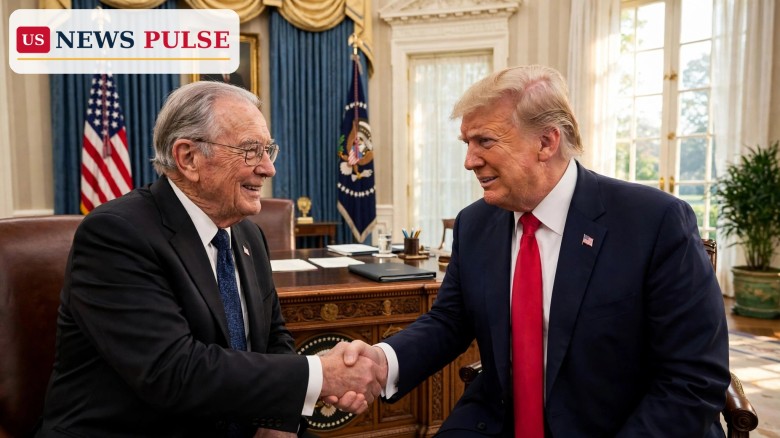
Stephen Hubbard walked into the Oval Office on Friday, October 30, 2026, as a free man for the first time in public since his release from a Russian prison, and told President Donald Trump, in the plainest possible terms, how close he had come to never coming home at all. “I wouldn’t have lasted another year,” the 74-year-old retired teacher from Michigan said, seated beside the president in the White House.
The meeting, Hubbard’s first public appearance since he was freed on October 21 after more than four years in Russian custody, closed a case that had moved from a small city in eastern Ukraine to a Moscow courtroom, through at least five detention centres, and finally to a phone call between Trump and Russian President Vladimir Putin. Trump called Hubbard “a very special man” who “suffered greatly” and told him: “It’s a great honor to have you.”
Hubbard arrived at the White House with his son, Greek Orthodox priest Father Joseph Coleman, and other family members, roughly a week after returning to the United States. Reporters were invited into the Oval Office for a brief, unusually intimate session in which the president did most of the talking at first, then turned to Hubbard and his son. “Everybody, this is a man who’s a very special man, and he suffered greatly,” Trump said, adding that Hubbard had been someone he personally wanted to bring home.
Hubbard, a retired English teacher who grew up in Big Rapids, Michigan, answered questions in a calm, measured voice. Asked when he realised he was truly being freed, he said he had stopped believing promises long before. “I had heard it many times before, and I reached the state where seeing is believing,” he said. “Actions speak louder than words. I never trusted what they said.” He said belief came only when guards gave him new clothes, led him to the prison exit, and put him in a car with two Russians for the drive from Moscow to St. Petersburg. “Then I believed, finally believed, on the drive from Moscow to St. Petersburg, ‘I’m really going somewhere,’” he said.
In St. Petersburg he met Witkoff, and he then flew home with family members. Trump told reporters he had spoken directly to Putin about Hubbard and that Russia agreed to let him go. “He was somebody I wanted to get back, and I spoke to President Putin, and they said, ‘We’ll let him come back,’” Trump said. The president repeated his earlier claim that the United States did not have to release a Russian prisoner in exchange, describing that as unprecedented, and he appeared to tie the release to his decision to exempt Russia from sanctions passed by Congress — sanctions he has not reimposed since Hubbard’s release.
Hubbard’s story begins far from Washington. After serving in the U.S. Air Force and National Guard and earning a master’s degree in English, he spent about 25 years teaching English in Japan. He later lived in Cyprus and moved in 2014 to Izyum, a city in eastern Ukraine, where he lived with a Ukrainian partner on a pension his sister later put at about $300 a month. When Russia launched its full-scale invasion in February 2022, Russian forces captured Izyum two months later. Hubbard was detained in April 2022; Ukrainian forces retook the city that September, but he was already in Russian custody.
His case came to public light only when a closed trial began in Moscow. Russian state media reported that he had been detained while manning a Ukrainian military checkpoint, an account Reuters said it could not independently verify. Prosecutors alleged he had joined a Ukrainian territorial defence unit, received training, weapons and ammunition, and been promised $1,000 a month. In October 2024 a Moscow court convicted him of acting as a mercenary and sentenced him to six years and 10 months in a penal colony. His family and his U.S.-based lawyer, Martin De Luca, disputed the charges; De Luca told Reuters in 2025 that Hubbard denied belonging to any military unit or taking part in combat, and his sister Patricia Hubbard Fox questioned a reported confession, noting her brother held pro-Russian views and was unlikely to have taken up arms in his seventies.
The New York Times reported in February 2025 that Hubbard had been moved through at least five Russian detention centres before his trial, and his legal team learned only in April 2025 that he was being held at a facility in the Mordovia region, east of Moscow. In January 2025 the State Department formally designated him as wrongfully detained, a step that empowered the Special Presidential Envoy for Hostage Affairs to negotiate for his release. That designation, and the quiet diplomacy that followed, set up the October breakthrough: Putin announced the release on October 21, at the start of talks with Witkoff in St. Petersburg, with Kremlin spokesman Dmitry Peskov saying Putin had freed Hubbard on humanitarian grounds after a request from Trump and taking his health into account.
Four and a half years, by Hubbard’s own count in the Oval Office, is a long time for a man detained at 69 and freed at 74. He described being held near the front lines at first, under artillery fire alongside the troops who had seized him, and later moved from centre to centre with little contact with the outside world. His son’s account filled in the family side of that isolation: Coleman said there had been talk of a release in 2025 that “dwindled down,” and that when Hubbard was left out of another group release, hope faded. “I even lost a little hope, but when we got the word we were happy,” Coleman said. “I was afraid we were going to lose him there,” he added.
Hubbard’s own verdict on his health was blunt. Trump remarked that he looked healthy, saying, “You look very healthy. I mean, you have no weight problem.” Hubbard answered with the line that defined the visit: he would not have lasted another year. His son said Hubbard is now eating more protein to rebuild his strength. Trump, who joked that Hubbard could run for office, also offered him a ride on Air Force One to Florida, where the president was headed for a rally that evening.
“Our country is great,” Hubbard said when Trump welcomed him, a short answer that drew applause in the room. Trump returned to the theme of personal intervention throughout the session. “It’s an honor to have you back. It’s a great honor,” he said. Asked about other detained Americans, Trump said the administration was working on their cases too: “We’re going to be working on them. This was one that seemed to have caught a lot of imagination, and a lot of people thought it was just a bad situation.” He put the number at “about eight,” while acknowledging he was hearing different figures.
Hubbard said he had been isolated from other foreign prisoners and did not know the other detained Americans personally. The White House session itself drew comment for its sparseness: only a small number of reporters were admitted, with most access reserved for photographers and a television crew, giving the meeting an almost private quality. Coverage also noted the scrutiny around timing — Hubbard’s release came less than two weeks after Trump announced he was waiving U.S. sanctions on Russian diesel, a move the administration framed as an effort to reduce surging global energy costs, and the Washington Times reported that Trump tied the release to the lifting of those sanctions during the meeting.
Hubbard’s return matters on two levels. For his family and for the small community of Americans held abroad, it is proof that a case can end after years of silence, even for a prisoner whose trial was closed and whose charges were contested from the start. For U.S. foreign policy, it is a reminder that hostage diplomacy now runs through the same channels as the wider, far more difficult negotiation over the war in Ukraine — the Witkoff-Putin meeting that produced Hubbard’s release was also part of Washington’s effort to end that war, an effort that continues against the backdrop of the U.S.-Israeli war with Iran and the strain on transatlantic alliances documented in recent weeks, including the new Canada-EU partnership launched in Montreal (Canada-EU alliance launches in Montreal) and the $2.1 billion Patriot sale approved for Ukraine (U.S. approves $2.1 billion Patriot deal).
It also matters because of what Trump chose to say about the price. By insisting no prisoner was exchanged and linking the release to sanctions relief, the president framed Hubbard’s freedom as a product of personal diplomacy rather than a concession — a framing critics will test against the fact that those sanctions remain lifted. And with days to go before the November 3 midterms, the Oval Office scene, staged between campaign stops in Florida and a weekend swing through Kansas and Iowa (Trump’s Daytona rally closing push), showed a president eager to present a tangible, human result from his dealings with Moscow.
Hubbard now faces the slower work of recovery: medical checks, rebuilding his strength, and reuniting fully with family after more than four years apart. His son’s remark about protein and rebuilding strength hints at the physical toll the family is only beginning to discuss publicly. No further public appearances have been announced, and Hubbard said in the Oval Office that he wanted rest first.
For the administration, the next test is the other detained Americans Trump mentioned. Officials have not named them publicly in this session, and Hubbard said he had been isolated from other foreigners, so the path to their release — whether through the same Witkoff channel, a formal swap, or further sanctions decisions — remains unclear. Whether Congress presses for the reimposition of the waived Russia sanctions, and whether Moscow treats Hubbard’s release as a one-off humanitarian gesture or as part of a wider negotiation, will shape how this homecoming is remembered: as a single family’s relief, or as a step in a larger deal.
Who is Stephen Hubbard? A 74-year-old retired English teacher from Big Rapids, Michigan, a U.S. Air Force and National Guard veteran who taught in Japan for about 25 years and moved to Izyum, Ukraine, in 2014.
How long was Stephen Hubbard held in Russia? More than four years. He was detained in April 2022 and released on October 21, 2026; he put the total at four and a half years in the Oval Office.
What was Stephen Hubbard charged with? Russian prosecutors charged him with acting as a mercenary for Ukraine. A Moscow court convicted him in October 2024 and sentenced him to six years and 10 months. Hubbard, his family and his lawyer denied the charges.
Was Stephen Hubbard exchanged for a Russian prisoner? Trump said no. He said the United States did not have to release anyone in return, and he linked the release to his decision not to impose new sanctions on Russia.
Are other Americans still detained in Russia? Trump said about eight Americans remain detained there and that his administration is working on their cases, though he acknowledged hearing different numbers.
Leave a Comment



 | Today's Date: