


 | Today's Date:




DOJ Names 1,000 Election Monitors Across All 50 States in Largest Effort Ever
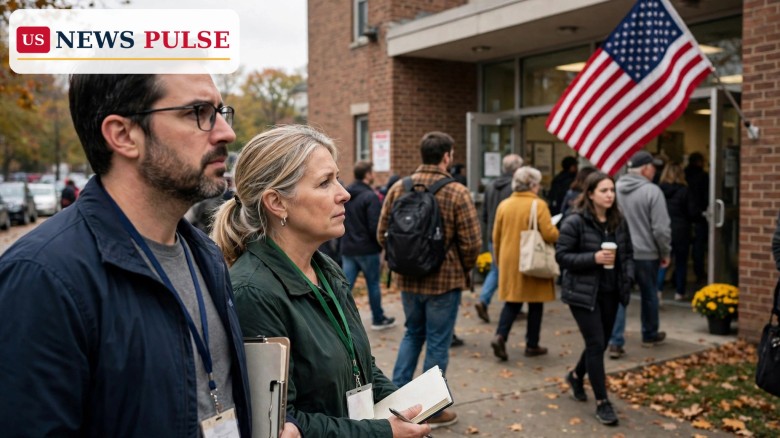
The United States Justice Department has named the jurisdictions where its 1,000 election monitors are deployed on Election Day, completing the largest Election Day monitoring effort in the department's history as voters across all 50 states cast ballots in the 2026 midterm elections on Tuesday, November 3, 2026.
Key Points
- A record 1,000 federal monitors and observers are deployed in all 50 states on Election Day.
- The department released the jurisdiction list on Tuesday, after withholding the full list until Election Day.
- Monitors check compliance with federal voting-rights laws; they do not run polling places or count votes.
- The deployment is roughly triple the 2022 midterm effort and larger than the 714 monitors used in 2024.
- Several states issued fresh guidance reminding local officials of the limited authority of federal observers.
What Happened
The Justice Department said on Tuesday, November 3, 2026, that it was deploying 1,000 election monitors and observers to jurisdictions in every state, describing the operation as the largest Election Day monitoring effort it has ever mounted. A department statement issued on Tuesday identified which jurisdictions within the states would receive monitors and observers, ending a period in which the full list had been withheld until Election Day itself.
The announcement matters because it turns a plan announced in advance into a concrete, public deployment on the day voters are actually voting. Until Tuesday, election officials, voting-rights groups and the public knew the headline number and the national scope, but not the complete local picture. The release of the jurisdiction list allows local officials to know where federal observers are expected, and allows voters and journalists to check what is happening in their own communities.
Background and Context
Federal election monitoring is not new, but its scale has grown sharply in recent years. In the 2022 midterm elections, the Justice Department deployed monitors to 64 jurisdictions in 24 states. In the 2024 presidential election, the number rose to 714. The 2026 figure of 1,000 monitors in all 50 states is therefore not a modest increase: it is roughly triple the 2022 deployment and clearly above the 2024 level, and it extends the federal presence to every state for the first time at this scale.
The growth reflects how contested the administration of elections has become. Since 2020, disputes over ballot handling, voter registration and the counting of mail ballots have repeatedly reached the courts, and federal agencies have become more visible participants in election administration. The Justice Department has pursued a series of voting-related cases and letters to states in the run-up to the 2026 midterms, including demands that officials preserve election records and set aside ballots from suspected noncitizens, demands that have themselves been challenged in court.
DOJ Election Monitors: What the Deployment Means
The focus keyword for this story is DOJ election monitors, and the central question on Election Day is what those monitors actually do when they arrive. The answer, according to the department's own description of the programme, is deliberately narrow. Monitors observe and take notes. They watch for compliance with federal voting-rights statutes, they note problems, and they report them. They do not speak to voters inside polling places in a way that interferes with voting, they do not challenge individual voters, and they do not direct local officials.
Reactions
The Justice Department has presented the deployment as a straightforward exercise of its responsibility to enforce federal voting-rights law, and as the largest monitoring effort in its history. Department officials have emphasised the scale of the operation and its nationwide reach, framing it as a safeguard for lawful voting in a high-stakes midterm election.
State officials have taken a more cautious line, issuing guidance that stresses the limits of federal observers' authority. That guidance does not refuse the monitors entry, but it draws a clear boundary: local officials remain in charge of polling places, and federal observers do not acquire special powers by virtue of their federal role. The guidance is, in effect, a reminder that American elections are administered locally even when they are observed federally.
Why It Matters
This deployment matters for three reasons. First, scale changes perception. A monitor in a handful of jurisdictions is a routine oversight tool; 1,000 monitors in all 50 states is a national statement, and voters will inevitably read it as one. How that statement is received may affect confidence in the election as much as anything the monitors actually observe.
Second, the deployment tests the balance between federal oversight and state administration at a moment when that balance is already under strain. Court cases over ballot segregation, record preservation and observer access have all reached judges in the days before the election. The monitoring operation will be judged, in part, by whether it proceeds without the kind of polling-place confrontation that those cases warned about.
What Happens Next
The immediate question is how the rest of Election Day unfolds. Monitors will file their observations, local officials will count ballots under state procedures, and any disputes that arise will move, as they usually do, into state courts and administrative processes rather than being settled at the polling place door.
Related coverage: the original announcement of the 1,000-monitor plan, the NAACP court challenge to federal agents serving as monitors, and the Justice Department's election-eve voting charges in 15 states.
Frequently Asked Questions
How many election monitors has the Justice Department deployed?
The department said it deployed 1,000 monitors and observers to jurisdictions in all 50 states on Election Day, November 3, 2026, its largest monitoring effort ever.
What do federal election monitors actually do?
They observe polling places and ballot handling for compliance with federal voting-rights laws and report what they see. They do not run polling places, decide who may vote, or count results.
Why was the jurisdiction list released only on Election Day?
The department withheld the full list until Election Day and then issued a statement identifying which jurisdictions within each state would receive monitors and observers.
How does this compare with previous elections?
The 2026 deployment is roughly triple the 2022 midterm effort, which covered 64 jurisdictions in 24 states, and larger than the 714 monitors deployed in 2024.
Do federal monitors have special authority inside a polling place?
No. Several states issued guidance reminding local officials that federal observers have limited authority and that local officials remain in charge of polling places.
Leave a Comment