
Early Voting Nears 50 Million as Democrats Lead Republicans
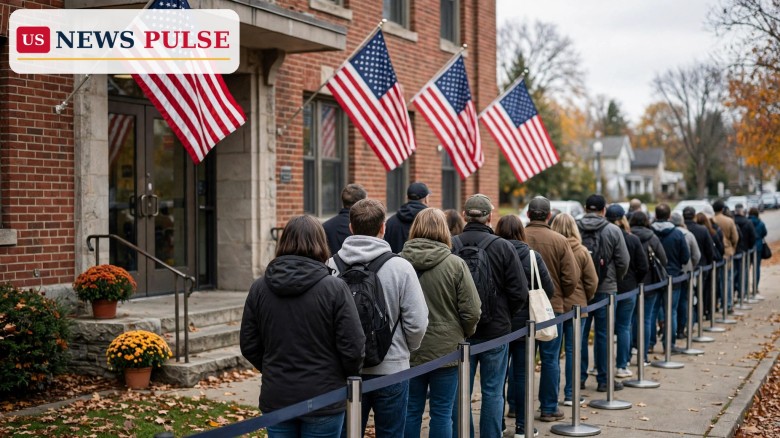
Early voting 2026 has now passed 49.6 million ballots, with registered Democrats accounting for a larger share than Republicans in the states that report party affiliation, according to the University of Florida Election Lab count relayed on Friday evening, October 30, 2026 — a new midterm record set four days before Election Day.
The total, 49.6 million by Friday evening, already exceeds the entire early vote of the 2022 midterms, which stood at 45.9 million. It comprises about 22.9 million returned mail ballots and 26.8 million in-person early votes, and it keeps climbing as the final weekend of early voting runs into Sunday, November 1, in several states.
Key Points
- Early voting 2026 reached 49.6 million ballots by Friday evening, October 30, 2026, passing the full 2022 early-vote total of 45.9 million.
- The total includes about 22.9 million mail ballots and 26.8 million in-person early votes.
- Registered Democrats account for 43% of the party-tracked early vote, Republicans 32%, and unaffiliated voters 25%.
- Texas leads with 6.9 million early votes, followed by California with 5.1 million and Florida with 4.7 million.
- Election Day is Tuesday, November 3, 2026; early voting ends Saturday in about 20 states and runs through Sunday in others.
What Happened
The latest update to early voting 2026 came on Friday evening, when Newsweek's count, based on the University of Florida Election Lab, put the national total at 49.6 million. By 9:39 p.m. ET on Friday, the Election Lab had recorded 10.3 million votes from registered Democrats, 7.5 million from Republicans and 5.9 million from voters with no major-party affiliation, in the 27 states that publish party registration data.
That party split — 43 percent Democratic, 32 percent Republican, 25 percent unaffiliated or minor-party — is a partial picture, not a national result. Party registration is available in only 27 states, and registration does not reveal how a person voted. In Texas, for example, the early vote is measured by primary history rather than registration, and it leans Republican by a much narrower margin than in 2022.
Even with those caveats, the headline total is unambiguous: more Americans have already voted early in 2026 than voted early in the whole of the last midterm cycle, and millions more can still vote before or on Tuesday. The 49.6 million figure remains below half of the 108 million votes cast in total in the 2022 House elections, according to Pew Research Center data cited in the reporting, so Election Day itself still matters enormously.
The update builds on the record reported at midday on Friday, when the Election Lab count stood at 47.9 million. The rise of roughly 1.7 million ballots in a single day shows how fast the final weekend is moving, as voters who waited until the last days of early voting join those who voted by mail weeks ago.
Background: A Record Built State by State
Early voting 2026 has outpaced 2022 in state after state, according to an Associated Press analysis published earlier in the week and updated state-level tracking on Saturday. Texas recorded the highest number of early votes, at 6.9 million, followed by California with 5.1 million and Florida with 4.7 million.
The AP found Texas up 50 percent on the same point in 2022, with more than 6.3 million ballots by Wednesday, rising to 6.9 million by Friday. South Carolina posted an 83 percent increase, Kansas was up by more than a third, and Maine and Michigan each rose by more than 30 percent. Michigan's increase is especially notable because 2026 is the first midterm in which the state offers statewide early in-person voting, after voters approved it in a November 2022 ballot measure.
State-by-state tracking on Saturday added further gains: North Carolina has already passed its entire 2022 early vote by 19 percent; Florida's ballots are up 11 percent on 2022 through Friday, with Democratic ballots up 16 percent and Republican ballots up 3 percent; Georgia is up 12.5 percent as in-person early voting ended on Friday; Michigan is up 24 percent a week out; Louisiana is up 44 percent; Tennessee is up 45 percent; and Kansas has more than doubled its 2022 pace.
Not every state is ahead. Kentucky is about even with 2022, down 3 percent after its first big in-person day, and Iowa trails its 2022 pace even after adjusting for weaker Democratic registration. Those exceptions are a reminder that a national record can hide very different local stories.
Early Voting 2026: What the Party Numbers Do — and Do Not — Show
Early voting 2026 party data invite a familiar mistake: reading them as a forecast. They are not. Registration figures count who voted, not for whom, and they cover only the states that publish them. A registered Democrat may vote Republican, and vice versa, and unaffiliated voters — a quarter of the tracked early vote — could break either way.
Polling averages offer a separate, if also imperfect, guide. RealClearPolling's generic congressional vote average put Democrats at 51.4 percent against 43.2 percent for Republicans, an 8.2-point gap. An Economist/YouGov survey of 1,440 registered voters conducted October 23-26 found that 44 percent expected Democrats to win the House, compared with 31 percent who thought Republicans would retain control.
Forecasters cited by Newsweek gave Democrats stronger projections in several election models, but they also stress that early-vote composition changes by the day. Republicans have traditionally voted more heavily on Election Day itself, so a Democratic lead in early voting does not guarantee a Democratic win on Tuesday — just as a Republican Election Day surge does not guarantee the opposite.
What the party data do show is enthusiasm and organisation. Democrats have banked a large early lead in North Carolina, where the party's share is up sharply on 2022, in Nevada, where Democrats lead by nearly 38,000 ballots as early in-person voting closed on Friday night, and in New Mexico and Colorado. Republicans, meanwhile, have narrowed the gap in Florida, where their lead is now 2.5 points compared with 7.2 points at the same stage in 2022, and they remain competitive in Texas on primary-history measures.
Reactions: Campaigns Read the Same Numbers Differently
Democratic strategists have presented the early voting 2026 record as evidence of momentum, pointing to the sheer volume of ballots and to the party's share in battleground states. They argue that banking votes early protects against bad weather, long queues or late-breaking news on Election Day, and that the record turnout reflects anger over the government shutdown, tariffs and the cost of living.
Republican strategists have urged caution, noting that their voters are more likely to turn out on Tuesday and that the party's early-vote performance has improved in several states compared with earlier in the cycle. They also point to Texas, where the early vote measured by primary history leans Republican by only 1.3 points, against 9.0 points for the whole of 2022's early vote — a shift they attribute partly to a larger Democratic primary electorate in March, rather than to a collapse in Republican turnout.
Election officials, for their part, have stressed process over politics. Secretaries of state in several states have reminded voters that early-vote totals are unofficial, can be delayed by county reporting, and can change as mail ballots arrive and are counted. In Texas, the secretary of state's office said county-submitted totals were unofficial and subject to revision.
Non-partisan analysts have made the same point in plainer language: an early-vote share is not a forecast, and treating it like one is how pundits end up surprised on Wednesday morning.
Why It Matters
Early voting 2026 matters because it is already the largest midterm early vote on record, and because it sets the terms for Tuesday. If Election Day turnout is normal, total turnout in 2026 could approach or exceed 2022's 122 million votes, according to TIME's figure for that cycle. If Election Day is also strong, the record could be larger still.
It matters politically because control of Congress is at stake: all 435 House seats, 35 Senate seats and 36 governorships are on the ballot, with Republicans currently holding both chambers, including a 53-47 Senate majority, midway through President Trump's second term. A high-turnout midterm with a Democratic early-vote lead raises the stakes for Republican Election Day mobilisation — and for Democratic efforts to hold their banked advantage.
It matters practically, too. Voters who have not yet cast a ballot need to know their state's deadline, and those deadlines vary sharply. Early voting ended on Saturday, October 31, in about 20 states, including Kentucky, North Carolina and South Carolina. It runs through Sunday, November 1, in Connecticut, Delaware, New Jersey and Michigan, among others. Alabama, Mississippi and New Hampshire do not offer early voting at all. Mail voters in states with Sunday deadlines are being urged to use drop boxes rather than post, as it may be too late for a mailed ballot to arrive in time.
What Happens Next
The final weekend of early voting runs through Sunday, November 1, in the states that still offer it. No early voting takes place on Monday in Michigan, and Oklahoma offers none on Sunday or Monday. Voter registration offices in Virginia are open for early voting on Saturday, according to the state elections department.
On Tuesday, November 3, polls open for Election Day itself, when the remaining tens of millions of voters will decide the House, the Senate and dozens of governor and state races. Results will begin to arrive on Tuesday evening, but mail ballots in several states can still be counted after Election Day if they were postmarked on time, so close races may take days to call.
For now, the record is the story: 49.6 million ballots already cast, a Democratic lead in the party-tracked vote, and a final weekend still to run. Whether that record becomes a Democratic wave, a Republican hold or something in between will not be known until the votes are counted — not just the early ones, but Tuesday's as well.
Frequently Asked Questions
How many people have voted early in 2026? 49.6 million by Friday evening, October 30, 2026, according to the University of Florida Election Lab count relayed by Newsweek — already more than the full 2022 early vote of 45.9 million.
Do Democrats lead the early vote? In the 27 states that report party registration, registered Democrats account for 43% of the tracked early vote, Republicans 32% and unaffiliated voters 25%. That counts who voted, not how they voted.
Which states have voted most? Texas leads with 6.9 million early votes, followed by California with 5.1 million and Florida with 4.7 million.
Can I still vote early? It depends on your state. Early voting ended Saturday in about 20 states and runs through Sunday, November 1, in Connecticut, Delaware, New Jersey and Michigan, among others. Election Day is Tuesday, November 3.
Does an early-vote lead predict the winner? No. Early-vote composition is not a forecast: Republicans traditionally vote more on Election Day, party registration does not show vote choice, and only 27 states report party data.
Related coverage: Record early voting: 47.9 million ballots already cast, Early voting surge: 43 million ballots cast as Texas smashes records, and Early voting passes 40 million midterm ballots.
© 2026 US News Pulse. All rights reserved.
 Print
 Save