
NFL Week 8 Injuries: Harvey, James and Sweat Land on Injured Reserve Before Sunday
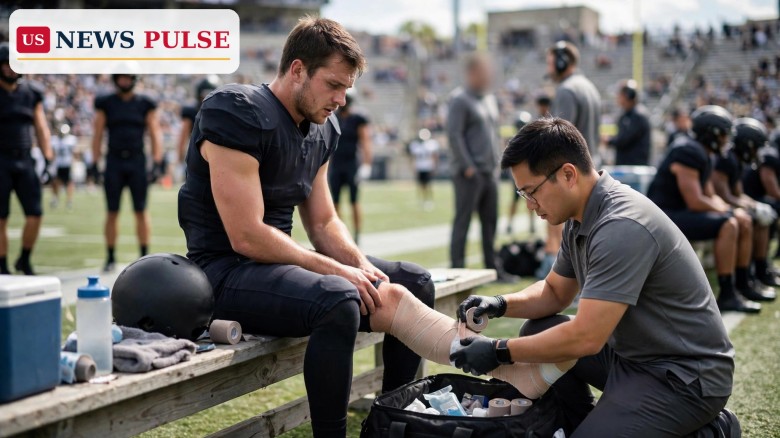
NFL Week 8 injuries reshaped Sunday's slate before a ball was kicked, after three starters were placed on injured reserve on Saturday, October 31, 2026, and a fourth high-profile player was ruled out. Denver Broncos running back RJ Harvey, Los Angeles Chargers safety Derwin James and New York Jets defensive tackle T'Vondre Sweat will each miss at least four games, while New England Patriots wide receiver A.J. Brown was moved from questionable to out for Sunday's game at the Miami Dolphins. The moves, all confirmed on Saturday, change the running game in Denver, the secondary in Los Angeles, the defensive front in New York and the passing game in New England — and they arrive with the NFL trade deadline, on November 10, now just nine days away.
Key Points
- Broncos running back RJ Harvey was placed on injured reserve on Saturday with a knee injury suffered in Thursday's practice; he will miss at least four games and is eligible to return in Week 13, on December 6 against the Miami Dolphins.
- Chargers safety Derwin James was placed on injured reserve on Saturday with a hamstring injury; he will miss at least four games, with the earliest return on November 29 against the New England Patriots.
- Jets defensive tackle T'Vondre Sweat was placed on injured reserve on Saturday with a knee sprain; he will miss at least four games and is eligible to return on November 29 against the Miami Dolphins.
- Patriots wide receiver A.J. Brown was ruled out for Sunday's game at Miami with an ankle injury after his status changed from questionable to out on Saturday afternoon.
- Washington's Daron Payne, whose season-ending foot fracture was reported on Friday, is covered separately and is not part of this roundup of Saturday moves.
What Happened
The busiest injury day of the week began in Denver. Harvey was added to the Broncos' injury report after being a limited participant in Thursday's practice, then missed practice altogether on Friday and was ruled out for Sunday's home game against the Kansas City Chiefs. On Saturday, the Broncos formalised the absence by placing the second-year running back on injured reserve, a move first reported by Ian Rapoport of NFL Network. Under NFL rules, a player on injured reserve must sit out at least four games, and because Denver has its Week 10 bye in that window, Harvey's absence stretches across five weeks before he can return in Week 13 against Miami on December 6.
In Los Angeles, the Chargers made a similar call on their most decorated defender. James, a five-time All-Pro safety, was placed on injured reserve on Saturday with the hamstring injury that has kept him out since late September. The team signed cornerback Isas Waxter to the active roster and elevated cornerback Kaiir Elam from the practice squad for Sunday's game at the Los Angeles Rams. James will miss the Rams game and at least three more, with November 29 against New England the earliest date he can return.
In New York, the Jets announced on Saturday that Sweat, their starting nose tackle, had been placed on injured reserve with a knee sprain. The move had been foreshadowed by his absence from Sunday's home game against the Las Vegas Raiders, for which he had already been ruled out. A source told ESPN that the injury is not considered season-ending, and Sweat is eligible to return on November 29 against Miami, the same date as James. Rookie Darrell Jackson Jr., a fourth-round pick from Florida State, is expected to start in his place.
The fourth blow landed in New England on Saturday afternoon, when Brown's designation changed from questionable to out for Sunday's 4:25 p.m. ET game at Miami, according to the official designations carried by Sleeper's player feed. The listed injury is an ankle injury. The feed carries an estimated return date of November 8, but that is an estimate, not a confirmed schedule, and the Patriots have not announced a return date. Efton Chism III and DeMario Douglas are next in line among New England's wide receivers.
Background/Context
None of these injuries arrived out of nowhere, and that is part of why Saturday's moves matter. Harvey's knee problem began in the early part of Thursday's practice, according to reports of the move, and the rapid sequence — limited on Thursday, absent on Friday, out for Sunday, on injured reserve on Saturday — shows a team deciding quickly that a short absence would not be enough. Harvey, in his second NFL season, has rushed for 87 yards on 24 attempts this season, and his loss leaves veteran J.K. Dobbins to lead the Denver backfield, with Jonah Coleman expected to share the workload and Cody Schrader a candidate for extra snaps.
James's case has been longer running. He played the first three games of the season but was sidelined with a hamstring injury after the Chargers' September 27 game at Buffalo. He was then ruled out for the next three weeks, and the Chargers had their bye in Week 7, yet he still suffered a setback in his rehabilitation as the team prepared for Sunday's game at the Rams. Head coach Jim Harbaugh had already flagged the possibility of injured reserve, and Saturday's move confirms that the setback, not the original injury alone, forced the longer absence. James signed a three-year, $75.6 million contract extension in May 2026 and had played in 16 of 17 games in each of the past three seasons, which makes this extended absence unusual for him.
Sweat's season has followed a similar pattern of interrupted availability. Acquired by the Jets in an offseason trade with the Tennessee Titans, he missed a chunk of training camp with a hamstring injury, then appeared in all seven games so far, recording no sacks, two tackles for loss and 17 total tackles. The knee sprain that put him on injured reserve is a separate problem, and the Jets are now thin at defensive tackle: David Onyemata, another interior lineman, has been on injured reserve since Week 3 after core muscle surgery. To fill the game-day roster, the Jets signed Payton Page to the roster and elevated Quinton Bell from the practice squad, while rookie edge rusher David Bailey is doubtful with a groin injury.
Brown's situation is the most fluid of the four. He has been listed as questionable with an ankle injury since October 28, was cleared and then re-listed during the week, and was only confirmed out on Saturday afternoon. He had been dealing with knee and ankle problems, and reports earlier in the week noted that Patriots executive Eliot Wolf had acknowledged in June that Brown had a degenerative knee condition, while the team's medical staff had signed off on the trade that brought him to New England. That history does not change Saturday's decision — the official designation is an ankle injury — but it explains why his availability has been watched so closely all week.
NFL Week 8 Injuries: What the Absences Mean on Sunday
Start with Denver, where the timing could hardly be worse. The Broncos host Kansas City at 4:25 p.m. ET on Sunday in an AFC West game, and they will do so without the running back who was supposed to give their ground game a second dimension. Dobbins now carries the lead role, with Coleman as the change-of-pace option, against a Chiefs defence that will not have to account for Harvey's speed out of the backfield. Denver also has Jaylen Waddle listed as questionable after being limited on Friday with a chest injury, so the offence could be thinner still by kickoff.
In Los Angeles, the Chargers' problem is different: they are winless at 0-6 and now lose their defensive leader for at least a month. James had already missed the last three games, so Sunday's game at the Rams was already going to be played without him, but injured reserve removes any hope of a quick return and forces the secondary to plan without him through late November. The Chargers also ruled out Brenen Thompson with a quad and hamstring problem, Deane Leonard with a concussion and Kayode Awosika with a fibula injury, so the roster moves on Saturday were about depth as much as about one star.
For the Jets, Sweat's absence tests a defensive line that was already stretched. The 366-pound nose tackle's job is to occupy blockers and hold the middle against the run, and his replacement, Jackson, is a rookie making his first start in that role. The Jets, 2-5 and losers of two straight, host the 3-4 Raiders at MetLife Stadium on Sunday, and the run defence will be the first place to look for the effect of the change. The same is true in New England, where Brown's absence removes quarterback Drake Maye's most established outside target against Miami, leaving Chism and Douglas to carry a larger share of the passing game.
It is worth noting what Saturday did not change. The week's biggest returns are still on: Lamar Jackson is cleared to play for Baltimore at Buffalo, Saquon Barkley and Rashee Rice are set to play, and the Sunday slate still features Minnesota's unbeaten 6-0 record on the line at Detroit, Kansas City at Denver and Philadelphia at Washington on Sunday Night Football. The injury news is a counterweight to that, not a replacement for it — and for fantasy managers and bettors, the official inactive lists, released 90 minutes before each kickoff, remain the final word.
Reactions/Quotes
No direct quotes from the players, coaches or teams were carried in the reports read for this article, so this section records reported assessments rather than inventing quotations. The reporting around Harvey framed the move as a short-term injured reserve stay, not a season-ending injury, with the December 6 return date presented as the earliest possible comeback rather than a promise. Around James, the reporting stressed the rehabilitation setback: a player who had already missed three weeks, plus a bye, was still not close enough to return, which is why the team moved from week-to-week listings to injured reserve.
Around Sweat, the reporting carried a similar reassurance — a source told ESPN the knee sprain is not considered season-ending — alongside the practical consequence that a rookie will start in his place. Around Brown, the reporting was deliberately narrow: a designation change, an ankle injury, an estimated return date that is explicitly an estimate. That caution matters, because Brown's status has changed several times this week, and the only confirmed fact on Saturday is that he will not play at Miami.
Why It Matters
Injured reserve moves matter more than a single week's absence because they lock in a minimum absence and change how teams plan. A player listed as out for one game might return the next week; a player on injured reserve cannot, and his team must build its game plans, its practice reps and, in some cases, its trade-deadline thinking around at least four games without him. With the trade deadline on November 10, Denver, Los Angeles and New York all now know they cannot count on these players for the stretch run that follows the deadline, which changes what a buyer or a seller might do in the next nine days.
The moves also matter for the standings. Denver is 5-2 and chasing Kansas City in the AFC West; losing its emerging running back for five weeks, including the head-to-head game, is a real handicap in a division race. The Chargers, at 0-6, are already in a different kind of season, and losing James until late November removes the player around whom their defence is built. The Jets, at 2-5, cannot afford to lose ground in the run game against a Raiders team that will test exactly that weakness. And New England, whose passing game has leaned on Brown since his arrival, must now prove it can move the ball at Miami without him.
What Happens Next
The immediate next step is Sunday's official inactive lists, released 90 minutes before each kickoff, which will confirm the final availability of the questionable players around these moves — notably Waddle in Denver and the rest of the Chargers' and Jets' depth charts. After Sunday, the calendar is fixed by the injured reserve rules: Harvey can return in Week 13 against Miami on December 6, James and Sweat can return on November 29, against New England and Miami respectively, and Brown's status will be reassessed during the week leading up to New England's next game, with November 8 only an estimate.
Beyond that, watch the trade deadline on November 10. Teams that lose a starter to injured reserve in late October often look for short-term cover, and teams with surplus depth at running back, safety or defensive tackle may find a market. For now, though, the story is simpler: three teams woke up on Saturday to find their Sunday plans rewritten, and a fourth found its star receiver unavailable hours before kickoff.
Frequently Asked Questions
How long will RJ Harvey be out? At least four games. Because Denver has a Week 10 bye in that window, he is eligible to return in Week 13, on December 6 against the Miami Dolphins.
When can Derwin James return? The earliest date is November 29, when the Chargers host the New England Patriots. He will miss at least four games with his hamstring injury.
Is T'Vondre Sweat out for the season? No, according to a source cited by ESPN. His knee sprain is not considered season-ending, and he is eligible to return on November 29 against Miami.
Why was A.J. Brown ruled out? Brown was moved from questionable to out on Saturday afternoon with an ankle injury for Sunday's game at Miami. An estimated return of November 8 has been reported, but it is an estimate, not a confirmed date.
Does injured reserve mean four games or four weeks? A player on injured reserve must miss at least four games. Bye weeks do not count as games, which is why Harvey's five-week absence still equals four missed games.
Related coverage: NFL Week 8 Sunday preview: Lamar Jackson returns as Vikings chase 7-0 and Daron Payne out for the season after foot fracture in practice.
Sources: Field Level Media via KWSN, October 31, 2026; ESPN via ESPN Philippines, October 31, 2026; USA TODAY, October 31, 2026; Yardbarker, October 31, 2026; Sportscasting, November 1, 2026; PrizePicks Week 8 injury report, November 1, 2026; Game Day Tourist NFL roundup, November 1, 2026. The featured image is an illustrative photograph of a player receiving treatment on a sideline, not a photograph of any of the players named in this article.
© 2026 US News Pulse. All rights reserved.
 Print
 Save