
Arizona Voter Registration Probe: DOJ Refers Three Groups to FBI
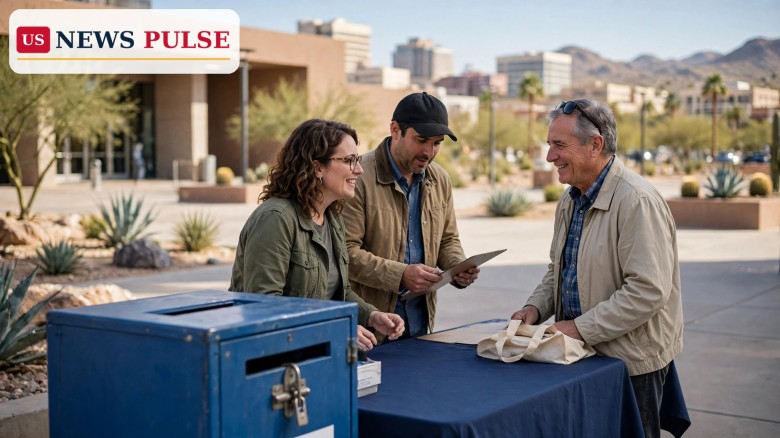
The Arizona voter registration probe escalated on Friday, October 30, 2026, when the United States Attorney for the District of Arizona announced that his office had opened a case into reports that three voter-registration groups registered noncitizens, and had referred the matter to the Federal Bureau of Investigation. The announcement landed four days before the November 3 midterm elections, in a state where voters will choose a governor, other statewide officers and all of Arizona's seats in the United States House of Representatives. No charges have been announced, and no public evidence has been presented that any noncitizen was actually registered by the groups named.
Key Points
- U.S. Attorney Timothy Courchaine announced on October 30, 2026, that his office opened a case and referred it to the FBI.
- The three groups named are Stand Indivisible Arizona, Worker Power and When We Count, a voter-registration programme associated with the Democratic National Committee.
- Courchaine wrote to Arizona Secretary of State Adrian Fontes and Maricopa County Recorder Justin Heap on October 26, asking them to review registrations submitted by the groups.
- The letters cite “written and video reports” and say personnel acting for the groups “either intentionally disregarded or were recklessly ignorant of” Arizona law barring registration of noncitizens.
- The underlying reporting traces to an October 22 undercover video from Muckraker, in which people posing as a noncitizen and as a felon asked canvassers about registering, but the exercises were stopped before any registration form was actually submitted.
- No charges, no named voter and no specific completed ineligible registration have been publicly established in the announcements and reporting used for this article.
What Happened
Courchaine's office said on October 30 that it had opened a case into “recent reporting” that the three non-profit organisations were registering noncitizens to vote in Arizona, and that it had already referred the matter to the FBI for a thorough federal investigation. The public announcement carried a reminder that voting is limited solely to United States citizens, even if a noncitizen has legal authority to be in the country on a visa or as a legal permanent resident, and that knowingly causing another person to be registered while knowing that person is not entitled to do so violates federal law.
Four days earlier, on Monday, October 26, Courchaine sent nearly identical letters to Fontes and to Heap. In those letters he wrote that, based on written and video reports, people acting for the three groups “either intentionally disregarded or were recklessly ignorant of” Arizona's ban on registering noncitizens. He asked both officials to review registrations submitted by the groups to ensure that only United States citizens were registered. The letters said the groups and their volunteers or employees “may have violated” Arizona Revised Statutes section 16-182, the state law that makes it a class 6 felony, Arizona's lowest felony grade, to knowingly cause someone to be registered who is not entitled to vote.
The timing matters. Arizona's voter registration deadline had already passed weeks earlier, so the review requested by Courchaine concerns registrations already submitted, not registrations still being collected. Fontes, as secretary of state, and Heap, as Maricopa County recorder, now decide what their reviews find, while the FBI decides whether to pursue the referral further. Election Day is Tuesday, November 3, and the announcement therefore arrives in the final days of a campaign in which Arizona's governor's race and House races are already being closely watched.
Background: Arizona Voter Registration and the Muckraker Video
The “recent reporting” at the centre of the case appears to involve an undercover video published on October 22 by the outlet Muckraker. According to reporting on the video, Muckraker went undercover in Arizona to investigate groups working to re-elect Governor Katie Hobbs and other Democrats. People posing as a noncitizen and as a felon on probation asked canvassers whether they could register to vote. The exercises were stopped before any registration form was actually submitted, and the video does not show any volunteer actually submitting a voter registration.
That distinction is central to how the case is being argued in public. The U.S. Attorney's letters describe what personnel acting for the groups may have done or disregarded, and ask for a review of registrations the groups submitted. The reporting on the video describes questions asked to canvassers, not completed registrations. A report on the referral noted that the letters behind the probe name no voter, no registration form and no video, and that the U.S. Attorney's announcement itself announced no charges and no specific findings of improper registrations.
The three groups are different kinds of organisations. Stand Indivisible Arizona describes itself as a non-partisan, volunteer-driven community organisation focused on activism, and is reported to be based in Scottsdale. Worker Power identifies as a multi-racial, multi-generational social welfare organisation involved in voter engagement and policy work, built around hotel, airport and food service workers. When We Count operates as a voter-registration effort linked to the Democratic National Committee, and Arizona's Family reported that it is the one group of the three tied to a political party, the Democrats.
Arizona has long been a focal point for disputes over voter rolls, and the new case does not arrive in isolation. In the same week, courts pushed back on other administration claims about noncitizen voting: on October 30, U.S. District Judge Trina Thompson barred the Justice Department from threatening election officials into halting counts of ballots it says came from noncitizens, and the department appealed that order on October 31. Separately, reporting has described internal documents showing federal immigration investigators examining hundreds of voter-registration groups nationwide, including at least one in Arizona. Those threads do not prove anything about the three Arizona groups, but they explain why election officials and observers are treating the timing and the public messaging of the referral as significant in themselves.
Arizona Voter Registration Probe: What the Law Says
Federal law restricts voting in federal elections to United States citizens, and Arizona law adds its own criminal provision for false registration. Section 16-182 makes it a class 6 felony to knowingly cause someone to be registered who is not entitled to vote. The key word in that provision is “knowingly”: prosecutors would need to show knowledge, not merely that a registration worker answered a hypothetical question in a particular way, or that a registration was submitted with an error.
That is why the gap between the video and a completed registration matters legally as well as politically. Asking a canvasser a question, even a misleading one, is not the same as submitting a registration form for an ineligible person, and no public announcement in this case has identified such a form. Courchaine's letters use conditional language, saying the groups “may have violated” the state law, and ask state and county officials to review the registrations and reach their own conclusions. Until that review or the FBI investigation produces a finding, the case remains an allegation under investigation, not an established violation.
Arizona's election machinery also matters here. Voter registration in Maricopa County, the state's most populous county, runs through the recorder's office, while the secretary of state oversees statewide election administration. A review of registrations submitted by specific groups would therefore involve checking those submissions against the voter file, citizenship attestations and any other records the offices hold. Neither Fontes nor Heap had, in the reporting used for this article, announced a completed finding on the groups' registrations.
Reactions
The Democratic National Committee responded through a spokesperson who told Axios Phoenix that the party was unaware of any fellow registering a noncitizen and called the allegations fabricated. That denial goes to the heart of the case: When We Count is the DNC-associated programme among the three groups, and the party says it has no knowledge of the conduct alleged. The other two organisations had not issued public statements responding to the investigation by the time the Axios Phoenix report was published, according to that reporting, and this article does not attribute positions to them that they have not stated.
Election officials and observers warned, in the reporting on the case, that an announcement of this kind days before an election, and after the registration deadline, could confuse voters and erode confidence, even before any finding is made. The concern is practical as well as political: voters who registered through any of the three groups may wonder whether their own registration is in question, even though no individual voter has been named and no registration has been publicly identified as invalid. The reporting on the referral advised such voters to confirm their registration before November 3.
The U.S. Attorney's office, for its part, framed the announcement as a straightforward law-enforcement reminder on the eve of an important midterm election: voting is limited to citizens, and the office will act on reports of unlawful registration. That framing, and the FBI referral, put the allegations on a much more serious track than a political dispute, as one report put it, even though the referral itself is not a charge and does not establish that an illegal registration occurred.
Why It Matters
The case matters for three reasons, and none of them depends on assuming the outcome. First, it is a federal criminal referral, not a press release: the FBI now holds a matter that could lead to charges, to a declination, or to a long-running investigation that outlasts the election. Second, it concerns the integrity of the voter file in a swing state days before voting ends, which means any finding, or any absence of a finding, will be read politically whether or not it is intended that way. Third, it tests how undercover reporting is treated as a basis for law enforcement action: a video showing canvassers answering questions is being used to justify a review of actual registrations, and the distance between those two things will be the central question for investigators, for the state and county reviewers, and for the public.
There is also a broader pattern. The Arizona referral is one of several Justice Department election actions in the final week of the campaign, including the California voter-list dispute, in which a court-ordered analysis found that a large share of names the department flagged as likely noncitizens did not match anyone on California's current voter file. That pattern does not decide the Arizona case, but it does mean the Arizona review will be scrutinised for the same kind of mismatch between an initial claim and the underlying records. If the Arizona review finds ineligible registrations, it will be a significant law-enforcement result. If it finds none, the referral itself will still have shaped the final days of the campaign.
What Happens Next
In the immediate term, three tracks run in parallel. The FBI will assess the referral and decide whether to open a full investigation, seek further records, or take no further action. Fontes and Heap will conduct, or decide whether to conduct, the reviews Courchaine requested of registrations submitted by the three groups. And the groups themselves may respond publicly, as the DNC already has, or may wait for the reviews to conclude. None of those tracks has a published deadline before Election Day, and voters should not expect a resolution by Tuesday.
Voters in Arizona can check their own registration status through the secretary of state's voter information systems and through Maricopa County's recorder's office, and anyone who registered through one of the three groups and is concerned about their status should do so before November 3. After the election, the question will be whether the FBI or the state and county reviews publish any finding at all. An investigation announced four days before an election, based on reports that do not yet identify a completed ineligible registration, will ultimately be judged by what its records show, not by the timing of its announcement.
Frequently Asked Questions
Which Arizona groups were referred to the FBI?
Stand Indivisible Arizona, Worker Power and When We Count, a voter-registration programme associated with the Democratic National Committee. U.S. Attorney Timothy Courchaine announced on October 30, 2026, that his office had opened a case into reports about the three groups and referred the matter to the FBI.
Has anyone been charged?
No. No charges have been announced, no voter has been named, and no specific completed ineligible registration has been publicly established in the announcements and reporting used for this article. The case is an investigation and a referral, not a prosecution.
What did the undercover video actually show?
An October 22 Muckraker video in which people posing as a noncitizen and as a felon asked canvassers about registering. Reporting on the video says the exercises were stopped before any registration form was actually submitted, and the video does not show a volunteer submitting a registration.
What did Courchaine ask Arizona officials to do?
In letters dated October 26 to Secretary of State Adrian Fontes and Maricopa County Recorder Justin Heap, he asked them to review registrations submitted by the three groups to ensure only United States citizens were registered, citing section 16-182 of Arizona law.
Where can I find related coverage?
See our coverage of the Justice Department's California voter-list dispute: DOJ California voter list: 42% of flagged names missing from state rolls, and of earlier noncitizen-voting charges: DOJ charges green-card holders with illegal voting in 5 states ahead of midterms.
© 2026 US News Pulse. All rights reserved.
 Print
 Save