
Magnificent Seven Debt Hits $578 Billion as AI Spending Raises New Alarm
The Magnificent Seven debt pile has jumped to $578 billion, according to a new SBI Research report published on Monday, November 2, 2026, raising a blunt question for investors who have spent two years funding the artificial intelligence boom: how much borrowing can the world's most valuable technology companies carry before higher interest rates start to eat into their valuations? The report says the combined debt of Alphabet, Amazon, Apple, Meta, Microsoft, Nvidia and Tesla rose nearly 45 per cent from about $399 billion in 2025 to $578 billion by mid-2026, a level nearly 1.7 times the group's debt stock in 2023, and warns that the bill for data centres, chips and computing power is now large enough to change how the market values even the strongest balance sheets in the world.
Key Points
- SBI Research puts Magnificent Seven debt at $578 billion by mid-2026, up nearly 45 per cent from about $399 billion in 2025 and nearly 1.7 times the 2023 level.
- The report also flags substantial off-balance-sheet commitments, including purchase and investment obligations tied to AI infrastructure.
- Higher borrowing costs and rising Treasury yields could pressure valuations by raising the discount rate applied to future earnings, SBI Research cautions.
- Using an equity duration approach, the report estimates a potential market-capitalisation decline of $1.67 trillion to $2 trillion for the seven companies, whose combined value it puts at about $23 trillion.
- Anthropic's expected listing around November 12, at a target valuation of $1.5 trillion to $2 trillion, is described as a high-stakes litmus test for whether AI revenues can justify the spending.
What Happened
The report landed on Monday as markets were still digesting one of the sharpest technology sell-offs of the year. On Friday, October 30, the Nasdaq 100 fell 3.5 per cent, its worst session since June, briefly entering a technical correction, while the S&P 500 slid 1.8 per cent and the Philadelphia Semiconductor Index plunged 7.2 per cent. Intel suffered its steepest one-day fall in more than four decades, dropping about 28.6 per cent after issuing weaker-than-expected guidance for the fourth quarter, with chief executive Lip-Bu Tan pointing to manufacturing and supply-chain troubles. Nvidia fell 4.2 per cent, AMD lost 11 per cent, Broadcom declined 5.5 per cent and Micron dropped 5.3 per cent, according to market reports on Friday's session. Amazon slipped 1.4 per cent after its third-quarter results missed forecasts and the company confirmed plans to increase infrastructure spending, while Alphabet eased a further 1.4 per cent after a 12.6 per cent fall in the previous session.
Against that backdrop, the SBI Research figures give the sell-off a balance-sheet explanation. The seven companies are not short of cash generation, but they are funding an AI build-out at a scale that has no recent precedent. Bloomberg reporting cited in Monday's market coverage puts the technology giants' combined AI spending at about $750 billion this year, with the advertising, consumer and retail businesses that fund much of that spending starting to show signs of slowing. Meta alone announced a $95 billion fundraising programme in late October, part of a single day in which about $198 billion of AI-related spending and financing was announced across the sector. The SBI report's point is not that the companies cannot borrow, but that borrowing at this pace, in a higher-yield world, makes their share prices more sensitive to every move in interest rates.
Early Monday trading offered only a partial relief. United States equity futures edged higher in Asian trading, with S&P 500 futures up about 0.5 per cent and Nasdaq 100 futures up at least 0.4 per cent, pointing to a steadier open when American cash markets resume. Asian benchmarks were mixed, with South Korea, Hong Kong and Japan rising while the broader MSCI Asia Pacific index gained only 0.1 per cent. Brent crude fell 3.3 per cent to $109.73 a barrel after a report that President Donald Trump wants to give diplomacy with Iran more time before potentially resuming strikes after Tuesday's midterm elections, a reminder that the week's other big market risk is political rather than corporate.
Background and Context
The Magnificent Seven label covers the seven companies that have dominated American equity returns for most of the decade: Alphabet, Amazon, Apple, Meta, Microsoft, Nvidia and Tesla. Together, SBI Research estimates, they are worth about $23 trillion, a figure larger than the annual economic output of every country except the United States and China. Their debt, at $578 billion, is therefore small relative to their market value, at roughly 2.5 per cent of it, but the direction and speed of the increase is what the report highlights. A 45 per cent rise in about a year, to nearly 1.7 times the 2023 level, is not the pattern of companies merely refinancing old loans. It is the pattern of companies borrowing to build.
What they are building is the physical backbone of artificial intelligence: data centres, the chips that fill them, the power to run them and the networks that connect them. Those assets are expensive, slow to build and quick to age, and they are being ordered in a race in which no leading company wants to be seen falling behind. The report also warns that the headline debt number understates the commitment, because it sits alongside substantial off-balance-sheet obligations for purchases and investments that do not appear in the main debt total. In other words, the $578 billion is the visible part of a larger set of promises to spend.
The timing matters because the companies are reporting into a market that has become less forgiving. Alphabet and Amazon reported last week, and investors punished signs that AI was eroding the core businesses paying for the investment, rather than yet enlarging them. Apple, which reclaimed the title of the world's most valuable company on Friday at about $5.03 trillion against Nvidia's $4.93 trillion, is due to report quarterly results on Monday after the close, and its shares are up about 27 per cent so far in 2026. That earnings calendar, combined with Tuesday's midterm elections and Friday's October jobs report, for which economists polled by Dow Jones expect a gain of 55,000 jobs, makes this week a concentrated test of the AI investment story.
Magnificent Seven Debt: Why the 45% Jump Matters
The mechanism in the SBI report is straightforward, and it is worth stating plainly because it explains why a debt figure can move share prices even for companies that are not in any danger of default. When Treasury yields rise, the discount rate investors apply to future earnings also rises, and future earnings are worth less in today's money. Companies whose value rests heavily on profits expected many years from now, which is true of most of the Magnificent Seven, lose more value from that maths than companies whose profits arrive sooner. SBI Research puts a number on that sensitivity: using an equity duration framework, it estimates that a rise in yields could trigger a potential market-capitalisation decline of $1.67 trillion to $2 trillion across the seven, or roughly 7 to 9 per cent of their combined $23 trillion value.
That is a scenario, not a forecast, and the report does not say yields will rise by any particular amount. But the direction of travel in 2026 has already shown how the channel works. The report notes that the United States 10-year Treasury yield rose from 4.18 per cent in December 2025 to 4.44 per cent by June 2026, and that the Federal Reserve's unrealised losses on its Treasury holdings increased by $26.3 billion over the same period, from $535.3 billion to $561.5 billion. Higher yields reduce existing bond prices, lowering the market value of the securities the Fed holds, the report says, while clarifying that the decline in the Fed's total assets largely reflected securities runoff under its quantitative tightening programme rather than an automatic write-down caused by rising yields. By Monday morning, the 10-year yield was little changed at 4.92 per cent in Bloomberg's market wrap, a level that keeps borrowing costs elevated for companies and governments alike.
None of this means the AI build-out is failing. It means the market is starting to price it as a leveraged bet rather than a free one. If enterprise revenues from AI grow fast enough to cover the interest, the data-centre capacity and the chip orders, the debt will look like a sensible bridge to a larger business. If they do not, the same debt will look like the reason valuations fell. That is why SBI Research frames Anthropic's expected listing, likely around November 12 at a target valuation of $1.5 trillion to $2 trillion, as a litmus test: public investors will be asked, in one transaction, whether they believe AI revenues can justify infrastructure costs on that scale.
Reactions and Quotes
SBI Research's own warning is the clearest statement in the report: "Higher borrowing costs and rising Treasury yields could put pressure on their valuations by increasing the discount rate applied to future earnings." The report also says, of the Federal Reserve's position: "Higher yields reduce existing bond prices, lowering the market value of Treasury securities held by the Fed and increasing unrealized losses." Both sentences are presented as cautions about valuation mechanics, not as predictions that any of the seven companies faces a funding crisis, and this article reports them in that sense.
Market strategists quoted in Monday's coverage struck a similar note of caution without calling the end of the AI trade. One strategist cited by Bloomberg said a modest rebound in Nasdaq futures offered some relief, while softer oil eased inflation concerns, but added that the November 3 midterms add another risk and that risks to the dollar were becoming more two-sided. Other strategists noted that the Cboe Volatility Index touched its highest intraday level since April on Friday, while demand for put options protecting against further losses surged, signs of mounting stress rather than panic. No company in the Magnificent Seven had, at the time of writing, issued a statement responding to the SBI Research report, and this article does not attribute any response to them.
Why It Matters
For American savers, the Magnificent Seven are not an abstract index. They dominate pension funds, index funds and retirement accounts, and a 7 to 9 per cent valuation swing across the group, the scale SBI Research's scenario implies, would run into trillions of dollars of household wealth. For the wider economy, the debt matters because the AI build-out is now one of the largest private investment programmes in American history, and it is being financed in credit markets that also fund mortgages, small businesses and state governments. If borrowing costs stay high, the cost of that programme rises for everyone, not just for technology companies.
There is also a political dimension this week. The midterm elections on Tuesday will decide control of Congress, and with it the fate of tax, spending and regulatory policy that affects both technology companies and the bond market. A divided government, or a change of control in either chamber, would change the odds of further AI-related subsidies, antitrust action and tariff policy, all of which feed into the earnings forecasts that justify today's valuations. The market's sensitivity to the SBI debt figure is therefore not only about interest rates. It is about a week in which investors are being asked to re-price growth, politics and borrowing costs at the same time.
What Happens Next
The immediate watch is Apple's earnings on Monday after the close, which will test whether the one Magnificent Seven company that reclaimed the top market-value spot on Friday can sustain its 2026 run of about 27 per cent. Tuesday brings the midterm results and the first read on whether political risk fades or intensifies. Friday brings the October jobs report, which will shape expectations for the Federal Reserve's next move and, through it, for Treasury yields. Anthropic's expected listing around November 12 is the next structural test: a successful debut at or near the reported $1.5 trillion to $2 trillion target would suggest public investors still believe AI revenues can cover AI costs, while a weak reception would reinforce the caution in the SBI report.
Longer term, the question is whether the debt curve bends. If the seven companies slow their AI capital spending, or if AI revenues accelerate, the debt-to-value ratio will stabilise and the SBI warning will read as a timely caution. If spending keeps rising at the current pace while yields stay near 5 per cent, the market will keep asking the question this report poses, louder each quarter. Either way, the $578 billion figure gives investors a single number to track, and Monday's report ensures they will be watching the next update closely.
Frequently Asked Questions
What is the Magnificent Seven debt figure? SBI Research puts the combined debt of Alphabet, Amazon, Apple, Meta, Microsoft, Nvidia and Tesla at $578 billion by mid-2026, up nearly 45 per cent from about $399 billion in 2025.
Why does the debt matter if the companies are so valuable? Because higher Treasury yields raise the discount rate applied to future earnings, and the report estimates that could cut $1.67 trillion to $2 trillion from the group's combined $23 trillion market value.
Does the $578 billion include everything the companies have committed to spend? No. SBI Research also flags substantial off-balance-sheet purchase and investment obligations tied to AI infrastructure, which do not appear in the headline debt total.
What is the Anthropic test? Anthropic is expected to list around November 12 at a target valuation of $1.5 trillion to $2 trillion, which SBI Research calls a high-stakes litmus test for whether AI revenues can justify AI infrastructure costs.
What should investors watch next? Apple's earnings on Monday after the close, the November 3 midterm results, Friday's October jobs report, and Anthropic's expected listing around November 12.
Related coverage: Meta $95 billion AI raise leads a $198 billion day of AI spending, Big Tech earnings test: Alphabet, Amazon and Apple face AI spending verdict and Anthropic IPO filing: Claude maker seeks Nasdaq listing in $2 trillion test.
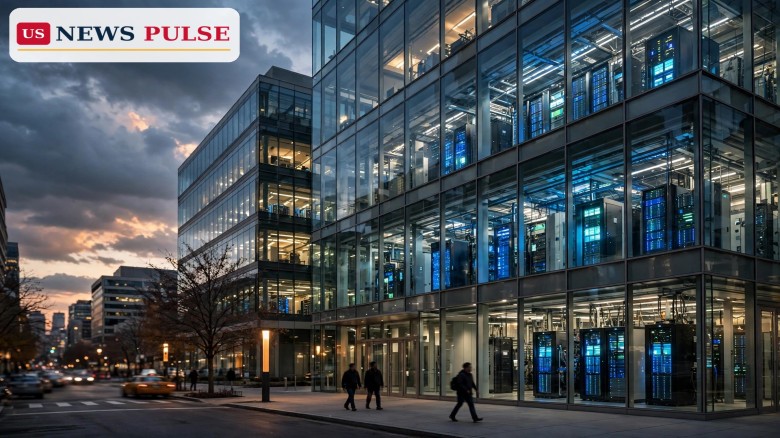
Sources: SBI Research report, November 2, 2026, as reported by The Hindu BusinessLine, Mathrubhumi English, The Economic Times and Asianet Newsable; Bloomberg Markets Wrap, November 2, 2026; CNBC TV18 market coverage, November 2, 2026; PSG Financial Services daily highlights, November 2, 2026. The featured image is an illustrative photograph of a modern data-centre building, not a photograph of any named company's headquarters.
© 2026 US News Pulse. All rights reserved.
 Print
 Save