
Bears Beat Seahawks 34-17 as Swift Scores Three Touchdowns in Monday Night Win
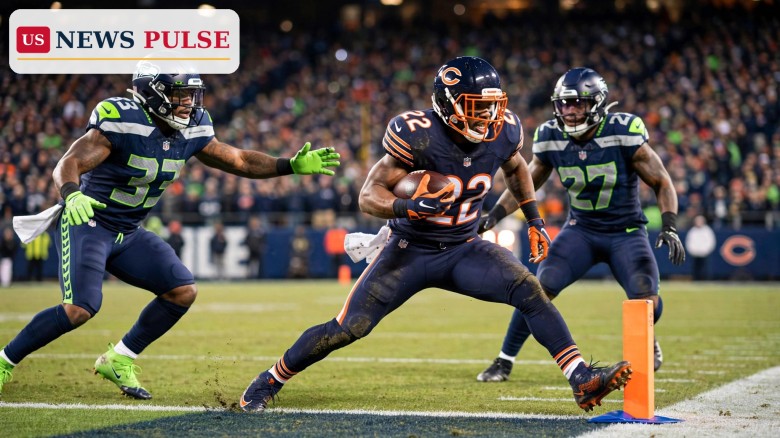
The Chicago Bears beat the Seattle Seahawks 34-17 in Monday Night Football on November 2, 2026, turning a tight game at Lumen Field into a comfortable road win with a dominant fourth quarter. D'Andre Swift scored three touchdowns, all on short runs, as Chicago improved to 6-2 and strengthened its standing as one of the NFC's most dangerous teams. Seattle, which had been a three-point home favourite, fell to 4-4 after a night in which its offence could not keep pace once Chicago seized control.
Key Points
- Final score: Chicago Bears 34, Seattle Seahawks 17, at Lumen Field in Seattle on Monday, November 2, 2026.
- D'Andre Swift scored three touchdowns, including two in the fourth quarter, to put the game beyond Seattle's reach.
- Caleb Williams threw a one-yard touchdown pass to Luther Burden III on Chicago's opening drive, a 17-play, 80-yard march.
- Seattle closed to 20-17 early in the fourth quarter before Chicago answered with 14 unanswered points.
- Chicago entered the game at 5-2 and left at 6-2; Seattle entered at 4-3 and fell to 4-4.
What Happened
Chicago set the tone immediately. After forcing Seattle into a three-and-out on the opening possession, the Bears took over and marched 80 yards in 17 plays, using more than eight minutes of clock. The drive survived a fourth-and-one at Chicago's own 49-yard line, converted on a five-yard carry by Swift, and ended when Williams found Burden for a one-yard touchdown with 5:25 left in the first quarter. It was, by the numbers, the longest drive Seattle had allowed all season in terms of plays, and it announced exactly how Chicago intended to play: patiently, physically, and on its own terms.
Seattle steadied itself and stayed in the game through the first half. Chicago led 13-3 after a Cairo Santos field goal, but Sam Darnold answered with a 43-yard touchdown pass to Jaxon Smith-Njigba just before half-time. Jason Myers missed the extra point, so the Bears took a 13-9 lead into the break, despite outgaining Seattle 208 yards to 114 and holding an 11-6 edge in first downs. Williams had thrown for 165 yards before half-time, and Burden had six catches for 53 yards and the touchdown.
The third quarter belonged to Chicago. Swift scored again to stretch the lead to 20-9, and the Bears' defence, which had bent without breaking in the first half, began to dictate the game. Seattle's best moment came early in the fourth quarter, when Darnold found Cooper Kupp for a seven-yard touchdown with 11:46 remaining and the two-point conversion succeeded, cutting the lead to 20-17. For a few minutes, Lumen Field believed in a comeback.
Chicago answered like a team that had been here before. On third-and-nine, after Seattle had stuffed Swift in the backfield on the previous play only for a delay-of-game penalty to stop play, Williams threw a backwards pass to Kalif Raymond, who ran 39 yards to set up first-and-goal. Swift ran in from five yards on the next play, restoring a 10-point lead at 27-17 with 8:28 left. By then Chicago had outgained Seattle 344 yards to 193.
The knockout blow followed a turnover. Darnold's pass was deflected by Austin Booker and intercepted by defensive end James Lynch, who returned it into the red zone. Swift punched in his third touchdown from five yards with 4:41 remaining, making it 34-17. Williams knelt out the final seconds, and a game that had been tied in spirit for three quarters ended as a rout on the scoreboard.
Bears Beat Seahawks: How Chicago Took Control
The Bears beat the Seahawks by winning the same battle three times: on the ground, on third down, and in the fourth quarter. The opening drive was the blueprint, a 17-play statement that kept Seattle's offence on the sideline and its defence on the field for more than eight minutes. Chicago converted on third down three times on that drive alone, and the fourth-down conversion at its own 49 showed a coaching staff willing to trust its players in its own territory.
That trust was repaid in the fourth quarter. When Seattle cut the lead to three points, Chicago did not retreat into safe, clock-killing football. It attacked, with the backwards pass to Raymond and the immediate Swift touchdown, and then its defence produced the turnover that ended the contest. Swift may not have piled up huge yardage, but his three short touchdowns were the product of sustained drives and red-zone efficiency, the two things that separate good road teams from great ones.
Reactions
Live coverage of the game framed Swift's third touchdown as the exclamation point on a dominant road performance, and the numbers backed that reading: three touchdowns, a 17-point winning margin, and a fourth quarter won 14-8. The broadcast also picked up a first-half sideline exchange between Williams and Raymond, a reminder that even in a comfortable win, Chicago's young offence is still working through its details in real time.
Why It Matters
This was Chicago's second game in a run of three consecutive prime-time fixtures, and winning on the road in Seattle, in front of one of the league's loudest crowds, is the kind of result that changes how a team is talked about. At 6-2, the Bears are no longer a surprise; they are a contender, and they have now won back-to-back games since Williams returned from injury, following their 30-24 win over New England.
For Seattle, the loss is a reality check. At 4-4, the Seahawks remain in the thick of the NFC West race, but they have now lost a home game they were favoured to win, and they did so against a team that outplayed them in every phase in the fourth quarter. How they respond in the coming weeks will say a lot about whether this season becomes a playoff run or a missed opportunity.
What Happens Next
Chicago will look to carry this momentum into the final game of its prime-time run, with the Bears now established as a team that can win in different ways: through the air early, on the ground late, and with a defence that produces turnovers when the game is on the line. Seattle, meanwhile, must regroup quickly, fix an offence that stalled between big plays, and find a way to protect its home field again.
Frequently Asked Questions
What was the final score of Bears vs Seahawks?
Chicago won 34-17 at Lumen Field in Seattle on Monday, November 2, 2026, in Week 8 of the NFL season.
How many touchdowns did D'Andre Swift score?
Swift scored three touchdowns, all on five-yard runs, including two in the fourth quarter.
How did Chicago score first?
On a 17-play, 80-yard opening drive, Caleb Williams threw a one-yard touchdown pass to Luther Burden III.
What are the Bears' and Seahawks' records now?
Chicago improved to 6-2, while Seattle fell to 4-4.
When did Seattle last lead in the game?
Related coverage: Cowboys beat Eagles 38-21 in Monday Night Football, Steelers beat Saints 16-10 in NFL Paris debut, and Oregon star Dante Moore out for the season.
© 2026 US News Pulse. All rights reserved.
 Print
 Save