
DeSantis Calls 2026 Midterms 'Close to an Extinction-Level Event' for Republicans
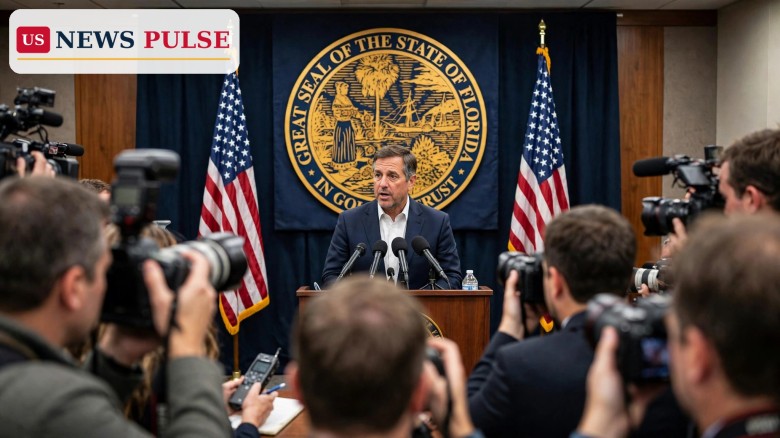
TALLAHASSEE, Florida — Outgoing Florida Governor Ron DeSantis delivered a blunt DeSantis midterm warning on Wednesday, November 4, 2026, calling the previous day's results close to an extinction-level event for Republicans in much of the United States. Speaking in Tallahassee a day after Democrats won control of both chambers of Congress in the November 3 midterms, he said Florida was the one state that held the line.
DeSantis told reporters the results were "close to an extinction-level event for Republicans in many parts of the country, as we have seen probably in the last 100 years" and "the political equivalent of a meteor strike that went all around the United States." He added: "to call it a wave, I think, would not be fully accurate." He predicted Democrats would finish with about 56 Senate seats and 258 House seats.
Key Points
- DeSantis called the 2026 midterms close to an extinction-level event for Republicans, comparing the losses to a meteor strike.
- He said Florida alone held the line, with Byron Donalds winning for governor and Senator Ashley Moody narrowly winning re-election.
- He predicted Democrats would finish with about 56 Senate seats and 258 House seats.
- He warned that without Texas as a Republican anchor, the party would struggle to remain viable nationally.
- He blamed Washington Republicans, and said anti-transgender advertising was not the issue motivating voters.
What Happened
DeSantis spoke in Tallahassee on Wednesday, November 4, the day after the midterm elections. Democrats won the House and Senate, reversing Republican majorities in Washington.
He argued the defeat went beyond a normal midterm swing against the president's party. Democrats won in states and districts where Republicans had long been competitive, and he said the losses could keep Republicans out of unified control in Washington for two, four or six years or longer.
In Florida, Republican Byron Donalds beat Democrat David Jolly for governor by about 50 percent to 48.7 percent, a margin of about 1.3 points. Republican Senator Ashley Moody narrowly beat Democrat Angie Nixon by roughly 50.9 percent to 48 percent. DeSantis said those wins showed Florida resisted a national tide, and credited Amendment 3, a property-tax measure approved with almost 62 percent support, with driving Republican turnout.
Background and Context
The midterms were held on Tuesday, November 3, after months of debate over the economy, the war with Iran, immigration, health care costs, and the Trump administration. Democrats campaigned on affordability and opposition to the administration, while Republicans pointed to their record in Florida and other Republican-led states. Outside Florida, voters appeared to use the election to register discontent with Washington.
The losses hurt most where they occurred. DeSantis pointed to Texas, where Democrats won the governor's race and a Senate race for the first time in decades. Texas has long been a Republican anchor nationally. From January, Florida will be the only one of the ten largest states with Republican control of state government.
DeSantis Midterm Warning: Florida Held the Line
The heart of the DeSantis midterm warning was his explanation. He framed the result as a rejection of Washington Republicans rather than an endorsement of Democrats. Voters, in his telling, did not necessarily embrace the Democratic agenda; they punished Republican officeholders in Congress for specific failures and for messaging that did not speak to their concerns.
Among those failures he named congressional stock trading and votes against releasing the Epstein files. Both have fuelled frustration with Washington insiders, and DeSantis suggested they convinced voters that Republican leaders were protecting themselves rather than serving the public. He also criticised campaign messaging, saying the hundreds of millions spent on anti-transgender advertisements — about 183 million dollars, according to AdImpact figures cited in reporting — were "not the issue motivating voters."
Florida, he argued, was different because its campaign was tied to concrete state policies voters could feel, including Amendment 3. Whether that lesson applies nationally is open to question, because national elections turn on federal issues such as the economy, war, and health care that governors cannot control directly.
Reactions and Quotes
DeSantis's own words set the tone. "Close to an extinction-level event for Republicans in many parts of the country, as we have seen probably in the last 100 years," he said, adding that the result was "the political equivalent of a meteor strike that went all around the United States."
On the national consequences, he warned: "we are not going to be viable nationally going forward" without Texas as an anchor. A party that loses Texas, and holds only Florida among the largest states, faces a much narrower map in presidential and congressional elections. DeSantis framed the defeat as a failure of leadership and messaging in Washington, not as proof that conservative ideas had been rejected. Democrats, meanwhile, presented the results as a clear mandate and are expected to use their majorities to challenge the Trump administration on funding, oversight, and the Iran war.
Why It Matters
The remarks matter for three reasons. First, they come from a prominent Republican governor, not a defeated candidate, signalling an internal reckoning is under way. Second, they highlight a geographic problem: without Texas as a reliable anchor, the path to national majorities becomes much harder. Third, the debate over stock trading, the Epstein files, and campaign spending goes to trust. Voters who believe officials use office for personal gain are less likely to support that party even when they agree with its policies.
Related coverage: Voters back transgender athlete bans in four states in the 2026 midterms and Trump says he will stay out of House GOP leadership race. Also see Schumer vows Democrats will end Iran war using funding power.
What Happens Next
Republicans in Congress now face a leadership reckoning. With Democrats taking both chambers, House and Senate Republicans will elect new minority leaders, and that contest will test whether DeSantis's critique gains support. President Trump has already said he will stay out of the House Republican leadership race. In Florida, the transition to Governor-elect Byron Donalds will proceed, while nationally Democrats' use of their majorities will show whether 2026 was a protest vote or a lasting realignment.
Frequently Asked Questions
What did Ron DeSantis say about the 2026 midterms?
He said the results were close to an extinction-level event for Republicans, called them the political equivalent of a meteor strike, and said calling it a wave would not be fully accurate.
When did DeSantis make the remarks?
He spoke in Tallahassee on Wednesday, November 4, 2026, one day after the November 3 midterms, when Democrats won both chambers of Congress.
Why did DeSantis say Florida held the line?
He pointed to Byron Donalds winning the governor's race by about 50 percent to 48.7 percent and Senator Ashley Moody narrowly winning re-election, while Republicans lost heavily elsewhere.
What did DeSantis blame for the losses?
He blamed Washington Republicans, citing congressional stock trading, votes against releasing the Epstein files, and campaign messaging, and said anti-transgender ad spending was not motivating voters.
What did DeSantis predict for Congress?
He predicted about 56 Democratic Senate seats and 258 House seats, and warned Republicans could be out of unified control for two, four or six years or longer.
© 2026 US News Pulse. All rights reserved.
 Print
 Save