
Voyager 1 Went Silent for Two Days, Then Answered on Its Own Before One Light-Day
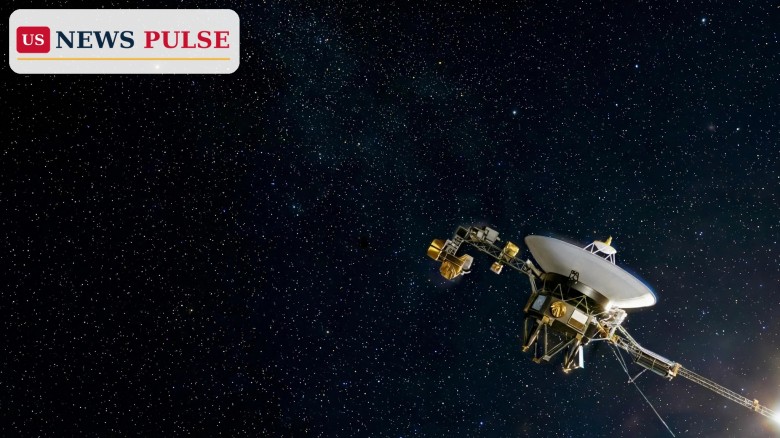
Voyager 1, the farthest human-made object in existence, went silent for two days in October 2026 — then, without a single command from Earth, it started talking again. The episode, described by NASA on October 29, is the latest reminder that a spacecraft launched in 1977 is still flying and still teaching us about the space between the stars.
In less than two weeks, Voyager 1 will pass a milestone no machine has ever reached: on November 18, 2026, it will be one light-day from Earth — 16.09 billion miles away, where a radio message takes a full day each way.
Key Points
- NASA heard nothing from Voyager 1 on October 18 and 19, 2026; the signal returned on October 20, with no commands sent from Earth.
- One set of thrusters had shut down, triggering the automatic fault-protection system to switch to backups.
- The trigger is still under investigation; mission manager Kareem Badaruddin said it is the first time the spacecraft has done anything like this.
- Voyager 1, launched in 1977, is about 16 billion miles away, travelling at about 38,000 mph (61,155 kph) through interstellar space.
- On November 18, 2026, it reaches 16.09 billion miles (25.89 billion km) from Earth — one light-day, a first for any human-made object.
What Happened
The silence began quietly. NASA's Deep Space Network — the large antennas at three sites around the world that talk to distant spacecraft — could not detect a radio signal from Voyager 1 during two scheduled attempts, 24 hours apart, on October 18 and 19. Every signal takes roughly a day to cross 16 billion miles, so the team could only wait and listen.
Then, on October 20, the signal reappeared — before the team had sent any troubleshooting commands. NASA has stayed in contact ever since; the recovery was entirely the spacecraft's own doing.
Engineers have since found what happened: one group of thrusters went offline, and their backups turned on — a swap programmed to happen automatically if the spacecraft's computers detect a problem with the active thrusters. Known as fault protection, the response puts the spacecraft in a safe, stable configuration and pauses normal operations, giving engineers time to diagnose the issue. What caused the thrusters to shut down is still unknown, and NASA has not said when it expects an answer.
Background: A Spacecraft Running on Borrowed Power
Voyager 1 launched in 1977 with 10 science instruments, some switched off after its planetary encounters. The Voyagers run on radioisotope thermoelectric generators, which turn heat from decaying plutonium into electricity — but both probes lose about 4 watts a year, and after nearly 50 years the power margins are thin, forcing the team to shut off nonessential devices. In recent years, the dwindling supply forced the team to turn off two instruments. Some were left on to study the outer heliosphere, the Sun's bubble of particles and magnetic fields. Now the Voyagers travel through interstellar space, beyond that bubble, and they are the only spacecraft to study this region directly.
Just weeks before the silence, the team completed a months-long effort to stretch the spacecraft's dwindling power. In early September, engineers switched off three devices on Voyager 1 and replaced them with lower-power alternatives — the "Big Bang" effort, finished about six weeks after the same swap on Voyager 2. The devices keep the spacecraft warm enough to operate in deep space, and the swap will let its remaining instruments run longer than previously expected. Without it, another instrument would have had to be switched off as early as summer 2027.
Voyager 1 and the One Light-Day Milestone
Voyager 1 is speeding at 38,000 mph (61,155 kph) toward a major milestone. On November 18, it will be 16.09 billion miles (25.89 billion kilometres) from Earth — one light-day, the distance light travels in a day. Radio waves take 24 hours to reach it and another 24 to return: a question sent today gets its answer the day after tomorrow.
"If you want to say 'hello' to Voyager, you send your message and then you go home and you wait two days before you finally get a response," said Suzanne Dodd, Voyager project manager at NASA's Jet Propulsion Laboratory. The spacecraft itself will not notice the crossing. Its significance, NASA said, is in showing the vastness of the universe and the endurance of humanity's most distant explorer.
Reactions and Quotes
NASA's announcement, published on its Voyager blog on October 29, 2026, mixed celebration with caution. The team was celebrating two things: the September power-saving effort and the self-resolved October silence — both about keeping a 49-year-old spacecraft alive.
"This is the first time we've seen the spacecraft do something like this, but we are also at a point in the mission where we have to expect the unexpected," said Kareem Badaruddin, Voyager mission manager at NASA's Jet Propulsion Laboratory. "We're relieved to be back in contact with Voyager 1 and are eager to understand what happened."
Why It Matters
Voyager 1 matters because there is nothing else like it. It is the only spacecraft ever to study interstellar space directly — the region beyond the Sun's protective bubble, where the solar wind gives way to the thin gas between the stars. Every measurement it sends back cannot be gathered any other way.
The October silence also tested the mission's design. A spacecraft 16 billion miles away must decide for itself when something is wrong, because no human can intervene in time. This time, that design worked — a lesson for every deep-space mission that follows.
Related coverage: NASA's Swift Observatory Plunges to Earth, NASA Mars Simulation Crew Emerges After 378 Days, and NASA X-70 Fractal Tests Flight Controls Never Flown Before.
What Happens Next
The immediate work is the investigation: engineers are still trying to determine what caused the thruster group to shut down, and whether it could happen again. The next date is November 18, when Voyager 1 reaches one light-day from Earth; NASA has announced no event to mark it. Beyond that, the mission's horizon is set by power, as the plutonium keeps decaying.
Frequently Asked Questions
What is one light-day?
The distance light travels in 24 hours — about 16.09 billion miles (25.89 billion kilometres). On November 18, 2026, Voyager 1 will be that far from Earth, the first human-made object ever to reach it.
Why did Voyager 1 go silent?
NASA heard nothing from the probe on October 18 and 19, 2026. Engineers later found one group of thrusters had shut down, triggering the automatic fault-protection system to switch to backups. The trigger is still under investigation.
How long does a message take to reach Voyager 1?
About 24 hours each way — a day for the message to arrive, and another day for the reply.
Is Voyager 1 still sending science data?
Yes. NASA has stayed in contact since the signal returned on October 20, 2026, and its remaining instruments keep working, helped by the September 2026 "Big Bang" power-saving effort.
© 2026 US News Pulse. All rights reserved.
 Print
 Save