
Japan Earthquake: Magnitude 6.1 Quake Strikes Off Tokyo Coast, No Tsunami Warning
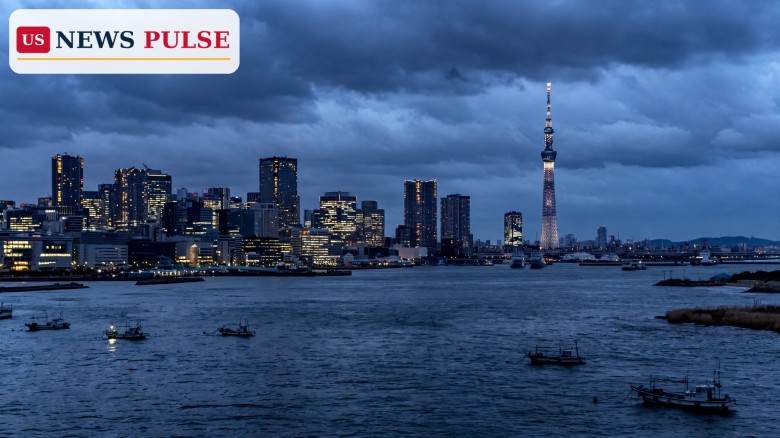
A magnitude 6.1 earthquake struck off the Kanto coast of Japan on Friday evening, shaking buildings across Tokyo and prompting the Japan Meteorological Agency to issue a tsunami forecast for slight sea-level changes along the coast. It was recorded at 7:39 p.m. local time on November 6, 2026, with its epicentre in the North Pacific Ocean about 145 kilometres from Choshi in Chiba prefecture. No tsunami warning was issued, and no damage or injuries were reported.
Key Points
- A magnitude 6.1 earthquake struck off Japan's Kanto coast at 7:39 p.m. local time on Friday, November 6, 2026, according to the Japan Meteorological Agency and the US Geological Survey.
- The epicentre was in the North Pacific Ocean, about 145 km from Choshi, Chiba — 35.087° N, 142.254° E, depth 40 km.
- The JMA issued a tsunami forecast for slight sea-level changes along the eastern Kanto coast, but no tsunami warning or advisory was triggered.
- Tremors were felt across the Kanto region, including Tokyo, yet no damage or injuries were reported.
- Japan sits on the Pacific Ring of Fire, where four tectonic plates meet — one of the most earthquake-prone countries on Earth.
What Happened
The earthquake hit on Friday evening as people across the Kanto region — Japan's most populous area and home to Tokyo — were ending their working week. The Japan Meteorological Agency (JMA) and the US Geological Survey (USGS) both recorded it at magnitude 6.1.
The epicentre lay offshore, south-east of Hasaki and roughly 145 km from Choshi, a port city on the Pacific coast of Chiba prefecture. At 40 km deep it was relatively shallow, which is why it was felt so widely across the Kanto plain, including Tokyo. There were no immediate reports of collapsed buildings, fires, injuries or major transport disruption.
Within minutes, the JMA issued a tsunami forecast — the lowest level of its sea-level alerts — warning of possible slight changes in sea level along the eastern Kanto coast. It stopped short of a tsunami warning or advisory, the higher levels that would signal a risk of damaging waves. Destructive waves were not expected, but coastal residents and maritime operators were urged to stay attentive.
Background: Why Japan Shakes So Often
Japan is one of the most seismically active countries in the world. The archipelago sits at the junction of four tectonic plates — the Pacific, Philippine Sea, Eurasian and North American plates — on the western edge of the Pacific Ring of Fire, which produces most of the planet's major earthquakes. Around 1,500 felt tremors are recorded in Japan every year.
The Kanto region has a painful seismic history. The Great Kanto Earthquake of 1923, estimated at magnitude 7.9, devastated Tokyo and Yokohama and killed more than 100,000 people, largely in the fires that followed. The magnitude 9.0 Tohoku earthquake of March 2011 generated a tsunami that killed more than 18,000 people and triggered the Fukushima nuclear disaster. Those disasters shaped modern Japan: an advanced early-warning system, strict building codes, and disaster drills in schools, offices and neighbourhoods.
Japan Earthquake: What a Magnitude 6.1 Reading Means
A magnitude 6.1 earthquake is classed as strong — it releases roughly 30 times more energy than a magnitude 5.1 tremor, and above the epicentre it can damage poorly built structures and topple furniture. But magnitude alone does not decide how much shaking people feel. Depth and distance matter just as much, and both worked in Japan's favour on Friday.
The epicentre was offshore, about 145 km from the nearest city, and its focus was 40 km below the seabed. That spreads the energy over a wide area before it reaches land, producing noticeable but moderate shaking rather than the violent jolts felt above a shallow, onshore fault — and the strongest shaking stayed out at sea. The same geography explains the sea-level call: a tsunami is generated when a quake shifts a large volume of water, and the JMA's instruments evidently showed no such displacement.
Reactions and Official Statements
The JMA moved quickly, issuing its tsunami forecast for the eastern Kanto coast and confirming no tsunami warning or advisory had been triggered. Its message was calm vigilance: slight sea-level changes were possible, destructive waves were not expected, and coastal residents should keep following official updates.
India's National Centre for Seismology published the quake's parameters on X, writing: "EQ of M: 6.1, On: 06/11/2026 16:09:29 IST, Lat: 35.087 N, Long: 142.254 E, Depth: 40 Km, Location: North Pacific Ocean." The USGS also listed the event. As of Friday night, no agency had reported casualties or structural damage.
Why It Matters
The Kanto region is home to more than 43 million people, including the greater Tokyo area, the largest metropolitan economy on Earth. Any significant earthquake there is watched worldwide — for the immediate risk to life, and for its potential effect on global supply chains, financial markets and travel.
Friday's event is also a reminder of how much has changed since 1923. A magnitude 6.1 tremor once might have spread panic through a wooden city; today it is absorbed by strict building codes, a seconds-ahead warning network and a population trained in what to do when the ground moves. The absence of damage is not luck — it is a century of preparation.
What Happens Next
The JMA will keep monitoring for aftershocks, which commonly follow a quake of this size over the following days and weeks. Most will be far smaller than the main shock, but seismologists will watch for any change suggesting further activity along the same fault system. Coastal authorities will watch sea levels until the forecast is formally lifted. If no further problems emerge, the event will be logged as another strong but harmless reminder of Japan's restless geology.
Frequently Asked Questions
How strong was the Japan earthquake?
Magnitude 6.1, per the Japan Meteorological Agency and the US Geological Survey, striking at 7:39 p.m. local time on Friday, November 6, 2026. It was felt across the Kanto region, including Tokyo.
Was a tsunami warning issued after the Japan earthquake?
No. The agency issued a tsunami forecast, its lowest sea-level alert, for slight changes along the eastern Kanto coast. No warning, advisory or major warning was issued, and destructive waves were not expected.
Where was the epicentre of the earthquake?
In the North Pacific Ocean off the Kanto coast, about 145 km from Choshi, Chiba, south-east of Hasaki — 35.087° N, 142.254° E, depth 40 km.
Was anyone hurt or was there any damage?
No. No damage or injuries were reported in the hours after the quake; the offshore epicentre and 40 km depth meant the strongest shaking stayed out at sea.
Why does Japan have so many earthquakes?
Japan sits where four tectonic plates meet on the Pacific Ring of Fire, with around 1,500 felt tremors a year — and has built one of the world's most advanced early-warning systems and strictest building codes in response.
Related reading: Magnitude 4.0 Quake Shakes Northern California; Russia Secretly Agreed to Supply Iran With 90 Missile Launchers, Leaked Records Show; Ten Governments Condemn Joshua Wong's 10-Year Hong Kong Prison Sentence.
© 2026 US News Pulse. All rights reserved.
 Print
 Save