
Earth Has a Temporary Second Moon as Tiny Asteroid 2026 QQ8 Loops in Orbit
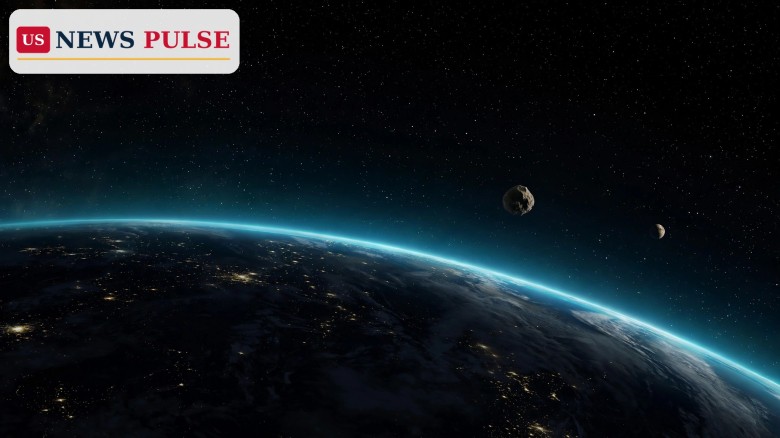
Earth has a temporary second moon. Astronomers have confirmed that a tiny asteroid, designated 2026 QQ8, has been captured by our planet's gravity and is now looping around Earth in a kidney-shaped orbit, where it will stay until it drifts away in December 2026. The rock measures only about one to two metres across, roughly the size of a washing machine, and it poses no collision threat. Its confirmation, announced by the International Astronomical Union's Minor Planet Center on October 29, 2026, makes 2026 QQ8 the latest member of a small class of objects known as mini-moons: natural satellites Earth borrows for a few months before gravity hands them back to the Sun.
Key Points
- Asteroid 2026 QQ8 is temporarily bound to Earth, the Minor Planet Center confirmed on October 29, 2026.
- The asteroid is only about one to two metres across, first spotted on August 20, 2026 by Hungarian astronomer Krisztian Sarneczky.
- It was probably captured by Earth's gravity in April 2026 and is expected to escape in December 2026, possibly in January.
- Its closest approach is about 0.0038 astronomical units away, roughly one and a half times farther than the Moon.
- It will not come this close again until 2058.
What Happened
The story began on August 20, 2026, when Krisztian Sarneczky, an astronomer at the Piszkesteto Observatory in northern Hungary, spotted a faint, fast-moving point of light. Follow-up observations with the Lowell Discovery Telescope in Arizona and the University of Hawaii's 2.2-metre telescope confirmed it was natural, not space junk or a spent rocket stage. Orbital calculations showed the rock had been pulled into orbit around Earth, probably back in April 2026, when it crossed the boundary of Earth's gravitational influence, the Hill sphere.
On October 29, 2026, the Minor Planet Center, the official body that tracks small bodies in the solar system, announced the confirmation. Its orbital integrations showed the object is, in its words, "temporarily bound to the Earth", and that "no link to a known artificial object has been found". That second point matters: Earth orbit is crowded with satellites and debris, so astronomers must rule out human-made objects before declaring a new natural satellite.
Background and Context
Mini-moons are not new, but they are rare and hard to find. Earth's gravity regularly snares small asteroids that wander too close, but most are flung away again within days or weeks, and many are never noticed. Only a handful have ever been confirmed, including 2020 CD3, a car-sized asteroid found in February 2020 that had orbited Earth for about three years, and 2006 RH120, which circled Earth for about a year in 2006 and 2007.
Mini-moons are elusive because of size and speed: a rock one or two metres across reflects very little sunlight, so it appears extremely faint, and it moves quickly relative to the stars. And a mini-moon is not a permanent moon: Earth's Moon is about 3,474 kilometres wide and has orbited our planet for billions of years, while a mini-moon is a temporary guest, held by gravity for months or a few years before the Sun's pull tips the balance.
Earth's Temporary Second Moon: What 2026 QQ8 Is
2026 QQ8 is a small, rocky asteroid, most likely a fragment knocked off a larger asteroid long ago, that approached Earth at just the right speed and angle to be captured. For comparison, the asteroid that exploded over Chelyabinsk in Russia in 2013 was about 20 metres wide. A rock the size of 2026 QQ8 would burn up harmlessly high in the atmosphere if it ever fell towards Earth, which is one reason astronomers stress that it poses no danger. Its path is shaped by a three-way gravitational tug-of-war between Earth, the Moon and the Sun, which is why its orbit looks kidney-shaped rather than circular. It comes close to Earth about once every ten years, but the geometry will not line up for another really close pass until 2058.
Reactions and Quotes
The Minor Planet Center's announcement was deliberately careful, as befits the official record keeper for the solar system's small bodies. Its statement that orbital integrations show the object is "temporarily bound to the Earth" is the formal confirmation astronomers were waiting for, and its note that "no link to a known artificial object has been found" closes off the most likely alternative explanation. Astronomers welcome the find because mini-moons are natural laboratories for understanding how gravity captures small bodies.
Why It Matters
The confirmation of 2026 QQ8 matters for science, for planetary defence, and for the simple wonder of it. Every mini-moon adds to a tiny but growing sample of objects whose capture and escape astronomers can model and test. For planetary defence, mini-moons are a useful rehearsal: the same telescopes that spotted 2026 QQ8 watch for larger asteroids that could threaten Earth, and finding a rock just one or two metres across at hundreds of thousands of kilometres shows how sensitive the world's asteroid-hunting systems have become. A temporarily captured mini-moon is also one of the most accessible targets in the solar system.
What Happens Next
For 2026 QQ8 itself, the future is already written in the orbital maths. It will keep looping around Earth for a few more weeks, then slip out of our planet's gravitational grip in December 2026, possibly in January, and resume its own orbit around the Sun. Astronomers will keep tracking it for as long as it remains bright enough to see. The next close approach is not due until 2058, and whether it will be captured again then depends on the exact geometry of the encounter. Sky surveys will keep scanning for the next mini-moon, and given how many small asteroids pass near Earth each year, another one will likely be caught before long. For anyone hoping to see it, the honest answer is that it is far too faint for backyard telescopes, let alone the naked eye.
Frequently Asked Questions
Does Earth really have a second moon right now?
Yes, temporarily. Asteroid 2026 QQ8 is orbiting Earth and will stay until December 2026, possibly January, before escaping back into orbit around the Sun.
How big is asteroid 2026 QQ8?
It measures only about one to two metres across, roughly the size of a washing machine. It is far too small and faint to see with the naked eye.
Who discovered 2026 QQ8?
Hungarian astronomer Krisztian Sarneczky first spotted it on August 20, 2026, at the Piszkesteto Observatory in northern Hungary. Follow-up observations from the Lowell Discovery Telescope and the University of Hawaii confirmed it was natural.
Is the mini-moon dangerous?
No. At its closest it stays about 0.0038 astronomical units away, roughly one and a half times farther than the Moon, and a rock this small would burn up in the atmosphere anyway.
When will 2026 QQ8 come back?
It makes close approaches about once every ten years, but it will not come this close again until 2058.
More on US News Pulse: a new dwarf planet candidate found beyond Pluto, NASA's Swift Observatory ends its 22-year mission, and Voyager 1 went silent for two days, then answered on its own.
© 2026 US News Pulse. All rights reserved.
 Print
 Save