
SoftBank and ABB Explore China Carve-Out to Save $5.4 Billion Robotics Deal
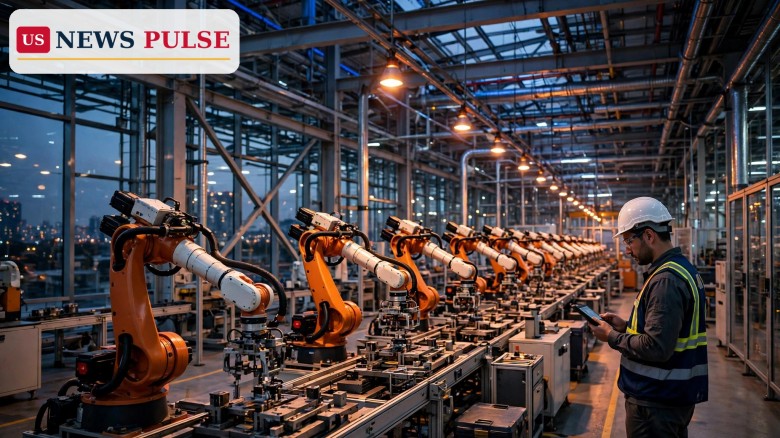
SoftBank and ABB are exploring a plan to carve out the Chinese arm of their $5.4 billion robotics deal after Beijing blocked the takeover, Bloomberg News reported on Saturday, November 7, 2026, in the latest twist in a transaction that has become a test of China’s leverage over global technology deals.
Under the idea, the China business would sit in a separate entity under different ownership, letting the rest of ABB’s robotics division change hands. ABB is also weighing other options, including another buyer, according to people familiar with the matter cited by Bloomberg.
Key Points
- SoftBank and ABB are exploring a carve-out of the Chinese part of the $5.4 billion robotics deal Beijing blocked this week, Bloomberg reported on Saturday, November 7.
- The China business would sit in a separate entity under different ownership, so the rest of the deal could proceed.
- ABB is also weighing another buyer. The robotics business could be valued at $2 billion to $3 billion.
- China is ABB’s biggest robotics market, about 30 percent of its robotics business.
- It is the second deal Beijing has blocked this year, after Meta was ordered in April to unwind its Manus acquisition.
What Happened
Bloomberg reported on Saturday that the two companies are exploring the carve-out, citing people familiar with the matter. The report did not say how far talks have advanced or when a decision might come.
The plan would separate the China operations from the rest of ABB’s robotics business, addressing Beijing’s concerns while preserving most of a deal both sides still want. No agreement on a new structure has been announced, and neither company has confirmed the reported figures. SoftBank did not respond to requests for comment, and ABB declined to comment.
Background: How the SoftBank ABB Robotics Deal Was Blocked
SoftBank agreed in October 2025 to buy 100 percent of ABB’s robotics division for about $5.375 billion, a deal central to founder Masayoshi Son’s push into artificial intelligence and automation. The unit employs more than 7,000 people and supplies industrial robots to customers including BMW. The European Union approved the deal in March 2026, and completion had been planned for mid-to-late 2026, with US approval still pending.
That timetable collapsed on Thursday, November 5, when the Financial Times reported that China’s National Development and Reform Commission had told SoftBank it would not allow the deal, fearing robotics data generated in China could be sent overseas and used to train AI models, including OpenAI’s. ABB confirmed the block and said it was working constructively with SoftBank. SoftBank shares fell about 5.5 percent in Tokyo that day. In April, Meta was ordered to unwind its acquisition of AI startup Manus, valued at more than $2 billion.
SoftBank ABB Robotics Deal: What a China Carve-Out Would Mean
A carve-out is the most direct way to rescue the deal, but it would come at a price. China is ABB’s biggest robotics market, about 30 percent of its robotics business, with about 30 local companies, around 15,000 employees in nearly 130 cities and channels in nearly 700 locations. Removing that piece would leave SoftBank with a considerably smaller business than the one it agreed to buy.
A separate China entity would need its own ownership, management and funding, and regulators would need to be satisfied that data and technology do not flow between the two parts. Beijing has not said publicly whether a carve-out would resolve its objections. For ABB, a sale to another buyer is the fallback, but a new buyer would face the same regulatory landscape, and a $2 billion to $3 billion valuation would be a steep discount to the SoftBank price.
Reactions
Neither company has commented publicly on the carve-out talks, according to Bloomberg. Investors will watch for any sign the two companies have found a structure Beijing can accept, or that ABB is moving toward a different buyer. Other firms with large China operations are watching too, because the answer will shape how similar deals are structured.
Why It Matters
The deal sits at the intersection of three forces reshaping global business: the race to build AI-powered robotics, China’s determination to control data generated inside its borders, and the growing willingness of governments to block deals on national security and technology grounds.
For SoftBank, the robotics division was meant to be a cornerstone of Son’s AI strategy, a hardware arm to match its investments in AI software and chips. For ABB, the sale was part of a broader focus on electrification and automation; a failed or discounted sale would leave it holding a business it planned to exit. More broadly, Beijing’s willingness to block a $5.4 billion deal on data grounds means dealmakers must now plan for Chinese regulatory risk from the start.
What Happens Next
There is no public timetable. SoftBank and ABB must settle on a structure, test whether it satisfies Beijing and seek formal approval, a process that could take weeks or months. If the carve-out fails, ABB may turn to other buyers. Investors should watch for a statement confirming the plan, any sign Beijing would accept a separated China business, and any move toward an alternative buyer. US approval was still pending when China blocked the deal.
Frequently Asked Questions
Why did China block the deal?
China’s National Development and Reform Commission told SoftBank it would not allow the $5.4 billion takeover, fearing robotics data generated in China could be sent overseas and used to train AI models, including OpenAI’s.
What is a China carve-out?
It would place the Chinese part of ABB’s robotics business in a separate entity under different ownership, letting the rest of the deal proceed.
How big is ABB’s China robotics business?
China is ABB’s biggest robotics market, about 30 percent of the business, with about 30 local companies, around 15,000 employees in nearly 130 cities and channels in nearly 700 locations.
What if the deal cannot be saved?
ABB is weighing other options, including another buyer. The business could be valued at $2 billion to $3 billion, well below the $5.4 billion SoftBank agreed to pay.
Was this the first deal China blocked this year?
No. In April, Meta was ordered to unwind its acquisition of AI startup Manus, valued at more than $2 billion.
Read more: China Blocks SoftBank’s $5.4 Billion ABB Robotics Deal — ING Puts $500 Million of Data Centre Loans Up for Sale — OpenAI Closes $11 Billion Funding at $1.25 Trillion Valuation
© 2026 US News Pulse. All rights reserved.
 Print
 Save