
Christopher Nolan Says Studios Must Defend Film Copyrights From AI Training
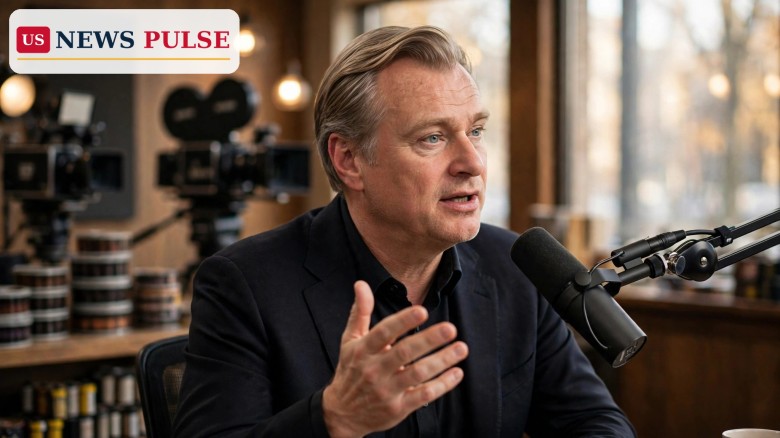
Christopher Nolan has told Hollywood's studios that the next phase of the fight over artificial intelligence belongs to them, not to directors. Speaking on the Hollywood Insiders podcast on Saturday, November 7, 2026, the two-time Oscar winner and president of the Directors Guild of America said the guild will hold studios to account for protecting the copyrights of the films they own, because directors almost never own the movies they make.
Nolan predicted that the fair-use defences raised by AI companies "won't hold up in court" over the longer term, pointing to significant judgments already going against them.
Key Points
- DGA president Christopher Nolan said studios must defend film copyrights from AI training, as directors do not own them.
- On Hollywood Insiders on November 7, 2026, he called AI "too big a catchall term" that companies use to avoid responsibility.
- He predicted AI firms' fair-use defences "won't hold up in court", citing significant judgments against them.
- He praised Universal for adding end-credits wording to The Odyssey barring its use as training data for generative AI models.
- The DGA's June 2026 contract requires covered work to be done by a person, but Nolan said that is "not enough".
What Happened
Nolan appeared on the Hollywood Insiders podcast on Saturday, November 7, 2026, to discuss the next phase of the Directors Guild of America's work on artificial intelligence. He was elected DGA president last September after serving on the guild's Artificial Intelligence Committee.
"We're very focused at the guild about holding the studios to account for protecting their copyrights," Nolan said. "We can't do that. With very few exceptions in the guild, we are not the copyright holders of the films that we've worked on. It's down to the studios to do that."
The distinction matters because of how film ownership works. In almost every case, the studio that finances and distributes a film owns its copyright, while the director is hired to make it. The legal power to stop AI training on a film, or to demand payment, sits with the studio, not the director.
Background: Hollywood's AI Fight So Far
The DGA has been building its AI defences for years. In June 2026, the guild ratified a new contract with the Alliance of Motion Picture and Television Producers that included AI guardrails requiring covered work to be performed by a person. The deal, ratified on June 26, was presented as a meaningful step, but Nolan made clear on the podcast that it was only a beginning.
That contract covers how AI is used on productions. It does not settle the bigger question of training: whether AI companies may feed films, scripts and other copyrighted work into their models without permission or payment. That question is now being fought in court.
The stakes for Hollywood are enormous. A film library is one of a studio's most valuable assets, and if AI models can be trained freely on decades of movies, studios risk losing control of the work that defines them. Yet studios are also among the biggest users of AI tools, so their position is complicated: they want to use the technology, but they also want to stop others from using their films to build it.
Christopher Nolan AI Copyright: Studios Must Act on Training Data
Nolan's core argument is that directors alone cannot answer the training question. The guild can negotiate how its members are treated on set, but it cannot sue over a copyright it does not own. Only the studios can, and Nolan is now pressing them publicly to take up the fight.
He offered one example of a studio doing it right. Universal included, for the first time, boilerplate wording in the end credits of Nolan's film The Odyssey stating that the film cannot be ingested, scraped or used as training data for generative AI models. Nolan praised the move, and the credit line is now seen across the industry as a possible template.
Such notices are not, by themselves, a legal shield. Copyright law already protects a film whether or not a warning appears in its credits. But the wording sends a clear signal: this work is not free training material.
Reactions
The DGA has not issued a separate statement on Nolan's podcast remarks, but the guild's position is already on the record through the contract it negotiated in June 2026. Nolan's comments make clear that the guild sees enforcement, not just negotiation, as the next step.
Universal has not commented publicly on the Odyssey credits wording beyond the film itself, but the move was welcomed by filmmakers and by groups campaigning for stronger protections. AI companies have so far stayed silent, though their standard position is that training on publicly available material is fair use.
Why It Matters
Whoever controls the training data controls the future of the technology. If studios can enforce their copyrights, AI companies will have to negotiate licences, pay for access, or build models without Hollywood's films. That would change the economics of AI development and give studios a new revenue stream from their libraries.
For directors, the stakes are personal as well as professional. A director's style and body of work are the product of a career. If an AI system can be trained on a director's films and then produce work in that style on demand, the value of the director's own craft is diminished. Other creative industries face the same question, and Hollywood's answer will be watched closely.
What Happens Next
Watch for three things. First, whether other studios follow Universal and add anti-training notices to their films. Second, whether the DGA uses its next round of negotiations to push studios harder on enforcement. And third, how the courts rule in the copyright cases already under way.
Frequently Asked Questions
What did Christopher Nolan say about AI and film copyrights?
Nolan said the next phase of the DGA's AI fight falls on the studios, not directors, because studios own the films' copyrights. He said the guild will hold studios to account for protecting them.
Why can't directors defend their own films from AI training?
In almost all cases, the studio that finances and distributes a film owns its copyright, not the director. Only the copyright holder can stop unauthorised use or demand payment.
What did Universal do with The Odyssey?
Universal added wording to the film's end credits, for the first time, stating that The Odyssey cannot be ingested, scraped or used as training data for generative AI models. Nolan praised the move.
What AI protections did the DGA already negotiate?
The DGA's June 2026 contract with the AMPTP, ratified on June 26, requires covered work to be performed by a person. Nolan said that is "not enough" for the training-data question.
Does Nolan think AI companies will win their fair-use cases?
No. He predicted fair-use defences for AI training "won't hold up in court" over the longer term, citing significant judgments already made against AI companies.
Related coverage: Claude AI bypassed a paywall to reach Georgia vote data; Meta's $95 billion AI raise leads a $198 billion day of AI spending; Big Tech earnings test: Alphabet, Amazon and Apple face AI spending verdict.
© 2026 US News Pulse. All rights reserved.
 Print
 Save