
Gaza Sandbank Collapse Kills Mother and Three Children as Storm Floods 70,000 Tents
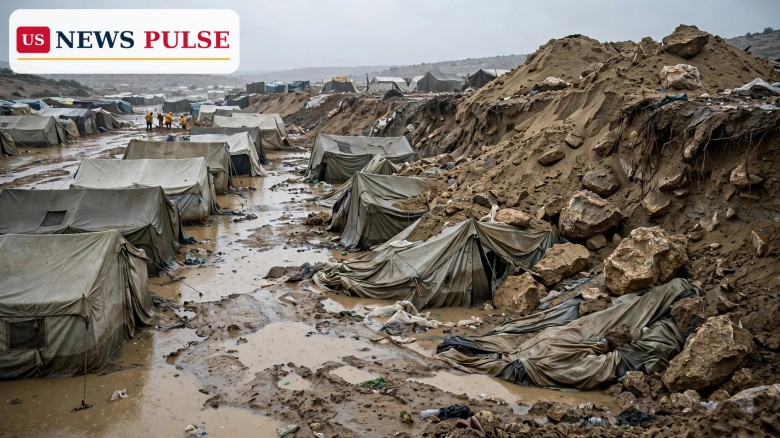
Heavy rain turned deadly in central Gaza on Sunday night, when a rain-soaked sandbank collapsed onto tents sheltering displaced families south of Deir al-Balah, killing a mother and three children and leaving two more people missing. The Gaza sandbank collapse came a day after the first winter storm flooded about 70,000 displacement tents across the territory.
Residents dug through mud and broken rock with bare hands, hammers and shovels, working by flashlight through the night. Three tents were completely buried, and five to six more people were injured. It was the first deadly incident of a winter aid agencies had warned would be catastrophic for families still living in tents.
Key Points
- A sandbank collapsed onto tents at a displacement camp south of Deir al-Balah late on Sunday, November 8, 2026, after heavy rain from the first winter storm.
- Five people were killed — four children and a woman — and two remain missing, the Gaza Government Media Office said.
- The dead were named as Tahrir Nabhan and three children, Mariam Nabhan, her brother Salah, and Habiba al-Zein, aged 8, 6 and 4.
- The collapse followed a storm that flooded about 70,000 tents, with water up to 1.5 metres deep, and Civil Defence answering only 10 percent of distress calls.
- Save the Children says more than 500,000 children in Gaza live in "critical or catastrophic" shelter conditions.
What Happened
Heavy rain late on Sunday washed away a rocky sand bank beside the camp south of Deir al-Balah. The bank gave way and collapsed onto the tents below, burying three of them under earth and large sandy rocks. Residents used hammers and shovels to dig with flashlights.
Gaza's health ministry first reported three children and two women killed, then corrected the toll on Monday morning to one woman among the dead. The Government Media Office said five people were killed, including four children and a woman, with two still missing. The dead were named as Tahrir Nabhan and three children — Mariam Nabhan, her brother Salah, and Habiba al-Zein — a mother and her two children among them, aged 8, 6 and 4.
Background and Context
The collapse came at the end of a weekend of flooding that had already overwhelmed Gaza's camps. Rain from the first winter storm began on Friday night, and within 12 hours at least 70,000 tents were flooded, the Government Media Office said. Water rose up to 40 centimetres at several sites, and to 1.5 metres in places.
Civil Defence received about 1,500 distress calls in 10 hours on Saturday, and by Monday the total had reached 2,100 — but the service could answer only 10 percent of them. In al-Mawasi, where more than 900,000 displaced people are sheltering, the rain fell for hours without stopping.
The United Nations says it needs about 121,000 tents, 561,000 tarpaulins and 1.7 million mattresses for displaced families, with only about 2,800 tents available inside Gaza. More than 74,600 people have been killed since the war began on October 7, 2023, and more than 1,600 since the October 2025 ceasefire.
Gaza Sandbank Collapse Exposes a Shelter Crisis
The collapse was not a freak accident. Families shelter in tents on exposed ground, at the foot of sandy banks, with no retaining walls, no drainage and no solid shelter to retreat to when the rain came. When the bank gave way, tonnes of wet sand and rock fell on canvas that could offer no resistance.
The ceasefire announced more than a year ago stipulated the entry of caravans as a sturdier alternative to tents. But Save the Children says Israeli authorities have repeatedly blocked their entry into Gaza, leaving hundreds of thousands of children exposed to another winter of hardship.
Even the rescue was hampered by shortages. Specialist equipment is in short supply, and residents dug with their bare hands. Fuel and spare parts needed to run municipal and Civil Defence machinery are being prevented from entering, the Government Media Office said.
Reactions and Quotes
The Gaza Government Media Office condemned what it called global "indifference and inaction". "This is a scene that should shame the conscience of humanity and reflects the extent of the complicity and abandonment to which our people are subjected," it said on Monday.
The office held Israel, the United States and the international community "fully and directly responsible", citing "absolute silence" and "complicity in preventing the entry of shelter supplies and fuel".
Reporting from Deir al-Balah, Al Jazeera correspondent Tareq Abu Azzoum said the victims were living in flimsy tents, on exposed ground, with no protection from the rain. "When the embankment collapsed, those people had no chance to escape or protect themselves," he said.
Save the Children said the ceasefire had stipulated caravans as a more durable alternative to tents, but "Israeli authorities have repeatedly blocked their entry into Gaza, leaving hundreds of thousands of children exposed to another winter of hardship."
Why It Matters
The collapse turns an abstract shelter shortage into named dead children. The weekend storm flooded 70,000 tents without killing anyone; the collapse a day later showed how quickly flooding becomes fatal when families have no solid shelter. Winter has only just begun, and every further storm carries the same risk for the more than 500,000 children in critical or catastrophic shelter.
It also tests the ceasefire's promises. The Board of Peace presented a $2.45 billion six-month Gaza recovery programme at the United Nations in September, but none of it has yet put a solid roof over families still sleeping in tents.
What Happens Next
The search for the two missing people continues, and the death toll may still rise. Civil Defence says it cannot cope with the emergency because of fuel shortages and damaged equipment, including hundreds of vehicles destroyed in the war. More winter rain is expected in the weeks ahead.
Attention now turns to whether shelter supplies will be allowed in at the scale the United Nations says is needed, and whether caravans will finally enter. For the families of Deir al-Balah, that decision cannot come soon enough.
Frequently Asked Questions
How many people died in the Gaza sandbank collapse?
Five people were killed — four children and a woman — and two remain missing, according to the Gaza Government Media Office.
Where did the collapse happen?
At a displacement camp south of Deir al-Balah, in central Gaza, where a rain-soaked sandbank collapsed onto tents late on Sunday, November 8, 2026.
Who were the victims?
Tahrir Nabhan and three children — Mariam Nabhan, her brother Salah, and Habiba al-Zein — a mother and her two children among them, aged 8, 6 and 4.
How many tents were flooded in the storm?
About 70,000 displacement tents were flooded across Gaza during the first winter storm, with water up to 1.5 metres deep in places.
Why are families still living in tents?
The ceasefire promised caravans, but Save the Children says Israel has repeatedly blocked their entry, and the UN counts only about 2,800 tents against a need of about 121,000.
Related coverage: Gaza flooding: first winter storm floods 70,000 tents of displaced Palestinians and Trump presses Netanyahu to advance Gaza peace plan after Israel election.
© 2026 US News Pulse. All rights reserved.
 Print
 Save