
Rugby League World Cup: Australia Beat New Zealand 32-12 for Fourth Straight Title
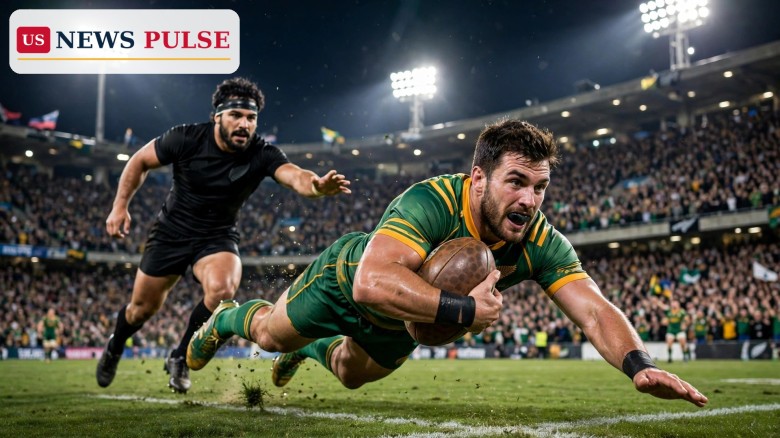
Australia are Rugby League World Cup champions for a fourth consecutive time after a clinical 32-12 victory over New Zealand in Sunday's final at Suncorp Stadium in Brisbane, with six tries and a first-half blitz. The Kangaroos led 24-6 at half-time in front of 52,461 fans and never allowed New Zealand back into the contest, sealing a 13th World Cup title overall and denying the Kiwis a first crown since 2008. Jack Bostock was named Player of the Final after scoring two tries that took his tournament tally to nine. Earlier in the day, Australia's Jillaroos beat New Zealand's Kiwi Ferns 34-10 in the women's final at the same ground, completing a fourth straight women's title of their own.
Key Points
- Australia beat New Zealand 32-12 in the men's Rugby League World Cup final at Suncorp Stadium, Brisbane, on Sunday, November 15, 2026, in front of 52,461 fans.
- The Kangaroos led 24-6 at half-time, scored six tries to two, and won a fourth consecutive title and their 13th overall.
- Liam Martin and Jack Bostock scored two tries each, with Bradman Best and Tom Trbojevic also crossing, and Cameron Munster kicked three conversions and a penalty.
- Bostock was named Player of the Final; his two tries took him to nine for the tournament, and Martin's opener after 84 seconds was the fastest try ever in a World Cup final.
- Earlier the same day, Australia's Jillaroos beat New Zealand's Kiwi Ferns 34-10 in the women's final, also a fourth straight title.
What Happened
The final was effectively decided in a devastating opening half. Martin opened the scoring after just 84 seconds, set up by hooker Harry Grant from dummy half after New Zealand's Jamayne Isaako kicked off dead on the full. It was the fastest try ever scored in a World Cup final, and it set the tone for everything that followed.
Australia kept coming. Bostock crossed twice, Martin added a second, and Best and Trbojevic also touched down as the Kangaroos built a 24-6 lead by the break. Munster's boot added three conversions and a penalty, and the home side's control of the middle meant New Zealand spent most of the half defending their own line.
New Zealand's tries came from Casey McLean and Isaiah Papali'i, both converted by Isaako, but the Kiwis never found a way to sustain pressure. Every time they threatened, Australia's defence held or the Kangaroos answered with points of their own.
Background and Context
New Zealand reached the final by beating Tonga 34-10 in the first semi-final at Newcastle on November 7, in which they scored 22 unanswered points after the break. Kalyn Ponga returned at fullback just 23 days after breaking his left forearm in the tournament opener and set up three tries, and the Kiwis arrived in Brisbane chasing their first World Cup title since 2008.
Australia, the defending champions, had been the tournament's benchmark throughout. No team has matched the Kangaroos' consistency at this level, and Sunday's win extended a run of dominance that now stretches across four consecutive tournaments. Related coverage: New Zealand reach Rugby League World Cup final with 34-10 win over Tonga.
The occasion was a double-header at Suncorp Stadium, with the women's final played earlier in the day. The Jillaroos' 34-10 win over the Kiwi Ferns, powered by a Jaime Chapman first-half hat-trick in a six-try opening 40 minutes, meant Australia left Brisbane with both trophies for the fourth tournament in a row.
Rugby League World Cup Final: How Australia Sealed a Fourth Straight Title
The difference between the sides was speed of thought as much as speed of foot. Grant's dummy-half service created the opening try inside two minutes, and Australia's forwards kept winning the ruck so quickly that New Zealand's defensive line was rarely set.
Bostock's tournament was the story of the final. The winger's two tries took him to nine for the tournament, the most of any player, and his finishing on the left edge punished every New Zealand error. Martin matched him with a double of his own, including the record-breaking opener, while Munster's goal-kicking kept the scoreboard ticking over.
Reactions and Quotes
The loudest statement of the day came from the scoreboard, but the individual honours told the same story. Bostock's Player of the Final award capped a tournament in which he finished as the leading try-scorer with nine, a return that marked him out as the breakout star of the World Cup.
Martin's opener will enter the record books as the fastest try in World Cup final history. It was the kind of start that finals are won from, and Australia never gave the advantage back.
Why It Matters
Four consecutive titles is a dynasty by any measure. Australia's 13th World Cup overall extends a record that no other nation comes close to matching, and the manner of this win, a 20-point margin in a final against their fiercest rivals, underlines how far ahead of the field the Kangaroos remain. Related coverage: Rugby League World Cup 2030 heads to US and Pacific in 'Magic Round' format.
The double matters too. The Jillaroos' fourth straight women's title, sealed hours before the men's final at the same stadium, means Australian rugby league now holds both World Cups for a fourth tournament running. With the 2030 tournament set to be staged as a travelling Magic Round across the Pacific and the United States, the Brisbane double-header was a showcase of the game's best on one day.
What Happens Next
Australia will return home as champions of both the men's and women's tournaments, and the focus will quickly turn to the next cycle. The 2030 World Cup will be played as a series of Magic Rounds in five cities across the Pacific and the United States, with the men's field expanding from 10 to 12 nations and the women's from eight to 10.
For New Zealand, the inquest will be about how to close a gap that looked wide in Brisbane. The Kiwis have the talent, as their semi-final win over Tonga showed, but beating Australia in a final remains the sport's hardest assignment.
Frequently Asked Questions
What was the score in the Rugby League World Cup final?
Australia beat New Zealand 32-12 in the men's final at Suncorp Stadium, Brisbane, on Sunday, November 15, 2026.
Who was named Player of the Final?
Jack Bostock, who scored two tries in the final to finish the tournament with nine, the most of any player.
What was the fastest try in World Cup final history?
Liam Martin's opener after 84 seconds, set up by Harry Grant from dummy half after Jamayne Isaako kicked off dead on the full.
Did Australia also win the women's final?
Yes. The Jillaroos beat New Zealand's Kiwi Ferns 34-10 earlier the same day at Suncorp Stadium, also a fourth straight women's title.
How many Rugby League World Cups has Australia won?
Sunday's win was Australia's 13th title overall and their fourth in a row.
© 2026 US News Pulse. All rights reserved.
 Print
 Save