
Houthis Free 600 Detainees in Sanaa in Largest Unilateral Release of Yemen War
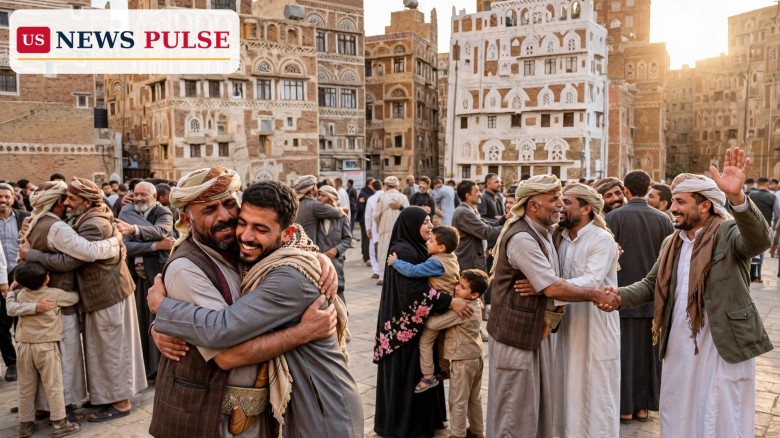
Yemen's Houthi authorities freed 600 detainees in Sanaa on Sunday in the largest unilateral prisoner release of the country's 12-year war, handing men held for years back to their families in a move overseen — but not chosen — by the International Committee of the Red Cross.
Key Points
- The Houthis released 600 conflict-related detainees in Sanaa on Sunday, November 15, 2026 — the largest unilateral release of Yemen's 12-year war, per the Associated Press.
- Red Cross delegates interviewed each detainee privately, checked their health and helped arrange their return home. The ICRC said it did not choose the names or the number freed.
- The release was initiated by the Houthis' National Committee for Prisoners' Affairs, not under the 2018 Stockholm Agreement framework.
- Committee head Abdul Qader al-Murtada said they were fighters from Saudi-backed government forces, captured mainly along the Saudi border in 2018 and 2019.
- The same day, government forces withdrew from Bab el-Mandeb to defend Aden, while a Houthi missile strike in Lahj killed eight and wounded 12, per AFP.
What Happened
The release took place in Sanaa, the capital held by the Houthis since 2014, where the 600 men were freed in a single day. It was the biggest one-sided release of the war, with no exchange: no Houthi prisoners were freed in return. The Houthis said the total freed under their amnesties now stands at 2,612, a figure that could not be independently verified, and the Yemeni government offered no immediate comment. Red Cross delegates were present, but the organisation stressed the limits of its role. Its teams spoke to each detainee alone and checked their health, yet the names and the size of the release were decided by the Houthis. The ICRC's presence verified the men were willing and fit to leave. Also read: Houthis Take Control of Bab el-Mandeb Strait as Yemeni Forces Withdraw.
Background and Context
Yemen's war began in 2014, when the Houthis seized Sanaa and much of the north, and deepened in 2015 when a Saudi-led coalition intervened for the internationally recognised government. Twelve years on, the country remains split — the Houthis hold the capital and the north, the government the south and east, including Aden. The war has killed tens of thousands and left millions dependent on aid. Prisoners have been one of the war's most painful issues. The 2018 Stockholm Agreement created a framework for exchanges, and swaps under it have freed hundreds at a time, including large exchanges in 2020 and 2023. But those were negotiated trades. A unilateral release is different: one side frees prisoners on its own terms — and the Houthis have never done it on this scale.
Houthis Free 600 Detainees: How the Release Was Verified
The Red Cross role is what gives the release its credibility. Before any detainee walked free, ICRC delegates interviewed each man in private, away from his captors, to confirm he understood what was happening and wanted to go home. Medical staff carried out health checks, and the organisation helped arrange the journey home to families not seen for years. The freed men were mostly fighters from Saudi-backed government forces captured on several fronts, above all along the Saudi border in 2018 and 2019, according to al-Murtada. The ICRC was careful to draw a line around its involvement: it did not select the names and did not decide how many would be freed — those decisions belonged to the Houthis' National Committee for Prisoners' Affairs. So the key questions — why these 600 men, and why now — can only be answered by the Houthis.
Reactions and Quotes
Al-Murtada presented the release as a landmark, calling it the largest unilateral prisoner release and pardon operation in the conflict's history. He said the freed men were government fighters captured mainly along the Saudi border in 2018 and 2019. His figure of 2,612 freed in total under Houthi amnesty initiatives could not be independently verified, and the Yemeni government offered no immediate comment. The Red Cross described its work in practical terms — private interviews, health checks, help getting the men home — and made clear it had no part in choosing who was freed. The contrast with the rest of Sunday was stark: while families reunited in Sanaa, a Houthi missile strike hit vehicles carrying families fleeing fighting in Lahj, killing eight and wounding 12 at a checkpoint near Khor Umairah, about 90 km west of Aden, per AFP. Related coverage: Iran Claims Six Drones Hit US Radar Base in Bahrain as Saudi Arabia Downs Houthi Missiles.
Why It Matters
For the 600 families, the release is everything: men captured as long as seven or eight years ago are coming home, in a war where detention has often meant years without contact. For Yemen as a whole, it is a rare moment of de-escalation. Prisoner releases are one of the few confidence-building measures that still work in Yemen — concrete, verifiable and popular on both sides — and a release of this size could open space for further steps, including a return to the Stockholm exchange framework. But the timing cuts both ways. The release came the same day government forces pulled back from Bab el-Mandeb to defend Aden, handing the Houthis a second shipping chokepoint, and the same day a Houthi missile killed civilians fleeing fighting in Lahj. Whether Sunday is remembered as a breakthrough or a goodwill gesture will depend on what follows. Also read: Ukraine and Russia Agree Large-Scale Prisoner Exchange in Abu Dhabi Talks.
What Happens Next
The first test is the Yemeni government's response. If it welcomes the release and answers with a gesture of its own — its own amnesty, or a new round of exchange talks — the Stockholm framework could come back to life after years of stalling. If it dismisses the release or says nothing, the moment will likely pass without changing the war. The second test is on the battlefield: government forces are redeploying toward Aden as the Houthis press south, and the fighting in Lahj shows the war still claims civilian lives on the same days it produces humanitarian gestures. For now, 600 men are home. What happens next depends on whether either side treats that as a beginning.
Frequently Asked Questions
How many detainees did the Houthis free?
600 conflict-related detainees, in Sanaa on Sunday, November 15, 2026 — the largest unilateral release of Yemen's 12-year war, per the Associated Press.
Who were the freed detainees?
Per committee head Abdul Qader al-Murtada, fighters from Saudi-backed government forces, captured mainly along the Saudi border in 2018 and 2019.
What did the Red Cross do?
ICRC delegates interviewed each detainee privately, checked their health and arranged their return home. The ICRC did not choose the names or the number freed.
Was this part of a prisoner swap?
No. The release was unilateral — no Houthi prisoners were freed in return — and it was not part of the 2018 Stockholm Agreement framework.
What else happened in Yemen the same day?
Government forces withdrew from Bab el-Mandeb to defend Aden, and a Houthi missile strike in Lahj killed eight and wounded 12, per AFP.
© 2026 US News Pulse. All rights reserved.
 Print
 Save