
Air Force One Diverted to Fairbanks as Extreme Weather Hits Anchorage - US News Pulse
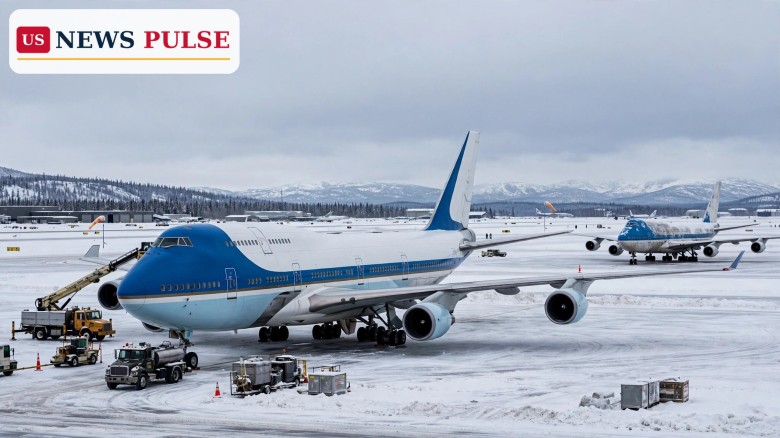
FAIRBANKS, Alaska — Air Force One diverted to Fairbanks, Alaska, on Monday, November 16, 2026, after extreme weather made its planned Anchorage refuelling stop unsafe. The presidential aircraft, the Qatari-gifted Boeing 747 now serving as Air Force One, touched down at Fairbanks International Airport at about 12:30 p.m. Alaska time and was back in the air less than two hours later, continuing to Manila for the ASEAN summit.
Trump did not leave the aircraft, and the older blue-and-white 747 support plane, carrying staff and equipment, was seen on the tarmac alongside the newer jet.
Key Points
- Air Force One was diverted from Anchorage to Fairbanks on Monday, November 16, 2026, by extreme weather in Anchorage.
- The Qatari-gifted Boeing 747 landed at Fairbanks International Airport at about 12:30 p.m. Alaska time and left at about 1:55 p.m.
- The White House said the jet stopped in Fairbanks "in order to refuel under better climate conditions."
- Trump stayed on board during the stop, and an older 747 support plane was parked alongside.
- Trump is travelling to Manila for the ASEAN summit, then to Shenzhen for APEC and a November 19 trilateral with Xi Jinping and Vladimir Putin.
What Happened
Air Force One had been scheduled to refuel at Joint Base Elmendorf-Richardson in Anchorage, the usual Alaska stop for presidential flights crossing the Pacific. But as it approached Alaska on Monday, conditions in Anchorage had deteriorated until the stop was no longer safe, and the flight was redirected to Fairbanks International Airport, a civilian airport about 260 miles to the north.
The press pool reported the touchdown at about 12:30 p.m. Alaska time; ground crews refuelled the jet while the president remained on board, and it departed at about 1:55 p.m. for the Philippines. The stop lasted roughly one hour and 25 minutes. The White House asked reporters to embargo the change until after landing, and its Rapid Response account later confirmed the diversion on X, writing: "AF1 refueled in Fairbanks due to inclement weather in Anchorage."
Background: Trump's Asia Trip and the Qatari Jet
The diversion came on the first leg of a high-stakes Asia trip. Trump is travelling with Secretary of State Marco Rubio, Treasury Secretary Scott Bessent and US Trade Representative Jamieson Greer, first to Manila for ASEAN, then to Shenzhen for APEC on November 18-19. The centrepiece is Thursday, November 19, when Trump sits down jointly with Chinese President Xi Jinping and Russian President Vladimir Putin, the first-ever trilateral of the three leaders, focused on nuclear non-proliferation.
The aircraft at the centre of Monday's diversion is itself part of this presidency's story. The Qatari-gifted Boeing 747 entered service as Air Force One, replacing the familiar older blue-and-white 747s that carried presidents for decades. One of those older aircraft was visible on the Fairbanks tarmac alongside the newer jet on Monday, now a support plane.
Air Force One Diverted: How Alaska's Weather Forced the Change
Alaska in mid-November is deep into winter, and Anchorage can turn hostile quickly, with snow, ice and high winds from the Gulf of Alaska. The White House did not detail the exact conditions, but a White House official was direct about the reason, saying: "Due to extreme weather conditions in Anchorage, Air Force One landed in Fairbanks in order to refuel under better climate conditions."
Diverting a 747 carrying the president is not taken lightly: it needs new ground arrangements, security sweeps at a different airport and a revised flight plan, all arranged while the aircraft is already in the air. That it was done smoothly, with the jet on the ground for less than 90 minutes, speaks to how thoroughly such contingencies are planned. Fairbanks, though a civilian field, regularly handles heavy cargo traffic bound for Asia, and its inland position, away from the coastal storms that batter Anchorage, makes it the preferred alternate.
Reactions and Quotes
The White House moved quickly to explain the change once the aircraft was on the ground. A White House official told travelling reporters it was purely a weather call, saying: "Due to extreme weather conditions in Anchorage, Air Force One landed in Fairbanks in order to refuel under better climate conditions."
The White House's Rapid Response account put it more briefly on X: "AF1 refueled in Fairbanks due to inclement weather in Anchorage." The press pool noted Trump was not seen leaving the aircraft, and nothing suggested the diversion would affect the rest of the trip's schedule.
Why It Matters
On its own, a weather diversion is a footnote. But it is also a vivid illustration of the logistics behind presidential travel. Every presidential journey across the Pacific depends on refuelling stops, secure airports and contingency plans, and Alaska is the linchpin of that chain. When Anchorage weather fails, the whole schedule has to flex, and on Monday it did.
The diversion also put the spotlight, briefly, on the Qatari-gifted 747 now serving as Air Force One: Monday's stop, with the older blue-and-white 747 beside it, was an unusual public sighting of the old and new presidential fleets side by side. Most importantly, the trip itself matters far beyond the diversion: the November 19 trilateral with Xi and Putin is among the most consequential engagements of Trump's second term, with nuclear weapons, trade and the war in Ukraine on the agenda.
What Happens Next
Trump is due in Manila for the ASEAN summit, where he will join the final talks on Tuesday, including discussions on sea disputes. Read more: ASEAN Summit in Manila: Trump to Join Final Talks Tuesday on Sea Disputes.
From Manila, the president travels to Shenzhen for APEC on November 18-19, where the trilateral with Xi Jinping and Vladimir Putin takes place on Thursday, November 19. The White House has said nuclear non-proliferation will top that agenda, though officials have played down expectations of a deal. Read more: Trump-Xi-Putin Trilateral Meeting Confirmed for APEC Summit in Shenzhen.
Trump has also said he may meet North Korean leader Kim Jong Un in China. Read more: Trump Says He May Meet Kim Jong Un in China During Asia Trip This Week. For now, the Fairbanks diversion is behind the president, and the focus returns to the diplomacy.
Frequently Asked Questions
Why was Air Force One diverted to Fairbanks?
Extreme weather in Anchorage made the planned stop at Joint Base Elmendorf-Richardson unsafe, so the jet went to Fairbanks, where conditions were better.
What plane is the new Air Force One?
The Qatari-gifted Boeing 747 now serving as Air Force One. An older blue-and-white 747 travelled alongside as a support plane.
How long did Air Force One stay in Fairbanks?
About one hour and 25 minutes: it landed at about 12:30 p.m. Alaska time on Monday, November 16, 2026, and left at 1:55 p.m.
Where was President Trump travelling to?
To Manila for the ASEAN summit, then to Shenzhen for APEC and a November 19 trilateral with Xi Jinping and Vladimir Putin.
Did the diversion delay the trip?
No significant delay was reported. The jet refuelled in Fairbanks and left the same afternoon for the Philippines, and the White House said the Manila programme was unchanged.
© 2026 US News Pulse. All rights reserved.
 Print
 Save