
DUNE Neutrino Experiment Construction Begins a Mile Underground - US News Pulse
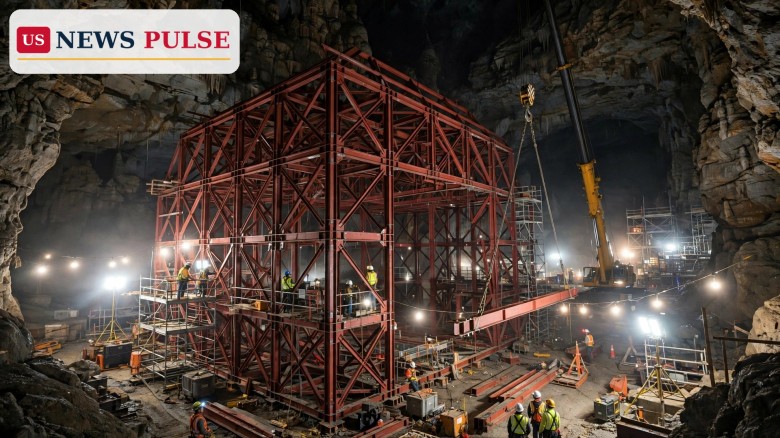
Lead, South Dakota — The DUNE neutrino experiment has taken its biggest step yet from blueprint to reality. Installation crews from Fermilab, CERN and the Sanford Underground Research Facility have begun building the giant cryostats that will hold the experiment's detectors nearly a mile beneath the Black Hills, Fermilab announced November 10, 2026.
The work is happening 4,850 feet below ground at the Sanford Underground Research Facility, known as SURF, in Lead, South Dakota. Thousands of red steel beams are being lowered one by one down a shaft and bolted together into the outer frames of two enormous detector modules. Each cryostat will hold about 17,000 tons of liquid argon cooled to about 300 degrees below zero Fahrenheit. DUNE, the Deep Underground Neutrino Experiment, is a $3.3 billion collaboration of more than 1,500 researchers hosted by Fermilab, aiming to answer why the universe is made of matter at all.
Key Points
- Crews from Fermilab, CERN and SURF began building DUNE's two detector cryostats in early November 2026, nearly a mile underground in Lead, South Dakota.
- Each cryostat will hold about 17,000 tons of liquid argon at about minus 300 degrees Fahrenheit, in a 216-foot frame — longer than a Boeing 747.
- A total of 2,600 red steel beams will form the two cryostats, with more than 6,200 tons of steel supplied by CERN.
- DUNE is a $3.3 billion collaboration of more than 1,500 researchers aiming to explain why matter dominates over antimatter.
What Happened
Construction of the detector cryostats began in early November 2026, Fermilab said. Installation teams from the three partner institutions are working in the South Cavern at SURF, assembling the outer steel structure of the first cryostat module. At the same time, SURF crews have started lowering steel components for the second cryostat into the North Cavern, where assembly is expected to begin in 2027.
Getting the steel underground is itself a major operation. Each of the 2,600 red beams travelled one by one from the surface down a shaft, after arriving in Rapid City from Houston earlier this year. The caverns are vast: the research space is more than 500 feet long and about seven stories tall, and each cryostat is 216 feet long, 62 feet wide and 60 feet high.
DUNE Neutrino Experiment: A Detector a Mile Underground
The DUNE neutrino experiment must be buried so deep because neutrinos are almost impossible to catch. Trillions pass through every person every second without a trace, since they almost never interact with ordinary matter. To spot the rare few that do, physicists need a huge target — tens of thousands of tons of liquid argon — shielded from cosmic rays by nearly a mile of rock.
Each cryostat is a giant insulated container, built like a thermos on an industrial scale. When a neutrino strikes an argon atom, it produces charged particles whose trails can be recorded by sensitive electronics. CERN leads the design, construction planning, logistics and installation, working with a Minnesota-based steel contractor. It is CERN's first major contribution to an experiment outside Europe, drawing on its ProtoDUNE prototype in Geneva.
Background: The Ghost Particles That Could Explain the Universe
Neutrinos are among the most abundant particles in the universe and the least understood. Made in the Sun, in exploding stars and in reactors, they travel at nearly light speed, passing through planets as if they were not there. Scientists discovered in the late 1990s that neutrinos change from one type to another as they travel — a change called oscillation, which proved they have mass and earned the 2015 Nobel Prize in Physics.
DUNE will study that change in detail. Fermilab, near Chicago, will send neutrinos 800 miles through the Earth to South Dakota, while a smaller detector near the source measures them before they set off. Together, the two sites form the Long-Baseline Neutrino Facility. Its three main goals: whether neutrinos and antineutrinos behave differently, the ordering of the three neutrino masses, and catching neutrinos from a supernova.
Reactions and Quotes
Fermilab director Norbert Holtkamp said the start of cryostat construction was a defining moment. "DUNE is Fermilab's top priority," Holtkamp said. "Once underway, DUNE has the potential to help us broaden our fundamental understanding of our universe."
Jolie Macier, project manager for DUNE's far detectors and cryogenics, pointed to the steel's arrival in Rapid City and the start of lowering it underground in Lead. "This brings us one step closer to science," Macier said.
CERN director general Mark Thomson stressed the international character of the work. "Collaboration is in CERN's DNA, and our contribution to DUNE is a brilliant example of cross-organizational partnership," Thomson said. "After years of planning and careful coordination, I am thrilled to see that we are ready to start installation."
Why It Matters
The question DUNE is built to answer — why anything exists at all — is one of the biggest in science. In the first moments after the Big Bang, matter and antimatter should have been created in equal amounts and annihilated each other completely, leaving a universe filled only with light. Instead, a tiny imbalance left behind the matter that became stars, planets and people. Physicists suspect the answer is a subtle difference between neutrinos and antineutrinos, which DUNE is designed to measure precisely.
At $3.3 billion, it is the largest particle physics project ever built in the United States, anchoring decades of research. For South Dakota, it is an economic anchor: the Black Hills, once defined by gold mining, now host a world-class laboratory drawing researchers worldwide and supporting steady, high-skilled jobs.
What Happens Next
Assembly of the first cryostat continues through 2027 in the South Cavern, while work on the second begins in the North Cavern. The underground space should be done by 2029 and the detectors by 2030, when about 1,800 researchers worldwide will begin probing the laws of nature more deeply than ever.
The first neutrino beam from Fermilab is expected in 2031, using the PIP-II accelerator upgrade. Before that, the detectors will already watch the sky: a supernova anywhere in our galaxy would send a burst of neutrinos through them, warning astronomers hours before its light reaches Earth.
Related coverage: Trump's space declaration, Voyager 1's silent two days.
Frequently Asked Questions
What is DUNE?
DUNE is the Deep Underground Neutrino Experiment, a $3.3 billion Fermilab project. It will fire neutrinos 800 miles through the Earth from Illinois to detectors a mile underground in South Dakota.
Why is the experiment a mile underground?
To shield the detectors from cosmic rays, which would swamp the faint neutrino signals. Nearly a mile of rock blocks almost all of them.
What is a cryostat?
A giant insulated container holding liquid argon at about minus 300 degrees. Each of DUNE's two measures 216 by 62 by 60 feet and holds about 17,000 tons of argon.
When will DUNE start taking data?
Underground space due in 2029, detectors in 2030. The first beam is expected in 2031, and the experiment should run into the late 2040s.
What could DUNE discover?
Whether neutrinos and antineutrinos behave differently — which could explain why matter dominates over antimatter — plus the ordering of neutrino masses.
© 2026 US News Pulse. All rights reserved.
 Print
 Save