
USS George Washington Leaves Middle East as US Carrier Force Off Iran Drops to Two
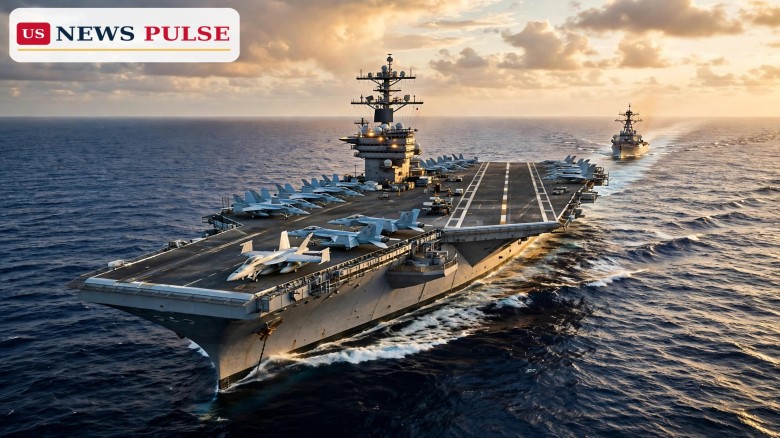
The aircraft carrier USS George Washington has left the Middle East after three months on station, cutting the American carrier force facing Iran back to two strike groups just two days after a third carrier arrived.
A spokesperson for the United States Pacific Fleet confirmed on Wednesday, November 18, 2026, that the Nimitz-class carrier had departed the region and was now operating in the Indian Ocean, ending a brief three-carrier overlap as the war with Iran enters its ninth month.
Key Points
- The Nimitz-class carrier USS George Washington (CVN-73) left the Middle East after three months on station, US Pacific Fleet spokesperson Commander Katie Koenig confirmed on Wednesday, November 18, 2026.
- The Japan-based carrier is now in the US 7th Fleet area in the Indian Ocean, "conducting routine operations", and is likely heading back to its home port of Yokosuka, Japan, Bloomberg reported, citing two US officials.
- The United States is now down to two carrier strike groups in the Middle East: USS Theodore Roosevelt, which arrived on November 15-16, and USS George H.W. Bush, there since April.
- The George Washington arrived in the US 5th Fleet area on August 19, 2026, replacing USS Abraham Lincoln, after deploying from Yokosuka in late May, sailing with escorts USS Robert Smalls and USS Shoup.
- The three-carrier overlap lasted only a couple of days, and US Central Command released footage on November 17 of the Roosevelt and the George Washington sailing side by side in the Arabian Sea.
What Happened
Commander Katie Koenig, a spokesperson for the US Pacific Fleet, confirmed to USNI News on Wednesday that the George Washington had left the Middle East. The carrier is now operating in the 7th Fleet area, which spans the western Pacific and the Indian Ocean.
Bloomberg reported, citing two American officials, that the carrier is likely sailing back to Yokosuka, its home port in Japan. The Navy has not said whether the ship will make a port call on its way east, and it remains part of the wider American naval blockade of Iran even as it leaves the immediate war zone.
Background and Context
The George Washington arrived in the US 5th Fleet area on August 19, 2026, taking over from USS Abraham Lincoln. It sailed with the guided-missile cruiser USS Robert Smalls and the destroyer USS Shoup, and spent three months as one of the main instruments of American pressure on Tehran.
Its stay covered some of the most intense weeks of the conflict. Iran's drone attacks on American bases continued through the autumn, including strikes on Ali Al Salem Air Base in Kuwait and targets in Bahrain, and crude oil flows through the Strait of Hormuz have fallen to about 8.5 million barrels a day, roughly half of prewar levels, according to Kpler.
USS George Washington Leaves After Three Months on Station
The departure does not mean the American naval presence is shrinking in any simple sense. Even with two carriers, the United States still has more than a dozen destroyers, cruisers and a littoral combat ship in the region, and the Roosevelt only just arrived with its full strike group.
But the timing matters. The George Washington is the second carrier to rotate out of the war zone since the fighting began on February 28, 2026, and its departure restores the two-carrier posture the United States held for most of the autumn. For the crew, it begins the long voyage home after a deployment of about six months.
Reactions and Quotes
The Navy's confirmation was brief and factual. Commander Koenig confirmed the departure to USNI News and said the carrier was now in the 7th Fleet area, "conducting routine operations". The Navy has not announced a date for its return to Yokosuka.
Central Command let the imagery speak. Its November 17 footage of the Roosevelt and the George Washington sailing together in the Arabian Sea was released without a detailed statement, but the message was clear: one carrier was arriving as the other prepared to leave. Neither the Pentagon nor the White House has commented publicly on the movement.
Why It Matters
Carriers are the most visible measure of American commitment in the region, and their movements are watched in Tehran, in allied capitals and in oil markets. Three carriers signalled maximum pressure; two is still a formidable force, but it suggests the Pentagon is settling into a sustainable rotation rather than a short surge.
The departure also matters for the ships themselves. Carriers cannot stay on station indefinitely: crews tire, aircraft need deep maintenance, and escorts need resupply. Its rotation home is how the Navy keeps the force credible over a war now in its ninth month with no settlement in sight.
What Happens Next
The George Washington will continue east through the Indian Ocean toward Japan, with the question of a port call still open. Its escorts, the Robert Smalls and the Shoup, are expected to travel with it, and the carrier will return to Yokosuka for maintenance and crew rest.
In the Middle East, the Roosevelt and the George H.W. Bush now carry the carrier mission alone. Their air wings will keep flying over the Arabian Sea and the Gulf of Oman, supporting the naval blockade of Iran and the defence of American bases in Kuwait and Bahrain. Any further change is likely to depend on the diplomacy under way in Shenzhen.
Frequently Asked Questions
Why did USS George Washington leave the Middle East?
It completed a three-month deployment in the US 5th Fleet area, and its departure follows the arrival of USS Theodore Roosevelt, which took over its place in the carrier rotation.
How many US carriers are now in the Middle East?
Two carrier strike groups remain: USS Theodore Roosevelt and USS George H.W. Bush, plus more than a dozen destroyers, cruisers and a littoral combat ship.
Where is the George Washington heading?
Bloomberg reported, citing two US officials, that it is likely returning to its home port of Yokosuka, Japan. The Navy has not confirmed a destination or a port call.
How long was the three-carrier overlap?
Only a couple of days. The Roosevelt arrived on November 15-16, and the George Washington departed on November 18.
Does the departure change the US naval blockade of Iran?
No. The carrier remains part of the wider blockade, and two carrier strike groups continue to operate in the region.
Read more on US News Pulse: USS Theodore Roosevelt Arrives in Middle East as Third US Carrier Joins Iran Standoff, Trump Sends Third Aircraft Carrier Strike Group Toward the Middle East, and Iran Claims Drones Hit US Patriot Systems at Kuwait's Ali Al Salem Base.
© 2026 US News Pulse. All rights reserved.
 Print
 Save