
Trump, Xi and Putin Open First-Ever Trilateral Summit in Shenzhen, China
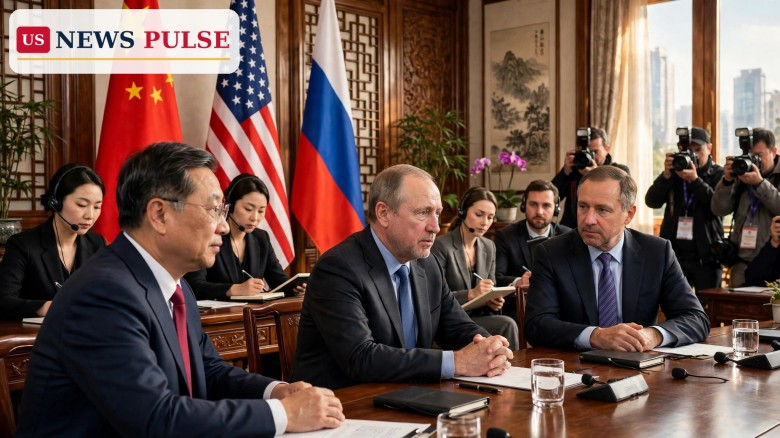
Donald Trump, Xi Jinping and Vladimir Putin sat down together on Thursday, November 19, 2026, for the first-ever trilateral summit between the sitting leaders of the United States, China and Russia. The Shenzhen meeting opened with vows to cut nuclear weapons and end the wars in Ukraine and Iran.
Trump opened by saying the three countries "must safeguard world peace, stability" and must discuss ways to reduce nuclear weapons. Xi, who chaired the meeting, hailed the historic gathering and said healthy interaction between major countries is a must. Putin said the three nations "are capable of making a significant contribution to peace and cooperation in the world." No agreement or joint statement had been reported by the time the three leaders took their seats.
Key Points
- Trump, Xi and Putin began the first-ever trilateral meeting of the three sitting leaders on Thursday, November 19, 2026, in Shenzhen, China, at the Kylin Villa state guesthouse, with Xi chairing.
- Trump opened by saying the world's three largest nuclear powers "must safeguard world peace, stability" and must focus on arms reduction.
- Xi hailed the historic meeting; Putin said the three nations "are capable of making a significant contribution to peace and cooperation in the world."
- Before the session, Trump held a roughly hour-long bilateral with Xi, followed by a working lunch, and a 35- to 40-minute bilateral with Putin, his first talks with Putin since the Alaska summit failed to end the Ukraine war.
- The agenda covers nuclear arms control, with the US-Russia New START treaty expired since February 2026, the war in Ukraine and the war with Iran; no statement had been reported at the start, though the Kremlin said a joint communique was possible.
What Happened
The three leaders gathered at the Kylin Villa for a session on the sidelines of the APEC summit. Xi chaired the meeting, which opened with brief public remarks from each leader before the doors closed. Trump spoke first, framing the gathering around the shared responsibility of the world's three largest nuclear powers, and Xi welcomed the meeting as a historic first.
The session followed a day of bilateral diplomacy. Trump met Xi for roughly an hour, followed by a working lunch, and then held a separate 35- to 40-minute meeting with Putin. US News Pulse reported on the handshake between Trump and Putin at the APEC welcome banquet the night before. SpaceX founder Elon Musk was in the US delegation to China.
Background: How the First Trilateral Came Together
The idea of a three-way meeting between the leaders of the United States, China and Russia has been discussed for years but never happened until now. The APEC summit in Shenzhen provided the occasion: all three leaders were already in the same city, and the meeting was arranged on its sidelines. US News Pulse reported when the trilateral meeting was confirmed, with Ukraine, Iran, nuclear arms and AI on the agenda.
The nuclear question gives the meeting its sharpest edge. The US-Russia New START treaty, the last agreement capping the arsenals of the two largest nuclear powers, expired in February 2026, leaving those arsenals uncapped for the first time in over half a century. China has been expanding its own arsenal and has never been part of a bilateral or trilateral arms-control treaty with the United States and Russia. Bringing all three leaders into one room does not by itself create a new treaty, but it is the first time the three powers holding the overwhelming majority of the world's nuclear weapons have discussed limits together.
Trump Xi Putin Trilateral Summit: What the Leaders Said
The opening remarks set out three different ways of framing the same meeting. Trump framed it as a responsibility that comes with nuclear power, saying the three largest nuclear powers "must safeguard world peace, stability" and must focus on arms reduction, echoing language he has used throughout his Asia trip about the dangers of a new arms race now that New START has lapsed.
Xi framed the meeting as a matter of how great powers should deal with one another, saying healthy interaction between major countries is a must, a line that fits Beijing's argument that rivalry with the United States should be managed rather than allowed to slide into confrontation. Putin kept his remarks short and general, claiming a shared responsibility for global stability while committing Russia to nothing specific on Ukraine or Iran, and reflecting Moscow's interest in a format that treats Russia as an equal partner with the United States and China.
Reactions
The reaction in the hours before the session began was dominated by caution. Officials in all three capitals set low expectations, warning that a single meeting, however historic, was unlikely to produce a breakthrough on Ukraine, Iran or arms control. No agreement or joint statement had been reported by the time the session began, and the Kremlin's suggestion of a joint communique was only a possibility, not a promise.
Why It Matters
The meeting matters first because it happened at all. The United States, China and Russia together hold the overwhelming majority of the world's nuclear weapons, and until Thursday their leaders had never met all three together. With New START expired, there is currently no treaty limiting the nuclear competition between Washington and Moscow, and no framework at all that includes Beijing.
It matters second because of the wars on the agenda. The war in Ukraine has resisted every diplomatic effort so far, including Trump's own Alaska summit with Putin, and the war with Iran has pulled the United States deeper into a conflict with no clear end. A three-way meeting cannot settle either war, but it puts the leaders of the three countries most able to influence both conflicts in the same room.
What Happens Next
The immediate question is whether the session produces anything beyond the opening remarks. The Kremlin said a joint communique was possible, and officials in all three capitals had set low expectations, so the absence of a statement would not by itself mean the meeting failed. Beyond the summit, the test will be what follows.
Frequently Asked Questions
What is the Trump-Xi-Putin trilateral summit?
It is the first-ever meeting between the sitting leaders of the United States, China and Russia, held on Thursday, November 19, 2026, in Shenzhen, China, on the sidelines of the APEC summit, chaired by Xi Jinping.
Where did the trilateral meeting take place?
The meeting took place at the Kylin Villa state guesthouse in Shenzhen, China, after Trump held separate bilaterals with Xi and Putin earlier in the day.
What did Trump say at the opening of the summit?
Trump said the world's three largest nuclear powers "must safeguard world peace, stability" and must discuss ways to reduce nuclear weapons.
What was on the agenda for the trilateral talks?
The agenda covered nuclear arms control, with the US-Russia New START treaty expired since February 2026, the war in Ukraine and the war with Iran, along with trade and limits on military artificial intelligence.
Was an agreement or joint statement announced?
No agreement or joint statement had been reported by the time the session began, though the Kremlin said a joint communique was possible.
© 2026 US News Pulse. All rights reserved.
 Print
 Save