
Senegal Migrant Boat Capsizes Off Yenne Coast With About 100 Aboard, Dozens Missing
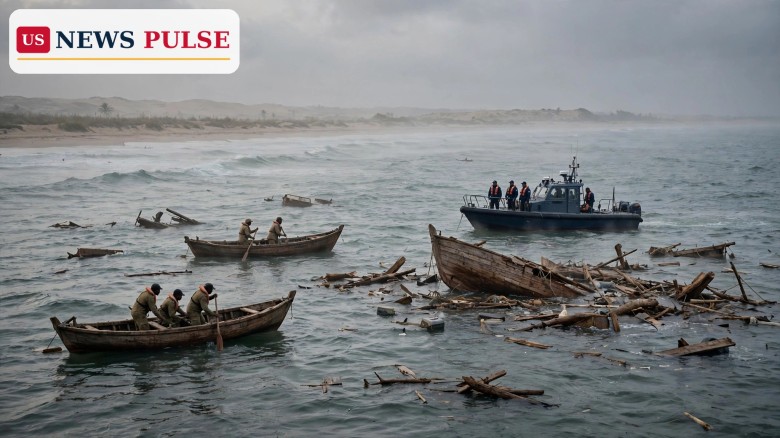
A migrant boat carrying about 100 people capsized off the coast of Senegal in the early hours of Wednesday, leaving dozens of passengers missing and at least four dead, in the second deadly shipwreck off the West African country in less than two weeks. The Senegal migrant boat capsized near the fishing village of Yenne, south of the capital Dakar, at around 2 a.m. local time, and search operations continued through Wednesday before they were due to resume on Thursday.
The badly damaged wooden boat washed ashore near Yenne, where police recovered identity documents, mobile phones and personal belongings from the wreckage, including a school enrolment document. A survivor questioned by police said about 100 people were on board, including five women. Initial reports said one person had died, but local media later reported that at least four bodies had been recovered.
Key Points
- A boat carrying about 100 migrants capsized off Senegal near the village of Yenne, south of Dakar, at around 2 a.m. local time on Wednesday.
- Dozens of passengers are missing and at least four bodies have been recovered, according to local media, after initial reports put the death toll at one.
- A survivor told police about 100 people were aboard, including five women, and the wrecked boat washed ashore with identity documents and phones inside.
- Search operations ran through Wednesday and were due to resume on Thursday, less than two weeks after a shipwreck off Thieppe killed at least 39 people.
- The UN migration agency IOM has recorded at least 454 deaths and disappearances this year on the Atlantic route off the West African coast.
What Happened
The boat went down in darkness off Yenne, a fishing village south of Dakar, at around 2 a.m. local time on Wednesday, November 18. Oumar Sow, a representative of the village chief, told reporters the tragedy unfolded within earshot of the shore. "Cries could be heard coming from the pirogue that were audible even from the beach," the AFP news agency quoted him as saying.
Rescuers and police worked through Wednesday along the coastline near Yenne, searching the water and the beach for survivors and the missing. Officials have not yet said how many people were rescued alive, and the gap between the first official figure of one death and the later local media reports of at least four bodies recovered underlines how uncertain the toll remains while dozens are still unaccounted for.
Background: The Deadly Atlantic Route
The crossing from West Africa to Spain's Canary Islands has become one of the deadliest migration routes in the world. As it has become harder to reach Europe through North Africa, because of tighter controls and closer cooperation between European countries and North African governments, migrants are increasingly turning to the Atlantic, boarding wooden fishing boats known as pirogues that are frequently overloaded and not suited to such long voyages across open ocean.
Most migrants arriving in the Canary Islands this year are from Senegal, according to the United Nations, driven by limited jobs, family pressures and migration networks, the IOM says. The IOM recorded at least 454 deaths and disappearances off the West African coast this year, warning the true toll is likely higher, as many boats vanish without a trace.
Senegal Migrant Boat Capsizes: The Second Tragedy in Two Weeks
The Yenne wreck comes less than two weeks after a shipwreck off the coast of the north-western town of Thieppe killed at least 39 people, in one of Senegal's deadliest migration disasters. That small wooden pirogue, from Saint-Louis and bound for the Canary Islands, capsized off Kebemer near the Lompoul dunes, about 180 kilometres north of Dakar, and was found broken in two. Only one passenger was rescued alive, and the death toll rose to 39 as more bodies were recovered over the following days.
Two disasters of this scale in under a fortnight have shaken a country that was already mourning. After the Thieppe wreck, President Bassirou Diomaye Faye offered his condolences and urged Senegalese people not to risk their lives attempting the dangerous sea crossings. The Yenne tragedy shows that warning has not stopped the boats.
Reactions
At a cabinet meeting on Wednesday, President Faye expressed concern about a renewed increase in irregular departures by migrants hoping to reach Europe. He instructed the interior ministry to prepare a report examining the factors driving the dangerous journeys and proposing measures to tackle the problem, a step that suggests the government is preparing a policy response rather than treating the wreck as an isolated accident.
The IOM has repeatedly warned that the official death tolls understate the real loss of life, as many boats disappear without leaving survivors or a trace.
Read how the earlier Thieppe shipwreck unfolded in our report on the Senegal migrant boat that capsized killing at least 39 people, and how the same dangers claimed lives closer to Europe in the two boats found adrift off Crete with at least 21 dead.
Why It Matters
It matters first because of the human scale. About 100 people were on a single wooden boat, and dozens of them are missing tonight. If the missing are confirmed dead, this would be one of the worst single incidents on the Atlantic route this year, and it would come only days after the country buried 39 people from the Thieppe wreck.
What Happens Next
Search operations were due to resume on Thursday, and the death toll is expected to change as rescuers work the waters and beaches around Yenne. The interior ministry's report ordered by President Faye will be the first test of whether the government moves beyond condolences to new measures against the smuggling networks that organise the departures.
Frequently Asked Questions
How many people were on the boat that capsized off Senegal?
About 100 people, according to a survivor questioned by police, including five women. The boat capsized near the village of Yenne, south of Dakar, at around 2 a.m. local time on Wednesday.
How many people died and how many are missing?
At least four bodies have been recovered, according to local media, after initial reports put the toll at one. Dozens of passengers are still missing, and search operations were due to resume on Thursday.
Where did the boat capsize?
Off Yenne, a fishing village south of Dakar on Senegal's Atlantic coast. The badly damaged boat washed ashore near the village, where police recovered documents, phones and personal belongings.
Why are migrants taking this dangerous route?
As reaching Europe through North Africa has become harder, migrants are increasingly targeting Spain's Canary Islands. Most arrivals there this year are from Senegal, driven by limited jobs, family pressures and migration networks, according to the IOM.
Was there an earlier shipwreck in Senegal recently?
Yes. Less than two weeks earlier, a pirogue capsized off Thieppe in north-western Senegal, killing at least 39 people in one of the country's deadliest migration disasters. Only one passenger was rescued alive.
© 2026 US News Pulse. All rights reserved.
 Print
 Save