
Wall Street Tumbles as Dow Drops 1,101 Points in Sixth Straight Loss - US News Pulse
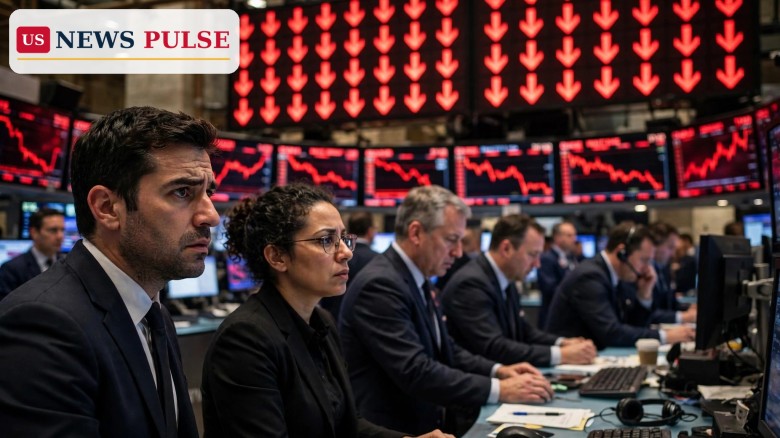
Wall Street tumbled again on Thursday as the Dow Jones Industrial Average dropped 1,101 points and the S&P 500 fell for a sixth straight session, its longest losing streak in two and a half years. Investors dumped AI-linked shares on growing fears that the breathtaking AI boom may finally be over, wiping out an early rally and dragging more than 90 percent of S&P 500 stocks lower. The benchmark index now sits 8.2 percent below its all-time high from last month.
The reversal stunned traders. Stocks opened higher on Anthropic's red-hot Nasdaq debut, with the S&P 500 up as much as 1.3 percent and the Nasdaq up 2.1 percent in the morning. But by the closing bell both had surrendered all of their gains and much more, their biggest blown gains since November 20, 2025.
Key Points
- The Dow dropped 1,101.11 points, or 2.2 percent, to 49,097.06, its first close below 50,000 since June.
- The S&P 500 fell 2 percent to 7,175.83 for a sixth straight loss, its longest losing streak since 2024.
- The Nasdaq sank 2.3 percent to 23,879.20 after giving up an intraday gain of as much as 2.1 percent.
- Nvidia erased an early 4.7 percent gain and closed down 3.3 percent; Micron and CoreWeave swung from sharp gains to steep losses.
- Anthropic closed at $97.17, up 17.1 percent from its $83 IPO price.
What Happened
Thursday began like a celebration. Anthropic sold shares at $83 apiece in its initial public offering, above the $70 to $78 range it had earlier expected, and the stock surged above $115 after it began trading shortly before noon. The strong demand appeared to show faith in the AI revolution remained intact, even after sharp recent drops on worries that prices had shot too high.
But the mood turned quickly. Nvidia erased an early 4.7 percent gain and closed down 3.3 percent. Micron swung from a 7.8 percent rally to a 2.1 percent loss, and CoreWeave from a 10.5 percent leap to a 6.1 percent drop. Williams-Sonoma led the S&P 500 down 15.2 percent on weaker-than-expected revenue, while Walmart sank 1 percent despite beating profit and revenue forecasts.
There were a few winners. Palo Alto Networks climbed 6.4 percent after topping expectations and agreeing to buy Applied Compute in a $4.5 billion all-stock deal, while Everpure rose 4.7 percent on stronger revenue helped by AI offerings. The 10-year Treasury yield fell to 5.04 percent from 5.07 percent as investors sought safety. Two economic reports also disappointed: jobless claims rose slightly, and mid-Atlantic manufacturing growth is slowing.
Background: How the AI Rally Unravelled
For much of the past two years, artificial intelligence was the engine of the American stock market. A small group of chipmakers, cloud providers and software companies drove the S&P 500 to repeated record highs as investors poured money into anything connected to AI. Nvidia became the world's most valuable company on insatiable demand for its AI chips.
That confidence cracked this autumn. First came criticism that AI stocks had gone into a bubble, with doubts that AI could produce enough profit to justify the massive data-centre spending. Then came worries that high interest rates would curb borrowing to fund the industry's growth, and the Democrats' sweeping midterm victories, which raised fears of more AI regulation. Most recently, Jensen Huang suddenly resigned as Nvidia's chief executive, amid reports of a federal investigation into his ties to a former executive suspected of links to Chinese intelligence.
Wall Street Tumbles as AI Fears Deepen
The central question is whether the AI boom is genuinely over, or whether this is a healthy correction after an extraordinary run. The bulls argue that demand for AI computing remains enormous, that the biggest companies are still spending hundreds of billions on data centres, and that earnings continue to grow. Anthropic's debut, closing 17.1 percent above its IPO price, suggests appetite for AI exposure has not disappeared.
The bears argue the numbers no longer add up, pointing to the scale of the spending, borrowing costs above 5 percent on the 10-year Treasury, and the unanswered question of when AI will generate enough revenue to justify the investment. Thursday captured that tension: the morning rally showed investors still want to believe in AI, while the afternoon collapse showed how quickly that belief can evaporate. Abroad, Germany's DAX lost 1.1 percent, while Japan's Nikkei rose 0.7 percent.
Reactions: "A Very Turbulent, White-Knuckle Period"
Dan Ives, an analyst at Yorkville Ives, called the current stretch for AI stocks "a very turbulent, white-knuckle period", capturing the mood on trading floors as Thursday's early gains evaporated. His words reflected a market swinging violently day to day, with sharp rallies followed by even sharper sell-offs.
Others urged calm, noting the S&P 500 is still up sharply from a year ago and that 8 percent corrections are a normal part of bull markets. For ordinary savers, the stakes are real: the S&P 500 sits at the heart of many 401(k) accounts, and an 8.2 percent drop from the record high has cut their value noticeably.
Why It Matters
The six-day streak is the market's clearest verdict yet that the AI boom, as an investment story, is under serious strain. For two years, the promise of artificial intelligence lifted almost everything: stocks, corporate profits, and business and consumer confidence. If that promise is now being repriced, the consequences will reach far beyond trading screens. A falling market can dent consumer spending, which drives about two-thirds of the American economy, and make it harder for companies to raise money, slowing the data-centre building boom that has powered growth.
What Happens Next
Traders will watch Friday's session for any sign buyers are willing to step in. A seventh straight loss would extend the S&P 500's longest losing streak in two and a half years. A strong rebound could suggest Thursday's plunge was a capitulation, the kind of washout that marks a bottom. For now, the message is clear: the easy gains of the AI boom are over, and investors demand proof that the enormous spending on artificial intelligence will pay off.
Frequently Asked Questions
How much did the Dow drop on Thursday?
The Dow Jones Industrial Average dropped 1,101.11 points, or 2.2 percent, to 49,097.06 on Thursday, its first close below 50,000 since June.
How long is the S&P 500 losing streak?
The S&P 500 has now fallen for six straight sessions, its longest losing streak in two and a half years, since 2024, and is down 8.2 percent from its record high.
Why are AI stocks falling?
Investors worry AI stocks rose too far too fast, data-centre spending may not generate enough profit, and high interest rates will raise borrowing costs.
What happened with Anthropic's IPO?
Anthropic priced its shares at $83, above the expected $70 to $78 range. The stock surged above $115 after it began trading and closed at $97.17, up 17.1 percent on its first day.
Read more: Anthropic IPO Opens at $111.50 on Nasdaq Debut, Briefly Passing $2 Trillion | Walmart Q3 Earnings Beat Forecasts as Revenue Hits $188.8 Billion | Dow Sinks 849 Points in Fourth Straight Wall Street Drop
© 2026 US News Pulse. All rights reserved.
 Print
 Save