
European Troops Hold First-Ever Poland Drill for Postwar Ukraine Mission
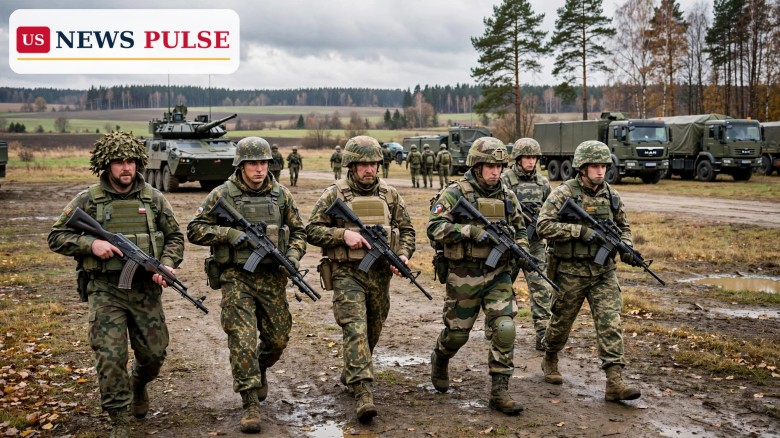
Thousands of European troops are wrapping up an unprecedented two-week military exercise in south-eastern Poland on Sunday, the first time the Coalition of the Willing has rehearsed deploying into Ukraine once the war ends. The European troops Poland drill, known as Exercise Koalicja, brought around 2,800 personnel from nine nations to the Nowa Deba training ground, It ended under a stark reminder of the stakes: two days earlier, suspected Russian missiles and a jet-powered drone landed within tens of kilometres of the site.
Key Points
- Exercise Koalicja ran from November 9 to 22, 2026, at the Nowa Deba training ground in south-eastern Poland.
- Around 2,800 troops from nine nations took part, with Poland backing the exercise and Turkey joining remotely.
- First Coalition of the Willing test of deploying in Ukraine after the fighting stops, after 12 months of planning.
- Macron said 1,100 French troops were deployed, with land, air and maritime operations in about a dozen countries.
- On Friday, two suspected Russian missiles and a jet-powered drone landed in Poland near the drill site.
What Happened
The exercise began on Monday, November 9, and concludes on Sunday, November 22, after two weeks of training at Nowa Deba, one of Poland's largest military training areas, close to the Ukrainian border. Troops rehearsed moving a multinational force into a country emerging from war. The non-NATO force is led by France and the United Kingdom, part of the wider 37-nation Coalition of the Willing. Planning was done by the Multinational Force-Ukraine, known as MNF-U, which spent 12 months preparing the exercise.
President Emmanuel Macron said on Thursday, November 19, that France had deployed 1,100 troops, with land, air and maritime operations under way across about a dozen active countries. The largest single contingent, reflecting France's leading role alongside Britain. British, German, Spanish, Dutch, Swedish, Lithuanian, Estonian and Belgian units trained alongside them.
Background and Context
The Coalition of the Willing took shape as European governments concluded they could not rely on the United States alone to guarantee Ukraine's security after any ceasefire. The group, now 37 nations strong, has spent the past year working out what a postwar force would look like: troop numbers, command, rules of engagement and the American backstop. Its Berlin summit earlier this month brought more than 30 leaders together, including President Volodymyr Zelenskyy.
That work runs alongside a diplomatic push. United States envoys Steve Witkoff and Jared Kushner have been shuttling between Kyiv, Moscow and European capitals, and Kushner said in Berlin that Russia was "comfortable" with the idea of NATO-style, Article 5-like security guarantees for Ukraine. Washington has also floated Ukraine ceding territory for NATO membership, which Kyiv firmly resists. Britain announced a £260 million drone package at the Berlin summit, as capitals race to fill a roughly 70 billion euro funding gap for Ukraine in 2027.
European Troops Poland Drill: What the Exercise Tested
At its core, Koalicja tested deployment, not combat. The scenario assumed hostilities had ceased and the force was moving into Ukraine to stabilise the country and help rebuild its armed forces. That meant practising cross-border movement, headquarters setup, secure communications and joint air and naval coordination.
Two missions in particular were rehearsed. The first was reopening Ukrainian airspace, closed since the invasion began, requiring air-defence coordination and air-traffic management. The second was clearing mines from the Black Sea, where drifting mines have threatened shipping and the export of Ukrainian grain for years. It also tested the command structure: the Multinational Force-Ukraine directing a dozen nations with different chains of command.
Reactions and Quotes
President Macron, announcing the French deployment on Thursday, put the scale of the effort in plain terms: 1,100 French troops were deployed, he said, with land, air and maritime operations running across about a dozen active countries. It underlined that France is prepared to put its own soldiers on the ground in a postwar Ukraine.
Polish officials struck a sterner note after Friday's incident, when two suspected Russian missiles and a jet-powered drone landed on Polish territory during Russia's overnight barrage of Ukraine. Polish Defence Minister Wladyslaw Kosiniak-Kamysz said Warsaw and its allies suspect "intentional provocation", adding that "it does not look like an accident". One missile landed less than a two-hour drive from the drill site, as Polish F-16s and Swedish Gripens stayed airborne. The episode, covered in full by US News Pulse, underlined why the exercise matters to Warsaw, and air-raid alerts went out in 20 districts on Friday night.
Why It Matters
The drill matters because it moves the postwar debate from communiqués to capability. For two years, talk of a European force for Ukraine has been mostly diplomatic: pledges, summits and working groups. Koalicja is the first time thousands of troops have physically rehearsed the mission, and the first time the coalition's command structure has been tested in the field. That gives the idea new credibility.
It also matters because of where it happened. Holding the exercise in Poland, within tens of kilometres of where Russian missiles landed on Friday, was a deliberate choice, showing Europe will train on NATO's eastern flank while Russia attacks Ukraine. And it matters for the peace talks: as American envoys press for a deal, European leaders can now argue that they have a force ready to secure it, strengthening their hand in negotiations over guarantees and territory.
What Happens Next
The exercise wraps up on Sunday, November 22, and the lessons learned will be fed back into the Multinational Force-Ukraine's planning over the coming weeks. Planners will assess communications between contingents and heavy-equipment logistics. Diplomatically, the focus shifts back to the peace talks: American envoys are expected to continue their shuttle diplomacy, and European leaders are pressing for a further coalition meeting before the end of the year.
No deployment can happen until hostilities cease, and no ceasefire is yet in sight, despite months of talks in Abu Dhabi, Berlin and elsewhere. The force rehearsed in Poland will remain a plan, not a presence, until a deal is signed. Poland has asked for more allied aircraft and air defences after Friday's incident.
Frequently Asked Questions
What is Exercise Koalicja?
A two-week exercise in south-eastern Poland, November 9 to 22, 2026, in which 11 European nations rehearsed deploying into Ukraine after the war ends.
Which countries took part?
Belgium, Estonia, France, Germany, Lithuania, the Netherlands, Spain, Sweden and the United Kingdom. Poland provided logistics; Turkey joined remotely. France sent the largest contingent, 1,100 troops.
Will European troops deploy to Ukraine now?
No. The force would only deploy after hostilities cease, and only under a political agreement. The exercise was a rehearsal, not a deployment.
What happened near the exercise on Friday?
Two suspected Russian missiles and a jet-powered drone landed in Poland near the Nowa Deba training ground. No one was injured, but Warsaw suspects deliberate provocation.
What is the Coalition of the Willing?
A 37-nation group, led by France and the United Kingdom, planning a postwar security force for Ukraine. It is a non-NATO initiative.
Related coverage: Kushner Says Russia 'Comfortable' With Article 5 Ukraine Guarantees and UK Ukraine Drone Package: £260 Million for 1,000 Long-Range Drones at Berlin Summit.
© 2026 US News Pulse. All rights reserved.
 Print
 Save