
Nigeria Boat Capsize Kills at Least 24 Mourners on Way to Funeral in Bayelsa
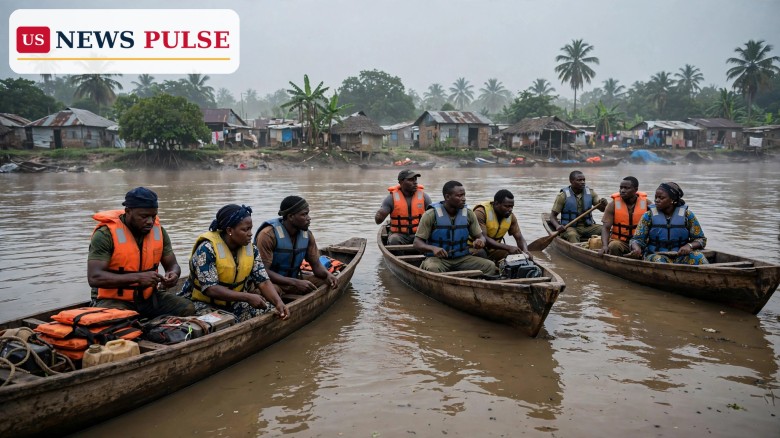
YENAGOA, Nigeria — At least 24 people drowned when an overcrowded boat carrying mourners to a funeral capsized in southern Nigeria, emergency officials said on Saturday, in the latest deadly accident on the country’s inland waterways. The Nigeria boat capsize happened on Friday in Bayelsa State, and rescuers were still searching the river on Saturday as families waited for news of the missing.
Nigeria’s National Emergency Management Agency (NEMA) said 24 bodies had been recovered and 24 survivors rescued by Saturday. Police at first reported only four deaths, before the scale of the disaster became clear.
Key Points
- At least 24 people died and 24 were rescued after a boat carrying mourners capsized on Friday in Bayelsa State, southern Nigeria; the search continued on Saturday.
- The boat was travelling from Ayama to the Ukubie community for a burial ceremony when it went down at the river junction between the Oweikorogha and Otuan communities in Southern Ijaw district.
- Police first reported four deaths and blamed a mechanical failure. Two children were among the four bodies first recovered.
- Of the 24 rescued, 19 were treated at a local clinic and five taken to hospital in Yenagoa. Residents told Reuters at least 300 people were on board; police have not confirmed a total.
- Bayelsa Governor Douye Diri visited the scene on Saturday and ordered an investigation, saying the accident should not have happened if government at every level had done its job.
What Happened
The boat left Ayama on Friday carrying mourners bound for a burial in the Ukubie community. It capsized at the junction of the rivers between the Oweikorogha and Otuan communities, in the Southern Ijaw district of Bayelsa State, a riverine area in the Niger Delta where boats are often the only way to travel between villages.
Police said the boat suffered a mechanical failure. The first four bodies recovered included two children. As the day went on, the official toll climbed from four to 24, and rescue teams kept working through Saturday.
NEMA officials, police and local residents worked together on the rescue. Survivors were pulled from the water; 19 were treated at a local clinic and five taken to hospital in Yenagoa. The search continued on Saturday for anyone still unaccounted for.
One question hangs over the rescue: how many people were actually on the boat? Only 48 are accounted for — 24 dead and 24 rescued — yet residents told Reuters at least 300 were on board. Police have not confirmed a total, and no passenger list is known to exist.
Background: Life on the Water in Bayelsa
Bayelsa sits in the heart of the Niger Delta, a maze of creeks and rivers where roads are few and boats carry people, goods and the dead to their burials. For many communities, the river is the road, and a funeral in a neighbouring village means a crowded boat, not a bus.
That dependence makes the waterways dangerous. Boat accidents are common on Nigeria’s inland waterways, where overcrowding is widespread and safety rules are often flouted. Ageing wooden boats, missing life jackets and weak enforcement combine into a pattern that repeats year after year.
Funerals, festivals and market days put extra pressure on the system. Large groups travel together, and operators paid per passenger take on more people than a vessel can safely carry. When something goes wrong, there are too many people and too few life jackets for a safe escape.
“Nigeria Boat Capsize” and the Overcrowding Question
The gap between the official count and the residents’ estimate is the heart of this story. If 300 people really were aboard one boat, it was carrying many times its safe load, and the mechanical failure cited by police is only part of the explanation. An overloaded boat sits lower in the water and is far more vulnerable when an engine fails.
The governor’s investigation will have to answer basic questions: what was the boat’s condition, what was its capacity, how many people boarded, and who was responsible for letting it sail. Without a manifest, investigators must rely on survivors and families to reconstruct the passenger list, a slow and painful process that can leave the true toll uncertain for days.
Reactions: “This Should Not Have Occurred”
Governor Douye Diri visited the scene on Saturday and ordered an investigation into the accident. He was blunt about where the blame may lie, saying the accident “should not have occurred if every department of government at the federal, state and local government diligently did their job.” The remark points the finger not only at the boat’s operator but at the officials supposed to keep the waterways safe.
NEMA is coordinating the search and rescue, and state officials are supporting the survivors and bereaved families. For Ayama and Ukubie, the loss is doubled: they set out to bury one of their own and lost many more on the way.
Why It Matters
This disaster exposes the enforcement gap on Nigeria’s waterways. Rules on passenger limits, life jackets and boat inspections exist, but on remote creeks there is little inspection and less consequence for breaking them. Each accident follows the same pattern, and each one fades before the next.
It also matters because of what is still unknown. Without a passenger list, families cannot be sure whether their relatives are among the dead, the rescued or the missing. That uncertainty is itself part of the tragedy, and it is a direct result of a system in which boats sail without records of who is aboard.
What Happens Next
The search continues on the river, and the death toll may still rise as rescuers work through the wreck and the surrounding water. The governor’s investigation will determine the cause and who bears responsibility, and its findings will be watched for whether they lead to prosecutions or to new safety measures.
The wider question is whether this accident changes anything. Safety advocates have long called for enforced passenger limits, mandatory life jackets and regular boat inspections. Until those measures are enforced on the creeks of Bayelsa, the next crowded boat carries the same risk.
Frequently Asked Questions
How many people died in the Nigeria boat capsize?
At least 24, according to NEMA, with 24 survivors rescued. The search was still under way on Saturday, so the toll could rise.
Where did the boat capsize?
At the river junction between the Oweikorogha and Otuan communities in Southern Ijaw district, Bayelsa State, southern Nigeria.
Who was on board the boat?
Mourners travelling from Ayama to the Ukubie community for a burial ceremony. Two children were among the first four bodies recovered.
What caused the boat to capsize?
Police said the boat suffered a mechanical failure. An investigation ordered by Governor Douye Diri is under way, and residents say at least 300 people may have been on board.
Why are boat accidents so common in Nigeria?
Overcrowding is widespread, boats are often old and poorly maintained, life jackets are rarely worn, and safety rules are weakly enforced.
Related coverage: US sanctions Iran missile network spanning Belarus, Russia and Nigeria and US basketball player Greene arrested in Nigeria with 75 pounds of cannabis.
© 2026 US News Pulse. All rights reserved.
 Print
 Save