
S&P 500 Surges Nearly 5% and Nasdaq Jumps 7% in Historic Market Rebound
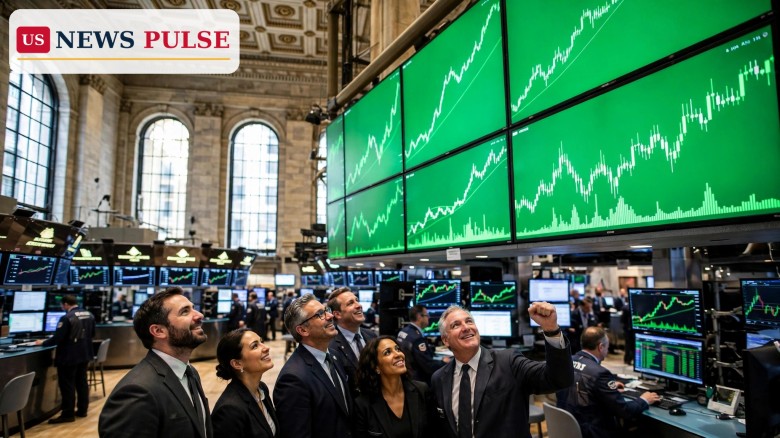
New York — United States stocks staged a historic rebound on Monday, November 23, 2026, as the S&P 500 leapt nearly 5% and the Nasdaq Composite surged 7% in early trading, powered by Nvidia's decision to reinstate Jensen Huang as chief executive. The rally followed the worst week for the major indexes since April 2025.
Key Points
- The S&P 500 leapt nearly 5% — 4.8% per Barron's — at Monday's open, while the Nasdaq Composite surged 6.9% and the Dow rallied 1,350 points (2.7%).
- Nasdaq-100 futures jumped 6.9% premarket and S&P 500 futures 4.3%, briefly tripping a Nasdaq 100 futures circuit-breaker.
- Nvidia shares jumped about 30% premarket after the chipmaker reinstated Jensen Huang as CEO, reversing his November 12 resignation.
- Marvell and Micron rose over 14% each; AMD 8%; Broadcom 5.4%; CoreWeave 27%; Anthropic 3-4% after Friday's 8.5% fall.
- Alphabet and Tesla each gained roughly 7%; Amazon, Meta and Microsoft each rose about 5%.
What Happened
Stocks surged from the opening bell, and the scale was clear before trading began. Nasdaq-100 futures jumped 6.9% premarket and S&P 500 futures 4.3%, and the buying briefly tripped a Nasdaq 100 futures circuit-breaker, which pauses trading when prices move too far too fast. At the open, the S&P 500 leapt nearly 5%, the Nasdaq Composite surged 6.9% and the Dow rallied 1,350 points, according to the Associated Press at 9:31 a.m. Eastern and Barron's live coverage.
Nvidia was the spark. Its shares jumped about 30% premarket after the board reinstated Huang as president, chief executive and board director, ending an 11-day leadership vacuum at the company whose processors power most of the world's artificial intelligence systems. The buying then spread through the chip sector and the wider market: Marvell and Micron each rose over 14%, AMD gained 8%, Broadcom 5.4% and CoreWeave 27%, while Anthropic rose 3-4% and Alphabet, Tesla, Amazon, Meta and Microsoft all climbed.
Background and Context
The rebound followed a brutal stretch. Last week was the worst for the major indexes since April 2025: the Nasdaq fell 10%, including a 5.3% plunge on Friday, while the S&P 500 and the Dow each lost over 8%. The S&P 500 and the Dow fell into correction territory, down more than 10% from their October 6 peak, the Nasdaq moved into the red for 2026, and the S&P 500 was on a seven-day losing streak, its longest since February 2020.
The sell-off was driven by doubts about heavy AI infrastructure spending, which spread from chip stocks to the broader market and wiped out the post-midterm rally. The $6 trillion slide also became political, with President Donald Trump blaming Democrats. Nvidia sat at the centre: Huang resigned on November 12 after revelations of extramarital affairs, including one with a businesswoman US authorities suspect of links to China's Ministry of State Security, an allegation Beijing denies. Its shares lost a third of their value in two weeks, falling nearly 50% from the October 6 peak.
S&P 500 Rebound: What Drove the Surge
The immediate trigger was Nvidia's announcement before the open. Reinstating Huang removed the leadership uncertainty hanging over the most important company in the AI supply chain, and investors responded before the bell, sending Nvidia shares up about 30% premarket and lifting every chip stock sold off alongside it.
But the scale of Monday's move — the S&P 500 up nearly 5%, the Nasdaq almost 7% — showed the market was reacting to more than one company's news. The previous week's selling had been broad and indiscriminate, and Monday's buying was equally broad, suggesting investors decided the sell-off had gone too far and the AI spending boom they had doubted a week earlier was still intact.
Reactions and Quotes
Huang struck a forward-looking note in Nvidia's statement. "I am honored to return to Nvidia and lead one of the most consequential technology companies in the world at the beginning of a new industrial revolution," he said — signalling he intends to pick up where he left off rather than govern as a caretaker.
The market's reaction was the loudest verdict. A petition calling for Huang's reinstatement drew more than 180,000 signatures, including Elon Musk's, and Trump's public backing on Sunday added pressure on the board, whose statement cited input from senior US officials. The morning reports from the Associated Press and Barron's carried no trader or analyst quotes, focusing on the figures.
Why It Matters
The rebound matters because the sell-off had started to feel like more than a correction. The S&P 500 and the Dow were in correction territory, the Nasdaq was down for the year, and the seven-day losing streak was the longest since February 2020, the month before the pandemic crash. A market that falls that far that fast can feed on itself, as investors sell to avoid further losses and companies delay spending and hiring.
Nvidia matters far beyond its own shareholders: its graphics processors are the backbone of the AI boom, and its customers include every major US cloud provider and AI laboratory. The rally also matters for millions of Americans whose retirement savings track the stock market — the S&P 500 is the benchmark for most pension funds and 401(k) plans, and a 5% one-day gain is among the largest in the index's history.
What Happens Next
The immediate question is whether the gains hold into the close and through a holiday-shortened week. Thanksgiving falls on Thursday, November 26, so the market closes that day and trades a short session on Friday, and thin holiday trading can exaggerate moves in either direction. Investors will watch whether the breadth of Monday's rally survives the week.
Huang's return also leaves unfinished business: the board's investigation into reporting that he was the target of a foreign intelligence effort continues, the Justice Department probe of Alice Huang and Megaspeed is ongoing, Congress has subpoenaed Huang, and the SEC's accounting examination remains open. If the rally holds, Monday may be remembered as the day the market found its floor.
Frequently Asked Questions
How much did the S&P 500 rise on Monday?
It leapt nearly 5% — 4.8% per Barron's — in early trading on Monday, November 23, 2026, after falling into correction territory last week.
How much did the Nasdaq rise?
The Nasdaq Composite surged 6.9% in early trading, while Nasdaq-100 futures had jumped 6.9% before the open, briefly tripping a circuit-breaker.
Why did stocks rebound?
Nvidia reinstated Jensen Huang as CEO before the open, ending an 11-day leadership crisis, and its shares jumped about 30% premarket, spreading the rally across chip stocks and the wider market.
How much did Nvidia shares rise?
About 30% in premarket trading — 29-30% by different reports — after losing a third of their value in the two weeks since Huang resigned.
What happened to the market last week?
The Nasdaq fell 10%, including a 5.3% plunge on Friday, while the S&P 500 and the Dow each lost over 8% and fell into correction territory.
Read more: Nvidia Reinstates Jensen Huang as CEO as Shares Surge 31%; Nasdaq Crashes 5.3% as Chip Stocks Plunge; Trump Blames Democrats for $6 Trillion Market Slide as Nasdaq Drops 20%.
© 2026 US News Pulse. All rights reserved.
 Print
 Save