
DEA Let 1.4 Million Fentanyl Pills Go Unseized in Hunt for Record Bust
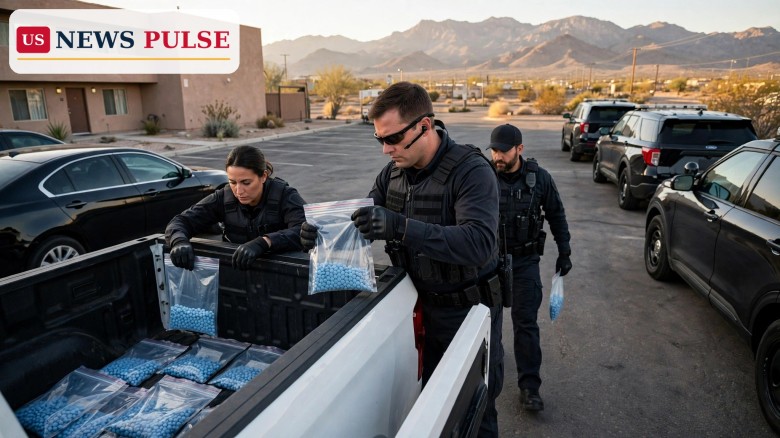
An Associated Press investigation published on Tuesday, November 24, 2026, found that the Drug Enforcement Administration let at least 1.4 million counterfeit fentanyl pills go unseized as it closed in on the largest fentanyl bust in United States history. The pills were allowed to reach the streets between August 2024 and April 2025 while agents tracked a trafficking ring across six states, and almost all of them remain unaccounted for today. The AP based its tally on thousands of pages of court documents, detailed wiretap reports, investigative records and 12 hours of DEA surveillance footage.
Key Points
- The DEA permitted at least 1.4 million additional fentanyl pills to be trafficked between August 2024 and April 2025, the AP investigation found.
- Agents watched a buyer leave an Albuquerque hotel with a backpack holding up to 100,000 pills in August 2024 and did not intervene.
- The ring was allegedly led by Heriberto Salazar Amaya, 38, whose network prosecutors say generated as much as $2 million a month in sales.
- Almost all of the pills remain unaccounted for, and overdose deaths from fentanyl in New Mexico spiked 44 percent last year.
- The reporting has prompted a congressional oversight inquiry, a criminal investigation by New Mexico's attorney general and a Justice Department inspector general review.
What Happened
On a Sunday in August 2024, federal agents staked out the parking lot and lobby of a Home2 Suites hotel in Albuquerque, New Mexico, while a surveillance plane circled overhead. At 2:24 p.m., a buyer arrived in a white pickup, greeted a mohawked courier and went inside. Eight minutes later, the two men left separately into the blazing sun, one of them carrying a backpack stuffed with as many as 100,000 potentially lethal counterfeit pain pills. The DEA did not pounce. Eight months passed before agents finally dismantled the ring that was flooding the Southwest with fentanyl.
Background: How the DEA's "Walk" Tactic Works
The DEA has long allowed traffickers to keep operating under strict surveillance when agents believe they are moving cocaine, heroin or marijuana, hoping not to spook bigger targets. The strategy is known as letting drugs "walk." Fentanyl, however, was supposed to be different. The drug is so dangerous that the DEA for years ran a public safety campaign with the slogan "One Pill Can Kill." In 2017, the Justice Department began instructing agents to seize fentanyl whenever "practicable," since even unintentional contact can prove deadly. But officials loosened those rules in 2024 to give agents more discretion, even after DEA whistleblower David Howell questioned the morality and effectiveness of letting fentanyl hit the streets. This is not the first time the tactic has come to light. In June, the AP revealed that agents in New Mexico in recent years had permitted hundreds of thousands of fentanyl pills to go unseized.
DEA Let 1.4 Million Fentanyl Pills Go Unseized: The Evidence Trail
The investigation was extensive and required finesse as agents eavesdropped on the network's every move. They set up covert cameras on residential streets and self-storage facilities, once nearly blowing the surveillance when a DEA technician stood shoulder to shoulder with a courier in the elevator of an Albuquerque Extra Space storage site. The DEA confirmed Salazar Amaya's identity through a series of ruse calls, including one in which agents at a Las Vegas eatery secretly filmed him answering a call from a woman asking about a washer and dryer for sale. "You have the wrong number," Salazar Amaya answered before hanging up. In recordings of intercepted phone calls reviewed by the AP, the soft-spoken Salazar Amaya sounded more like a switchboard operator than a cartel kingpin. Using a string of aliases and 14 phones, he could be heard taking orders and dispatching couriers to deliver large orders of drugs to major dealers from Phoenix to Denver.
Reactions and Quotes
The findings drew sharp criticism from former DEA officials and from New Mexico's governor. "Everybody wants the big fish, but the big fish isn't guaranteed," said Brian Besser, a former DEA senior executive who oversaw the agency's Rocky Mountain division. "When you're dealing with a substance that can take this much human life, you can't gamble like that." Kevin Small, a former colleague of whistleblower David Howell, was blunter. "Agents are driving around in a car plastered with 'One Pill Can Kill' and at the same time walking hundreds of thousands of pills of fentanyl," Small said. "They're hypocrites." New Mexico Governor Michelle Lujan Grisham, a Democrat, accused the agency of covering up its mistakes. "This is like trying to prevent my house from burning down by negotiating with an arsonist," she said in an interview, referring to the DEA.
Why It Matters
The stakes in this case are measured in lives, not just pills. Fentanyl is the deadliest drug in American history, and the 1.4 million pills the DEA allowed through were enough to kill many times over, given that a dose of just two milligrams can be lethal. Almost all of them remain unaccounted for, and the DEA has chalked up the loss to the need to safeguard a sensitive investigation as agents sought to trace the source of the fentanyl back to Mexico.
What Happens Next
Three investigations are now running in parallel. Congress is conducting an oversight inquiry, New Mexico's attorney general has opened a criminal investigation, and the Justice Department's inspector general is reviewing the DEA's decisions. Any of them could force the agency to explain, in detail, why it chose surveillance over seizure at each of the moments the AP documented.
Frequently Asked Questions
How many fentanyl pills did the DEA let go unseized? The AP found the DEA permitted at least 1.4 million additional counterfeit fentanyl pills to be trafficked between August 2024 and April.
Who led the trafficking ring? Prosecutors say the ring was allegedly led by Heriberto Salazar Amaya, 38, a Mexican national who had been on the DEA's radar.
Why did the DEA let the pills go? The agency was using a tactic known as letting drugs "walk," keeping traffickers under surveillance in the hope of reaching bigger targets.
What investigations followed the AP's reporting? The reporting prompted a congressional oversight inquiry, a criminal investigation by New Mexico's attorney general and a review by the Justice Department's.
How has New Mexico responded? Albuquerque declared a state of emergency and sued the Justice Department last week for $153 million in damages, after fentanyl overdose deaths.
Related coverage: Operation TorNado: 354 arrested in global dark web fentanyl crackdown; Mexico will try El Chapo Isidro at home despite US extradition request; US opioid deaths fall to lowest in nearly a decade, HHS says.
© 2026 US News Pulse. All rights reserved.
 Print
 Save