
Amazon Workers Strike in 20 Countries on Black Friday in Make Amazon Pay Action
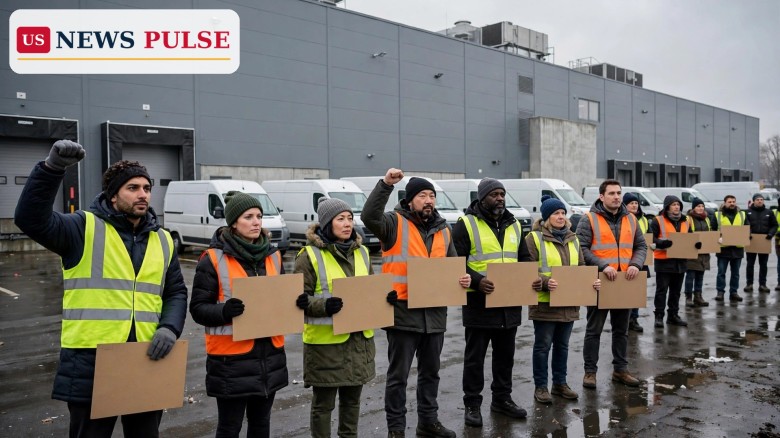
Amazon workers are striking and rallying in more than 20 countries from Black Friday, Friday, November 27, 2026, through Cyber Monday, in the annual Make Amazon Pay days of action. The campaign, co-convened by UNI Global Union and Progressive International, is pressing the world's largest online retailer for decent wages, safe work, union rights, fair taxation and action on climate. The action lands on Amazon's busiest shopping weekend of the year, when warehouses and delivery networks run at full capacity.
Key Points
- Amazon workers are striking in more than 20 countries from Black Friday to Cyber Monday, November 27-30, 2026.
- Make Amazon Pay demands decent wages, safe work, union rights, fair taxation and climate action.
- In the US, the Teamsters will rally on Cyber Monday in Los Angeles and Chicago for a Delivery Protection Act making Amazon hire its delivery drivers directly.
- Workers at 11 Amazon sites in Germany are striking on Friday, with actions also planned in India, Canada and Japan.
- It follows the first binding Amazon union contract anywhere in North America, won two weeks ago by about 800 workers in British Columbia.
What Happened
The Make Amazon Pay days of action began on Friday, November 27, 2026, as Black Friday sales began. Workers and supporters are striking and rallying in more than 20 countries through Cyber Monday on November 30. In Germany, workers at 11 Amazon sites are striking on Friday, and actions are also planned in India, Canada and Japan.
In the United States, the Teamsters will rally on Cyber Monday in Los Angeles and Chicago. The Los Angeles rally is at the DLX5 facility, 4841 West San Fernando Road, from 9 a.m. PT; the Chicago rally is at the Goose Island facility, 1237 W. Division Street, from 9 a.m. CT. The Teamsters want Chicago to pass a Delivery Protection Act making Amazon hire its delivery drivers directly, rather than using third-party delivery firms.
Background and Context
Make Amazon Pay is now an annual Black Friday fixture and one of the largest coordinated labour actions against a single company anywhere. Its demands span pay, safety, union recognition, tax and climate: organisers argue Amazon's size gives it responsibilities beyond the warehouse floor. Amazon has also been in the news this month: it agreed to buy AI chip startup Decart's technology for $7.5 billion, 155 child safety groups urged it and eBay to halt AI chatbot toy sales, and a threatened Los Angeles and Long Beach ports strike was averted by a tentative deal.
The campaign arrives with fresh momentum from Canada. Two weeks ago, warehouse workers at Amazon's YVR2 centre in Delta, British Columbia, won the first binding union contract for Amazon workers anywhere in North America: about 800 members of Unifor, Canada's largest private-sector union, won a three-year deal set by an independent arbitrator. Amazon has resisted unionisation across North America for years, so a binding contract in one country changes the argument everywhere.
In the United States, the legal backdrop is also shifting. In April, the National Labor Relations Board ordered Amazon to recognise and bargain with the union at its JFK8 warehouse on Staten Island. Amazon is contesting that order in federal court, so those workers still have no contract. The dispute over who counts as an Amazon employee runs through the campaign: in Chicago, the Teamsters argue that drivers who wear Amazon uniforms, drive Amazon-branded vans and follow Amazon routes should be Amazon employees, with employee pay and protections.
Amazon Black Friday Strike: What the Workers Want
The demands are deliberately broad and the same in every country. Workers want decent wages, safer work in warehouses where algorithms and targets set the pace, and the right to organise without retaliation. They also want Amazon to pay fair tax and act on climate.
In Germany, workers at 11 sites are walking out on Friday, the busiest day in Amazon's German calendar, in a years-long dispute over pay and working conditions. In India, Canada and Japan, the actions take different forms, but the demands are the same.
Reactions and Quotes
Amazon said it "recognises the right of employees to organise" and is committed to safe workplaces and fair compensation. The company argues it already pays competitive wages and offers benefits, and that most workers do not want union representation. That position is now being tested in court, where Amazon is challenging the order to bargain at JFK8, and in Chicago, where the Teamsters want the Delivery Protection Act.
The organisers present the action as a global response to a global employer. UNI Global Union and Progressive International argue Amazon's model depends on the same workers everywhere, and only coordinated pressure can change it. The British Columbia contract is their strongest evidence: a binding deal, set by an independent arbitrator, for first-time union workers.
Why It Matters
The strike matters first because of who is striking. Amazon employs more than a million people worldwide, and its warehouses and delivery networks are now basic infrastructure in the United States and many other countries. When they stop, the effect is felt in sales figures and in homes waiting for parcels.
It matters second for what it says about the future of work. Amazon's model, built on subcontracted drivers, algorithm-set warehouse targets and a vast logistics network, has become the template for the modern economy. Whether drivers are employees or contractors, and whether warehouse workers can bargain collectively, go far beyond one retailer.
What Happens Next
The action runs through Cyber Monday, November 30, when the Teamsters rallies in Los Angeles and Chicago will be the most visible US events. The Chicago push for a Delivery Protection Act will be watched closely: if it passes, other cities could follow, and Amazon's delivery model would face a new legal challenge in its largest market.
Beyond the weekend, the tests are the JFK8 case and the next round of bargaining in Canada. If Amazon loses its challenge, it must bargain with the Staten Island union. If the British Columbia contract becomes a template, others may follow it.
FAQ
What is Make Amazon Pay?
An annual campaign, co-convened by UNI Global Union and Progressive International, in which Amazon workers and supporters strike for decent wages, safe work, union rights, fair taxation and climate action.
How many countries are taking part?
More than 20 countries, from Black Friday, November 27, to Cyber Monday, November 30, 2026, including the US, Germany, India, Canada and Japan.
What is happening in the United States?
The Teamsters will rally on Cyber Monday in Los Angeles (DLX5 facility) and Chicago (Goose Island facility), pushing Chicago to pass a Delivery Protection Act making Amazon hire its drivers directly.
What did Amazon workers in Canada win?
Two weeks ago, about 800 workers at Amazon's YVR2 centre in Delta, British Columbia, won the first binding union contract for Amazon workers anywhere in North America, a three-year deal set by an independent arbitrator.
What has Amazon said?
Amazon said it "recognises the right of employees to organise" and is committed to safe workplaces and fair compensation. It is contesting the order to bargain at its JFK8 warehouse on Staten Island in federal court.
© 2026 US News Pulse. All rights reserved.
 Print
 Save