
Thanksgiving Storm Tears Kennedy Center Tarp, Revealing Trump's Name Is Gone
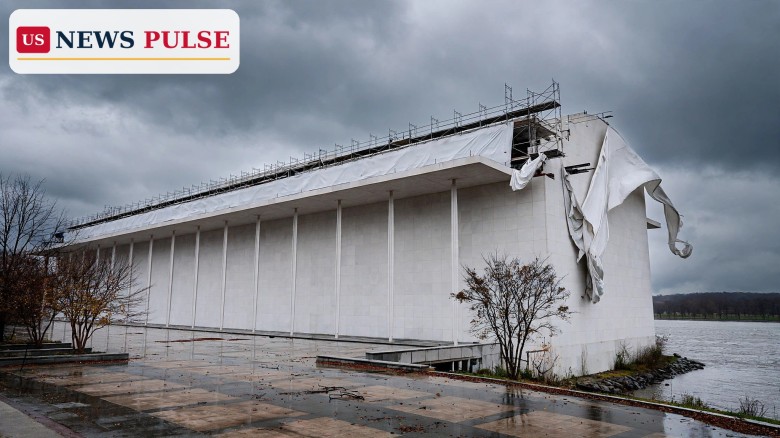
A Thanksgiving nor'easter did in hours what months of scaffolding and secrecy could not: it showed the world the Kennedy Center's front. On November 27, 2026, strong winds tore an upper corner of the giant tarp that had hidden the facade since June, revealing blank white marble where President Donald Trump's name once stood. The gap, filmed by NBC4 Washington, confirmed the metal letters added in December 2025 were gone, and that the only name now on the building is Kennedy's.
Key Points
- A Thanksgiving nor'easter tore an upper corner of the tarp off the Kennedy Center facade on November 27.
- The gap showed blank wall where Trump's name had been; only Kennedy's name was visible.
- Metal letters reading "The Donald J. Trump and the John F. Kennedy Memorial Center for the Performing Arts" were added in December 2025.
- A judge ruled in May 2026 the name needed Congress; crews removed the letters overnight in June.
- Crews repaired the tarp by early afternoon; an appeals court blocked restoring the name in July.
What Happened
The Thanksgiving storm hit Washington hard, and the Kennedy Center's riverside facade took the brunt of it. The white tarp that has covered the front of the building since June held across most of its length, but the wind peeled back an upper corner, leaving a visible gap. Through it, cameras could see the wall beneath: plain white marble, with no trace of the Trump name that had been mounted there.
NBC4 Washington video showed most of the tarp still attached to the scaffolding, with the torn section hanging loose at the top of the building. Until the storm, nobody could verify the removal: the tarp and scaffolding had hidden the facade for five months. Crews repaired the tarp by early afternoon, closing the window as soon as it had opened.
Background: A Year of Fighting Over the Name
The fight began in December 2025, when metal letters were added above the existing name so the building read "The Donald J. Trump and the John F. Kennedy Memorial Center for the Performing Arts." The addition followed a board vote and drew immediate legal challenges: the centre's name is set by law, challengers said, and cannot be changed by a board or a president alone.
In May 2026, US District Judge Christopher Cooper ruled that Trump's name could not be added without congressional approval. The board appealed, but in June crews removed the letters overnight, under scaffolding and the giant tarp that has stayed up since. A Kennedy Center official assured the judge in June that all Trump references, inside, outside and online, had been removed. In July, an appeals court blocked restoring the name while the appeal proceeds, leaving the building in limbo: unnamed in practice, but still covered up.
Earlier this month, President Trump announced the Kennedy Center will close for about two years starting July 4 for a complete rebuild. A court filing in the case had earlier argued that money, not repairs, drove the shutdown push.
Kennedy Center Tarp: Why the Cover Stayed Up for Months
The letters were removed in June, yet for five months nobody outside could see the wall and confirm it. The scaffolding and tarp were presented as removal work, but stayed up long after the job was done, hiding the facade through summer and autumn.
Representative Joyce Beatty, a Democrat from Ohio who sued over the tarp, had accused the administration of leaving it up to "defy a return to the status quo" — of avoiding the visible return to the name Congress set. The storm cut through that argument in a single gust: the wall underneath is blank, the Trump letters are gone, and the only name the facade now carries is Kennedy's. Crews covered it again within hours, so the glimpse lasted only a morning, but the images have been seen widely.
Reactions: A Lawsuit, an Assurance and a Storm
Beatty's case argued the tarp itself was the problem, hiding a public building from the public that owns it. Her accusation framed the tarp not as construction equipment but as a political choice, and the storm's brief unveiling gave her argument its most vivid illustration yet.
The Kennedy Center's assurance to the court in June was that every Trump reference had been removed, inside, outside and online. The storm appears to confirm it for the facade: the video shows no letters, no outline and no mounting hardware, only the blank marble from before December 2025. The centre has not needed to say more: the image speaks for itself, and the appeals court has already blocked putting the name back while the appeal runs.
Why It Matters
The episode matters because so much of this fight has been about visibility. A name on a public building states who it belongs to and what it stands for, and for almost a year that statement was contested in court, in the press and on the facade. The December 2025 letters announced a new identity; the May ruling rejected it; the June removal restored the old one behind a cover. The storm supplied the check, and the blank wall is now public record, not a courtroom assurance.
The building will shut for a rebuild starting July 4, and the question of what name it carries when it reopens is still before the courts. The appeal could yet change the outcome, but one fact is now fixed: the Trump name is not on the building, and the only name visible is the one Congress gave it more than sixty years ago.
What Happens Next
The repair is already done: the tarp was patched by early afternoon on November 27, and the facade is hidden again. The legal fight continues, with the board's appeal pending and the July order blocking the name's return. If the board wins, the name question returns; if it loses, the Kennedy name stands alone.
The bigger date is July 4, when the centre closes for about two years. What it looks like on reopening, and what name it carries, will depend on the courts and the rebuild. Until then, the storm's brief glimpse is likely to remain the clearest public evidence of the facade, and the image of the torn tarp may outlast the tarp itself.
Frequently Asked Questions
What did the storm reveal?
Winds on November 27, 2026 tore an upper corner of the tarp, revealing blank wall where Trump's name had been; only Kennedy's name was visible.
When was Trump's name added to the building?
Metal letters were added in December 2025, so the building read "The Donald J. Trump and the John F. Kennedy Memorial Center for the Performing Arts."
Why was the name removed?
Judge Christopher Cooper ruled in May 2026 the name needed Congress's approval; crews removed the letters in June, and an appeals court blocked restoring the name in July.
Why was the facade covered for so long?
The tarp went up for the June removal and stayed five months. Representative Joyce Beatty sued over the covering.
Is the Kennedy Center closing?
Yes. President Trump announced a closure of about two years starting July 4 for a complete rebuild.
© 2026 US News Pulse. All rights reserved.
 Print
 Save