
Five Tankers Hit in Strait of Hormuz Attacks as Iran Mines Key Oil Route
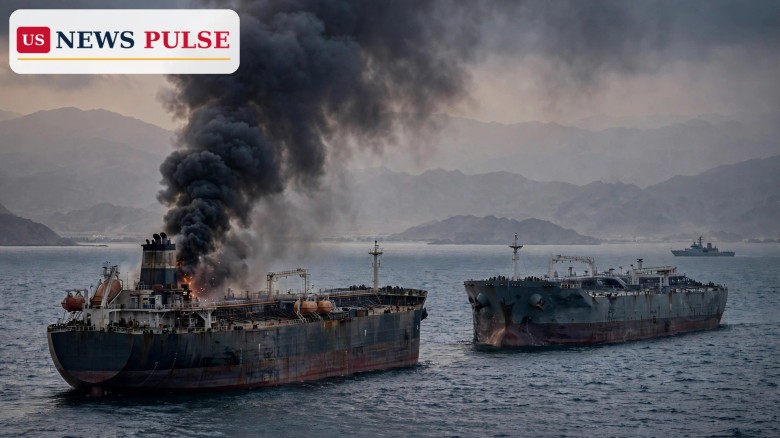
At least five oil tankers were attacked in or near the Strait of Hormuz over the weekend, British and Iranian maritime authorities said, in the sharpest escalation yet of the campaign against shipping through the world's most important oil chokepoint. Two tankers were struck by projectiles early on Saturday while leaving the Persian Gulf, a third was reported to have hit a mine, and two more vessels, including a supertanker carrying more than two million barrels of crude oil, exploded after striking naval mines early on Sunday. No casualties were reported on Saturday.
Key Points
- Two tankers were hit by projectiles early on Saturday while exiting the Persian Gulf, one in the stern and one in the engine room. No casualties were reported, Britain's maritime trade body said.
- A third tanker was reported to have hit a mine on Saturday and caught fire east of the strait.
- Early on Sunday, Iran's Revolutionary Guard navy said two more tankers exploded and caught fire after hitting mines on an unauthorised southern route, one a supertanker with more than two million barrels of crude.
- Iran's navy chief said the strait will remain closed unless security is restored; the mine claims have not been independently verified.
- November has seen about two dozen tanker attacks in the strait, nearing October's record of more than 30.
What Happened
The first strikes came early on Saturday, November 28, as tankers were leaving the Persian Gulf through the strait. Britain's United Kingdom Maritime Trade Operations centre said two vessels were struck separately by projectiles, one hit in the stern and the other in the engine room, with no reports of casualties. A third tanker was reported to have hit a mine, and Iran's navy said it struck a mine east of the strait before noon and caught fire.
The second wave came early on Sunday, November 29. The Revolutionary Guard navy said two more oil tankers exploded and caught fire after hitting naval mines while trying to cross what it called an unauthorised southern route. One was a supertanker carrying more than two million barrels of crude oil, which struck a mine north of Oman's Khasab port; the second hit a mine in the eastern part of the strait while exiting the Gulf. Both caught fire. It did not name either vessel or report casualties, and the claims could not be independently verified.
Background
The strait has been one of the central battlegrounds of the war between the United States and Iran since it began in late February 2026. A June memorandum of understanding that briefly paused the fighting collapsed, and Washington reimposed a naval blockade of Iranian ports in mid-July to cut off the oil revenue funding Tehran's war effort. Tankers have been hit in waves since: four ships on November 17, three vessels on November 19, two supertankers on November 22, and four tankers across November 23 and 24.
On Friday, November 27, United States Central Command said American forces and regional partners control the strait and have restored freedom of navigation, with shipping moving freely under American protection. The weekend attacks are the most direct challenge to that claim since the statement. On Saturday, President Donald Trump also rejected Iran's offer to reopen the strait within seven days, calling it not acceptable.
Strait of Hormuz Tanker Attacks Put Oil Markets on Edge
The strait is the chokepoint through which around a fifth of the world's gas and oil usually flows, and every new attack pushes insurance costs higher and forces shippers to weigh whether the passage is worth the risk. Brent crude settled on Friday at 95.44 dollars a barrel, up 3.1 percent for the week. Traders will watch Monday's open for the market's verdict on whether the latest wave marks a new phase.
The flow of vessels has already thinned. Shipping data from Kpler shows a recent ten-day average of about 18 transits a day, dropping as low as nine vessels on some days. Seven members of the OPEC group, including Saudi Arabia, Russia and Iraq, announced on Sunday that they will keep crude output unchanged during the first three months of 2027, citing the need to safeguard international maritime routes.
Reactions
Iranian state media said the military carried out its most intense and varied operations yet in the strait overnight, aimed at stopping vessels and foiling American efforts to escort shipping through the narrows. Navy chief Shahram Irani said the strait will remain closed unless security is restored. The Revolutionary Guard has warned that vessels using unauthorised routes face explosions and fires.
There was no immediate comment from Iran on the British report, and the United States has not yet commented publicly. Central Command's Friday statement, denying a 2.5 million dollar American toll and saying Iran no longer has a navy, is the most recent American word on the strait, and the weekend attacks put its claim that navigation has been restored to its hardest test yet.
Why It Matters
The strait carries the oil that heats homes and powers factories across Asia and Europe, so each attack lands twice, once on the ships themselves and once on the confidence of everyone who depends on the cargo. A supertanker carrying more than two million barrels of crude is not a symbolic target: it is a floating piece of the world's energy supply, and its loss tightens a market already near 96 dollars a barrel.
The attacks also test the American naval campaign at its core. The United States has staked its position on controlling the strait and keeping it open, and has enforced a blockade of Iranian ports. A weekend in which five tankers are hit suggests that control is contested in practice even where it is asserted in public. For Tehran, the campaign is a way to raise global energy prices and pressure Washington.
What Happens Next
The first question is verification. The Saturday projectile strikes are confirmed by the British maritime centre, but the Sunday mine claims rest on Iranian statements alone, with no vessel names, casualty figures or independent confirmation. Satellite imagery and shipping records in the coming days should show whether two more tankers were damaged. The second question is the American response, and whether the weekend changes the calculation behind the rejected seven-day reopening offer.
Read more: Three more tankers hit mines under US escort; Fourth tanker explodes after hitting a mine; CENTCOM denies Hormuz toll claim.
Frequently Asked Questions
How many tankers were attacked this weekend?
At least five: two by projectiles on Saturday, a third by a reported mine strike, and two more on Sunday.
Was anyone hurt?
No casualties were reported on Saturday. The Guard gave no figures for Sunday, and the crews' fate was unknown.
What was the supertanker carrying?
More than two million barrels of crude oil, lost after it struck a mine north of Oman's Khasab port.
Why is the Strait of Hormuz so important?
Around a fifth of the world's gas and oil usually flows through it.
Have the Sunday mine claims been verified?
No. They come from Iranian statements, the vessels were unnamed, and Reuters could not verify them.
© 2026 US News Pulse. All rights reserved.
 Print
 Save