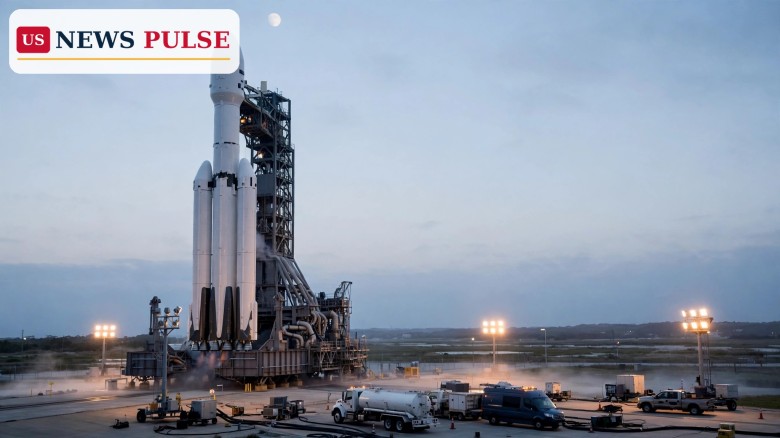
For nearly two decades, NASA's return to the Moon has rested on a single bet: that SpaceX would always be there to fly it. New reporting on SpaceX NASA Moon landing plans suggests that bet is now being tested, as the company steers its rockets, engineers and launch slots toward the businesses that pay it most — satellite internet and artificial intelligence. The shift does not cancel the Artemis programme, and no delay has been formally announced, but it changes the balance of power inside America's lunar effort at the very moment NASA is trying to lock in a crewed landing for 2028.
The story broke in two layers. First, veteran space journalist Eric Berger of Ars Technica reported that SpaceX had informed lunar-lander developers it would no longer provide launches for their NASA missions. The report, published on 29 October and cited by three sources, said at least two cargo-lander developers had previously held Falcon 9 launch estimates or arrangements before being told SpaceX would not fly them. RuntimeWire's summary of the report stressed an important caveat: this is not a public announcement from SpaceX, and no delay or replacement for any affected mission has been confirmed.
The second layer is the wider strategic picture set out in that reporting and in coverage of it on 30 and 31 October. SpaceX, having acquired xAI and completed a public listing, is described as pivoting its centre of gravity from government contracting toward its own revenue engines. Its Falcon rocket engineering core has reportedly been moved to Memphis, Tennessee, to work on ground-based AI data-centre construction. Bloomberg reporting, cited in the same coverage, says AI company Anthropic has become SpaceX's largest single customer, contributing more than a third of its revenue in the third quarter of 2026, under a contract worth up to $120.5 billion through 2029 — with exit windows after January and March 2027. Elon Musk is reported to have predicted that NASA payments will account for less than 5 percent of company revenue in 2026.
For the small lunar cargo firms caught in the middle, the practical consequence is immediate: they must now look elsewhere. The alternatives named in the reporting are Blue Origin's New Glenn and Relativity Space's Terran R, neither of which is yet a proven, high-cadence substitute for Falcon 9. NASA's Moon base plan calls for more than 20 robotic landings through 2029, so even a handful of firms losing their ride matters.
The partnership began as a rescue. In 2006 NASA gave SpaceX $278 million to develop a cargo spacecraft for the International Space Station, then $1.6 billion in 2008 for twelve Dragon cargo flights. Company leaders later acknowledged that funding probably saved SpaceX from bankruptcy. In 2020 Crew Dragon carried astronauts to the station for the first time, ending the United States' reliance on Russian Soyuz spacecraft after the space shuttle retired in 2011. A year later NASA selected Starship as its crewed lunar lander for $2.89 billion. Almost overnight, the agency's two most important and expensive projects — the space station and the lunar landing programme — both hinged on one company.
That dependence became public in June 2025, when Musk and President Donald Trump clashed briefly, with Trump threatening to terminate SpaceX government contracts and Musk retorting that he would retire Dragon. The Pentagon reviewed the relationship the following month and concluded that the vast majority of its SpaceX contracts were irreplaceable. The episode passed, but it exposed a structural fact that the new reporting now brings back into focus: when a private company's priorities move, a public programme built on that company moves with it, whether it wants to or not.
NASA's own plan has already been reshaped once this month. On 23 October the agency revised its Artemis architecture, giving SpaceX and Blue Origin different routes to the Moon and redefining Artemis III, launching in 2027, as an Earth-orbit test of lander hardware rather than a landing mission. The first crewed landing remains targeted for 2028, with the first provider chosen on readiness. That revision was presented as a way to go faster. The SpaceX shift, if it holds, points in the opposite direction for at least part of the programme.
The arithmetic of a Starship lunar landing is the heart of the problem. An internal estimate at NASA's Johnson Space Center puts the number of Starship launches needed for a single lunar landing mission at about 22, most of them tankers for orbital refuelling. Musk has said six to eight would actually be needed, and NASA Administrator Jared Isaacman has explained that six to eight represents Starship's ultimate future potential. At the current stage, limited by payload capacity, executing a landing within the next year or two would still require roughly 20 launches, according to the coverage of the estimate.
At an assumed early cost of $100 million per Starship launch, 20 launches alone burn $2 billion — against a $2.89 billion contract that covers one uncrewed demonstration and one crewed landing. Starship has also yet to complete key tasks such as on-orbit propellant transfer and storage, and the most recent target timeframe presented by NASA and SpaceX for the crewed lander is early 2027. Set against that, a single Starship launch can deploy Starlink V3 satellites whose bandwidth equals that of ten Falcon 9 launches — bandwidth that can be monetised for years. The commercial logic is not hard to follow, even if its consequences for NASA are uncomfortable.
The cargo-lander squeeze sharpens the point. These are not flagship crewed missions; they are the robotic supply runs a lunar base needs. When SpaceX told at least two of their makers it would not fly them, it did not merely remove a rocket from a manifest. It removed the cheapest, most flown rocket in the American fleet from a programme that was designed around it, and it did so, according to the reporting, in recent weeks — as NASA was finalising its revised Artemis plan.
SpaceX has not issued a public announcement confirming the reported decisions, and the reporting itself is careful to rest that point. What is on the record is the reaction from inside NASA's programme. Artemis programme manager Jeremy Parsons, in an interview cited in the coverage, defended the partner, saying he frequently visits SpaceX facilities in Hawthorne, California, and Starbase, Texas, and that management remains firmly committed to the lunar mission. But when asked whether a post-listing SpaceX would still pause profitable Starlink and Starship launches to devote substantial time to the lunar landing, he acknowledged it was a very real question.
Blue Origin, by contrast, is positioning itself as the willing alternative. Chief executive Dave Limp said last November that as long as NASA wants to accelerate the schedule, the company is willing to do everything it can to help the United States return to the Moon sooner. To meet that schedule before 2030, Blue Origin rewrote its lander design in 2025, adopting a smaller Blue Moon Mark 2 paired with multiple transfer stages based on the Mark 1, bypassing cumbersome orbital refuelling — without any new funding commitment. For Artemis III, Blue Origin has built a dedicated test version of its lander that astronauts can enter and check; SpaceX, by contrast, plans to use an ordinary Starship from the production line that Orion can only dock with, with no life-support equipment inside for astronauts to enter.
Musk's own public framing, as reported, is that debt markets have essentially closed financing channels for companies lacking substantive revenue beyond AI data centres, while SpaceX has both Starlink and rocket launches as revenue pillars. That is a statement about where capital now rewards a company like SpaceX — and, by extension, where its attention will go.
This is not a story about one rocket company changing its mind. It is a story about what happens when a national programme is built on a single supplier whose business model outgrows the programme. NASA bought low-cost launch and crewed transport, and it got them, brilliantly, for years. The price was concentration: the station, the lunar lander and much of the cargo manifest now run through one firm's manifest, its engineering teams and its launch cadence. When that firm reallocates capacity to Starlink and AI, NASA does not get a vote.
The risk is not only delay. It is also leverage. If Blue Origin becomes the only credible alternative, NASA's negotiating position, its schedule and its technical choices all bend toward the one company still willing to prioritise the Moon. Blue Origin's record so far — three orbital missions, and a New Glenn launch-pad explosion earlier this year, followed by a rapid rebuild and $3 billion more invested in Florida — shows ambition and money, but not yet the flight-proven cadence that Falcon 9 earned over a decade. A programme that swaps one dependency for another has not solved its problem; it has renamed it.
There is a wider lesson for every government that has outsourced flagship capability to a private champion. The champion's incentives are set by its shareholders, its customers and its capital markets, not by a space agency's timetable. SpaceX's largest customer is now, by the reported figures, an AI company, not NASA. That is a rational business outcome. It is also the reason NASA's Moon plans are now, in the words of the Korean coverage of the Ars Technica report, directly affected not only by technical difficulty but by a private company's priorities in allocating resources.
Three things will decide whether this becomes a footnote or a turning point. First, whether SpaceX confirms, qualifies or walks back the reported decisions — a public statement would settle the status of Crew Dragon, Falcon 9 commercial sales and the cargo-lander refusals. Second, whether the affected cargo firms secure New Glenn or Terran R slots in time to keep the robotic landing schedule through 2029 intact, or whether missions slip. Third, how Artemis III performs in 2027: a clean Earth-orbit docking test for both lander designs would keep the 2028 crewed landing credible; trouble there would force NASA to choose, publicly, between waiting for Starship and betting on Blue Moon.
Watch also for NASA's budget and contracting response. If the agency concludes that concentration itself is the risk, expect new money and new language aimed at a second, genuinely independent cargo and crew path — and expect Blue Origin to argue, with some justification, that it has already redesigned its lander to meet NASA's schedule without extra funding. The Moon race of the late 2020s may therefore be decided less by who builds the best lander than by who is still willing to fly it when the manifest gets crowded.
No. No cancellation has been announced. The reporting says SpaceX has told lunar cargo firms it will not fly their missions, and has signalled future limits on Crew Dragon and Falcon 9 commercial sales. NASA's Artemis programme and its 2028 crewed landing target remain in place.
According to the reporting, its revenue centre has moved. Starlink and AI data-centre work, including a very large Anthropic contract, now dominate its income, and a Starship launch spent on Starlink satellites can earn revenue for years, while a lunar landing mission may need around 20 launches against a $2.89 billion fixed contract.
It is an internal Johnson Space Center estimate of the Starship launches needed for one lunar landing mission, mostly tankers for orbital refuelling. Musk says six to eight will ultimately be needed; NASA's administrator says that is the future potential, not the near-term reality.
Not yet on cadence. Blue Origin has redesigned its Blue Moon lander to avoid orbital refuelling and is building an Artemis III test article astronauts can enter, but it has only three orbital missions so far and its New Glenn rocket suffered a launch-pad explosion earlier this year.
Not immediately. The reporting concerns future commercial sales and cargo-lander launches, and Crew Dragon's reported retirement date is 2030 or earlier. Existing NASA and Space Force commitments are described as continuing, but the long-term crew-transport picture after 2030 is now an open question.
Related coverage on US News Pulse: NASA's revised Artemis plan for a 2028 Moon landing, SpaceX's six-week Florida launch pause, and California's rocket launch record as SpaceX passed Florida.
Leave a Comment



 | Today's Date: