A federal judge in Washington sharply questioned the Trump administration's case for a planned 250-foot triumphal arch on Friday, October 30, 2026, pushing back on the claim that the monument is needed for national security and asking why construction must begin as early as next week. US District Judge Tanya Chutkan, hearing a bid by Vietnam War veterans to block the project, said she would rule "expeditiously" — a decision that could land just days before planners are due to consider final approval on November 5.
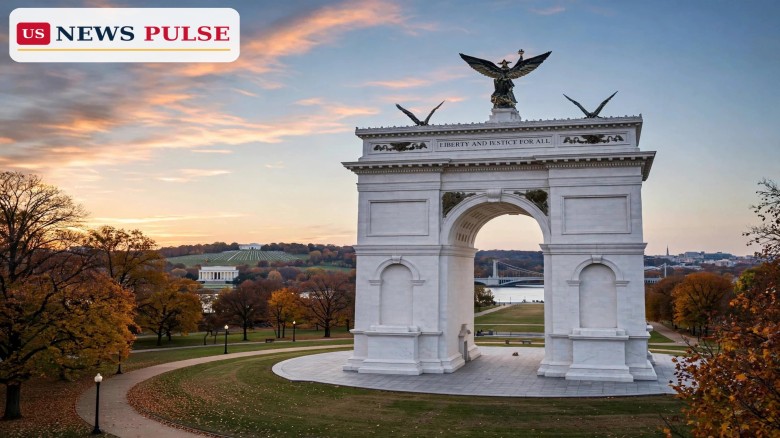
The Trump 250-foot arch, a white triumphal structure modelled on the Arc de Triomphe in Paris, would stand in a traffic circle between the Lincoln Memorial and Arlington National Cemetery. The administration says work could begin as soon as November 5 if the National Capital Planning Commission grants final approval that day. The veterans suing to stop it argue the project lacks congressional authorisation and would damage the sightline between two of America's most hallowed landmarks.
The hearing before Judge Chutkan was the first major court test of the arch project, and it turned quickly on the administration's shifting rationale. President Donald Trump did not mention national security when he first announced plans for the arch. He said later, in a post on Truth Social, that it would include a "top grade military complex" that could house drones and snipers. At the hearing, the Justice Department relied on sworn declarations from Defense Secretary Pete Hegseth and Homeland Security Secretary Markwayne Mullin describing the arch as a "generational national defense opportunity."
Chutkan was sceptical. "It doesn't make the use of national security talismanic in this case," she said. "This is the first time the government has proffered a national security aspect to this case." She noted that the president had also invoked national security in presenting the case for building a White House ballroom to the Supreme Court, and she pressed the government's lawyer on the logic of the claim. The arch, she observed, would not be completed for about three years — raising the question of how it could deter threats in the meantime. "The arch is somehow supposed to deter assassination attempts on the president? It's going to be completed 3 years from now," she said, according to reports of the hearing.
Robert Stander, a lawyer for the Justice Department, told the court the arch is a "high priority project" for the administration. He argued the challengers lacked standing because the plans will not be finalised until the National Capital Planning Commission meets next week. Chutkan turned that argument back on the government, pointing out that under its own reasoning the plaintiffs would have only one day to bring a lawsuit once approval lands. "What would be final agency action," she asked, "when bulldozers start digging up the ground?"
Several of the veterans spoke at the hearing. Chutkan told the plaintiffs she was not interested in any "distaste and disgust against the administration," but in how their personal experiences would be affected by the planned arch. She appeared receptive to their argument that they had more at stake than the plaintiff in the ballroom case, who cited aesthetic concerns: the veterans are active participants at Arlington National Cemetery, and construction of the arch has not yet begun.
The arch was originally proposed as a monument for the country's 250th birthday, a celebration of American independence that has shaped a string of presidential projects in the capital. At 250 feet — about 76 metres — it would tower over the traffic circle at the western end of the National Mall axis, on the route between the Lincoln Memorial and Arlington National Cemetery, the final resting place of hundreds of thousands of American service members.
The planning process has moved quickly. The National Capital Planning Commission approved preliminary plans in July 2026 and asked for more information before final review. Its project page lists November 5 for consideration of the final plans, with no decision yet recorded. The Justice Department says construction could begin as soon as that date if the commission approves the plans, the Department of the Interior authorises the work and the National Park Service issues a notice to proceed. The government says the first six to eight months would involve below-ground excavation and foundation work, with above-ground construction not expected before May 2027 and a total schedule of 33 to 39 months.
The National Park Service's updated review identifies an adverse impact on at least one historic property, and the Washington Post has reported on a shadow study suggesting the arch would cast shade over graves and memorials at Arlington. The plaintiffs argue recent renderings confirm it would disrupt the visual connection between the Lincoln Memorial and the cemetery.
At the heart of the case is a dispute over whether Congress has authorised the arch at all. The four plaintiffs — Vietnam War veterans Michael Lemmon, Shaun Byrnes and Jon Gundersen, and architectural historian Calder Loth — want construction-related steps stopped unless Congress authorises the project. They contend it needs separate congressional authorisation under the Commemorative Works Act and 40 U.S.C. Section 8106, the law governing construction on federal land in the capital.
The Justice Department disagrees. It argues the plaintiffs lack standing and says a 1925 law authorising Arlington Memorial Bridge also supports the arch. Government attorneys have described the plaintiffs' legal motions as "breathless" and urged Chutkan to apply recent Supreme Court precedent from litigation involving the proposed White House ballroom. The court has not yet resolved those competing arguments, and Friday's hearing was about a preliminary injunction — an emergency order to freeze the project — rather than a final ruling on the merits.
The fight does not end in Chutkan's courtroom. Arlington County has filed a separate lawsuit in federal court in Virginia seeking fuller environmental review, so even a ruling for the administration in Washington would not clear every obstacle. Six organisations, including Vietnam Veterans of America, filed a brief supporting construction — but the group's president, Tom Burke, told the Washington Post the national group had taken no position on the arch's construction or design and said he had been misled before it endorsed the project.
Wendy Liu, a lawyer for the plaintiffs, told the court that given its massive size, the arch would obscure the sightlines between the Lincoln Memorial, one of Washington's iconic landmarks, and Arlington National Cemetery. Shaun Byrnes, one of the plaintiffs, has described his opposition as a matter of responsibility toward fellow veterans who died during the Vietnam War. The plaintiffs argued in court papers that the public interest supports blocking construction immediately, before early site work causes harm that cannot be undone.
Stander's position is that the project is a high priority, that the challengers cannot show the imminent, irreparable harm an injunction requires, and that courts should defer to the planning process. Chutkan's questions suggested she was unconvinced on urgency: if the government can wait for a full planning review, what is lost by waiting a few more months while courts examine whether the project is lawful?
The stakes go beyond one monument. The November 5 planning decision creates a narrow window: if the commission approves final plans and the Interior Department and Park Service move quickly, excavation could begin while litigation is still pending. Once foundations are dug and the ground is disturbed, the veterans argue, the harm to the site's historic character cannot easily be reversed — which is precisely why they sought emergency relief before work starts rather than after.
The case also tests how far a president can reshape the capital's monumental core without a specific vote from Congress. The arch joins the White House ballroom, the Reflecting Pool renovation and a proposed East Potomac Golf Links revamp among Trump's capital projects. A ruling requiring separate congressional authorisation would set a marker for all of them; the opposite ruling would give the administration a freer hand.
For veterans and their families, the issue is personal: Arlington is a burial ground, and the sightline from the Lincoln Memorial across the Potomac frames national remembrance. A 250-foot structure in the middle of that view, they say, would change the experience permanently — and the shadow study and the Park Service's adverse-impact finding give that argument factual footing.
All eyes are now on Chutkan's promised expeditious ruling. If she grants the injunction, construction steps will be frozen while the case proceeds, and the November 5 planning meeting will go ahead against a court order barring work. If she denies it, the administration could move to start excavation as soon as the commission, the Interior Department and the Park Service give their approvals — and the plaintiffs would face the harder task of stopping a project already under way.
Either way, the fight continues: Arlington County's Virginia lawsuit proceeds independently, and the planning agencies still have to complete their reviews. With the country's 250th birthday celebrations as the backdrop, the question of what belongs on the Mall — and who decides — will not be settled by a single hearing.
The arch would stand 250 feet, or about 76 metres, tall — modelled on the Arc de Triomphe in Paris — in a traffic circle between the Lincoln Memorial and Arlington National Cemetery.
The Justice Department says construction could begin as soon as November 5, 2026, if the National Capital Planning Commission grants final approval that day and the Interior Department and National Park Service authorise the work.
Three Vietnam War veterans — Michael Lemmon, Shaun Byrnes and Jon Gundersen — and architectural historian Calder Loth. They argue the project lacks congressional authorisation and would harm sightlines and the sanctity of Arlington National Cemetery.
She made no immediate ruling at the October 30 hearing but said she would rule "expeditiously" on the request for a preliminary injunction, after sharply questioning the administration's national-security justification and its rush to build.
The administration now says the arch would serve as both a tourist attraction and a military facility for storing drones and ammunition, citing declarations from the defence and homeland security secretaries. The plaintiffs and the judge have questioned that rationale, noting it was not part of the original announcement.
Related coverage: Federal judge blocks DOJ election-pressure campaign days before midterms; Judge blocks Trump East Potomac golf course renovation after 400 trees felled; Trump fires back at Obama over 'Cheesecake Factory' White House renovation jibe.
Leave a Comment



 | Today's Date: