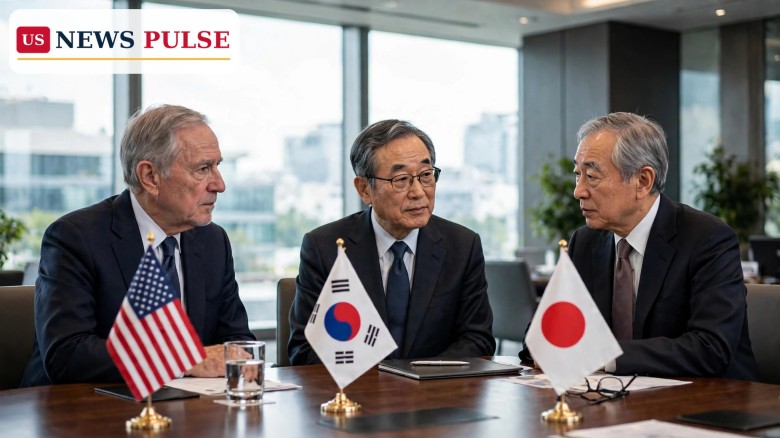
The United States, South Korea and Japan have reaffirmed their "resolute commitment to the complete denuclearization" of North Korea, after their foreign ministers met in Atlanta on Friday, October 30, 2026, on the sidelines of the Group of 20 foreign ministers' meeting. The trilateral pledge, issued as North Korea continues to reject disarmament and insists its nuclear arsenal is permanent, pairs a hard line on sanctions enforcement with an open door to dialogue, and adds a new Arctic partnership to a security relationship that Washington, Seoul and Tokyo say must now stretch from the Korean Peninsula to the Pacific Arctic.
US Secretary of State Marco Rubio, South Korean Foreign Minister Cho Hyun and Japanese Foreign Minister Toshimitsu Motegi held their first trilateral meeting in about a month, their fourth gathering of the year. The timing was pointed: the talks came a day after North Korea launched around 10 short-range ballistic missiles from the Wonsan area toward the East Sea, according to South Korea's Joint Chiefs of Staff, and as speculation grows over a possible meeting between US President Donald Trump and North Korean leader Kim Jong Un at next month's APEC summit in China.
The meeting took place in Atlanta, Georgia, where foreign ministers from the Group of 20 were gathered for a two-day session. It was the same meeting whose traditional group photograph had been scrapped shortly before it opened, after several European officials refused to pose alongside Russia's Sergei Lavrov. The trilateral session, by contrast, went ahead as planned, and the three foreign ministries issued closely matching readouts afterwards.
According to the US State Department readout, Rubio, Cho and Motegi "reaffirmed their resolute commitment to the complete denuclearization" of North Korea and the full implementation of UN Security Council resolutions. South Korea's foreign ministry added that the ministers called on North Korea to join efforts to ease tensions and establish lasting peace on the Korean Peninsula, and that they agreed to maintain a robust deterrence posture against North Korea through close coordination while continuing efforts to achieve peace, stability and denuclearization through dialogue and diplomacy.
Cho emphasised that South Korea would fulfil its role as a "pacemaker" in efforts to establish a peace regime on the Korean Peninsula and to resume dialogue between Washington and Pyongyang, in close coordination with the United States. The three ministers also underscored the need to enforce UN sanctions prohibiting activities that generate revenue for Pyongyang's nuclear and ballistic missile programmes, and commended the Multilateral Sanctions Monitoring Team, which tracks and reports violations and evasion of UN sanctions against North Korea.
Beyond the peninsula, the ministers emphasised the importance of maintaining peace and stability across the Taiwan Strait. Rubio also raised concerns about China's actions in the South China Sea, East China Sea and Yellow Sea, as well as cooperation between China and Russia that Washington says threatens peace and stability in the Indo-Pacific region.
On economic security, the three agreed to strengthen cooperation on diversifying critical mineral supply chains, developing small modular reactors and advancing artificial intelligence and other emerging technologies. They then signed a memorandum of cooperation establishing the Trilateral Arctic Pacific Partnership, known as TAPP, to explore maritime cooperation and economic partnerships in the Pacific Arctic. South Korea's ministry said the three countries would pursue cooperation on maritime safety and emergency response in the region, including through the Arctic Council and a newly planned working group.
Separately, Cho held talks with Rubio on the sidelines of the G20 meeting, discussing bilateral relations, high-level exchanges and visa-related issues, according to Seoul's foreign ministry.
The Atlanta session was the fourth trilateral foreign ministers' meeting of 2026, following talks in Türkiye on July 7, the Philippines on July 22 and New York on September 21. The rhythm matters: the three countries have used these regular meetings to keep their North Korea policy aligned even as their wider diplomacy has pulled in different directions, with Washington pursuing its own channels and Seoul pressing for a resumption of dialogue.
North Korea, backed by Russia and China, has enshrined its status as a nuclear-armed state in law, and its regime has repeatedly declared its atomic arsenal permanent and irreversible. Despite long-running UN sanctions, Pyongyang has continued to develop its nuclear and ballistic missile programmes, financing them in part through activities that the sanctions regime is designed to block — the very revenue streams the Atlanta statement singles out. The Multilateral Sanctions Monitoring Team, praised in Atlanta, was set up to track those violations after the UN Security Council's own panel of experts lapsed, and its reports have become a regular irritant for Pyongyang.
The missile launches reported on the eve of the meeting fit a familiar pattern: short-range tests from the Wonsan area toward the East Sea, timed to coincide with high-level diplomacy, and read in Seoul as both a capability demonstration and a political signal. South Korea's Joint Chiefs of Staff reported around 10 missiles, a scale that underlined why the three ministers paired their deterrence language with their dialogue language in the same statement.
At the same time, the diplomatic door is visibly ajar. Trump has made repeated overtures to Pyongyang for nuclear talks, has said he is "100%" open to a meeting, and last year bucked long-held US policy by conceding that North Korea was already "sort of a nuclear power". He has also scaled back joint military drills with ally South Korea. Speculation is now mounting over a possible Trump-Kim meeting at next month's APEC summit in China, although no such meeting has been confirmed, and Pyongyang has so far given no public sign of accepting the overtures.
The Atlanta statement is best read as three commitments stitched together. The first is the goal itself: complete denuclearization, stated without qualification and without any suggestion that the allies would settle for a freeze or for arms control in place of disarmament. The second is the method: full implementation of UN Security Council resolutions, with an explicit focus on cutting off revenue for the nuclear and ballistic missile programmes, and public praise for the monitoring team that documents evasion. The third is the posture: robust deterrence maintained through close coordination, pursued alongside — not instead of — efforts to achieve peace through dialogue and diplomacy.
That combination is deliberate. Deterrence without dialogue leaves no path out of confrontation; dialogue without deterrence, Seoul and Tokyo have long argued, invites Pyongyang to pocket concessions while continuing its programmes. By naming both in a single readout, the three ministers signalled to Pyongyang that talks are available, but not on terms that would relax the sanctions pressure first.
The economic and Arctic elements widen the partnership beyond the peninsula. Critical mineral supply chains, small modular reactors and artificial intelligence are the terrain on which the three countries now compete with China and Russia as much as they cooperate with each other, and the Arctic partnership extends that cooperation into a region where shipping routes, resources and strategic access are all becoming more contested as sea ice recedes.
The US State Department's readout put the core commitment in the allies' own words: the secretary and foreign ministers "reaffirmed their resolute commitment to the complete denuclearization" of North Korea and the full implementation of UN Security Council resolutions. South Korea's foreign ministry echoed the point, saying the ministers agreed to maintain a robust deterrence posture through close coordination while continuing efforts to achieve peace, stability and denuclearization through dialogue and diplomacy.
Cho's "pacemaker" framing, reported by Yonhap from Seoul's ministry, cast South Korea as the country that would keep the peace process moving and help resume dialogue between Washington and Pyongyang, in close coordination with the United States. It is a role Seoul has claimed before, and one that will be tested by whether any contact follows the Atlanta statement.
Pyongyang's response, delivered on Saturday, October 31, rejected the premise outright. Denouncing a joint statement by the group of nations monitoring sanctions implementation against it, North Korea vowed that "the stereotyped sanctions racket of the US and the West can neither influence the position of the DPRK [North Korea] as a nuclear weapons state". The statement, carried by AFP, made no mention of the dialogue offer in the Atlanta readout, and no direct response to the prospect of a Trump-Kim meeting at APEC.
The Atlanta statement matters less for what it promises — the denuclearization goal has been restated for years — than for what it preserves. With a US president openly courting a personal meeting with Kim, and with South Korea pushing to resume dialogue, there was a real risk that the three allies' positions would drift apart, with Washington chasing a summit, Seoul chasing a peace regime and Tokyo worrying about being left behind. Atlanta shows the three still able to sign the same page, on the same day, in the same words.
It also matters for the sanctions regime. By naming revenue-generating activities and praising the monitoring team, the ministers put enforcement at the centre of the statement rather than treating it as boilerplate. If Pyongyang's programmes are financed through evasion, then enforcement is not a side issue — it is the policy. And if the monitoring team's work is publicly championed by all three allies, its findings carry more weight when they are next presented to the Security Council.
For Americans, the stakes are not abstract. North Korea's ballistic missile programme is the reason US missile defence, alliance commitments in Northeast Asia and the safety of US forces in South Korea and Japan remain live issues, and the country's suspected cyber thefts — including the theft of billions from cryptocurrency platforms, attributed by blockchain firms to North Korean hackers — show how its revenue-raising reaches far beyond the peninsula. A denuclearization policy that fails on enforcement, the Atlanta statement argues, fails everywhere else too.
The immediate test is whether any US-North Korea contact follows. The APEC summit in China next month is the obvious venue for a Trump-Kim encounter, but no meeting has been announced, and Pyongyang's Saturday statement gave no opening. If a meeting does happen, the Atlanta language will be the baseline against which it is judged: complete denuclearization, sanctions enforced, deterrence maintained.
The second test is the Arctic partnership. A memorandum of cooperation is a beginning, not a programme, and the planned working group, the Arctic Council channel and the maritime safety and emergency response work will need to produce concrete projects before TAPP can be called a success. Watch for the first joint activities and for any Chinese or Russian reaction to a trilateral presence in the Pacific Arctic.
The third test is the missile and sanctions cycle. If North Korea answers Atlanta with further launches, or with new evidence of sanctions evasion, the allies' deterrence and enforcement language will be tested in practice. If it answers with silence, or with a quiet signal of interest in dialogue, Seoul's "pacemaker" role will move to the centre of the story. Either way, the next trilateral meeting — the fifth of the year, if the pattern holds — will have a clearer record to judge.
They reaffirmed a "resolute commitment to the complete denuclearization" of North Korea, pledged full implementation of UN Security Council resolutions, including a ban on revenue-generating activities for Pyongyang's nuclear and ballistic missile programmes, and agreed to maintain robust deterrence alongside dialogue and diplomacy.
US Secretary of State Marco Rubio, South Korean Foreign Minister Cho Hyun and Japanese Foreign Minister Toshimitsu Motegi met on Friday, October 30, 2026, on the sidelines of the G20 foreign ministers' meeting in Atlanta, Georgia.
It is a new framework, established by a memorandum of cooperation signed in Atlanta, to explore maritime cooperation and economic partnerships in the Pacific Arctic, including maritime safety and emergency response work through the Arctic Council and a newly planned working group.
On Saturday, October 31, Pyongyang denounced a sanctions-monitoring statement and vowed that the "sanctions racket" of the US and the West cannot change its position as a nuclear weapons state. It did not publicly respond to the dialogue offer or to speculation about a Trump-Kim meeting at APEC.
Speculation is mounting over a possible meeting at next month's APEC summit in China, and Trump has said he is "100%" open to a meeting. No meeting has been confirmed, and Pyongyang has not publicly accepted any overture.
Related coverage: G20 Group Photo Cancelled as Europeans Refuse to Pose With Lavrov in Atlanta; Iran Strike Warning: Axios Says Trump May Go Bold if Midterms Turn Bad; US Approves $2.1 Billion Patriot Missile Sale to Ukraine After Delay Row. Sources: Yonhap News Agency, Korea Herald, AJU Press, The Hindu/AFP, Channel News Asia/AFP, October 30-31, 2026.
Leave a Comment



 | Today's Date: