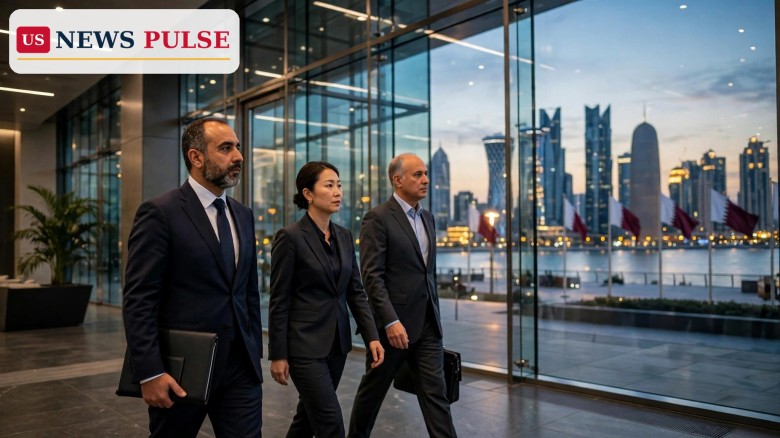
Qatari mediators are racing the clock to keep the United States and Iran from returning to war, after more than 12 hours of talks in Tehran on Friday and a further round in Doha on Saturday produced what Iranian officials described as a marked change in Washington's tone — but no agreement yet. With the American midterm elections on Tuesday, November 3, diplomats on both sides are treating the next two days as decisive, and the mediation itself has now become the clearest alternative to a resumption of strikes that both capitals say they would prefer to avoid.
The sequence began in Tehran on Friday, when Qatari mediators arrived for what the Washington Post, cited by Ajel English, described as a "last-ditch attempt to broker a temporary agreement between Iran and the United States." The discussions lasted more than 12 hours, according to Axios, and the Qatari delegation remained in regular contact with the White House throughout. On Saturday, the talks shifted to Doha, where an Iranian delegation travelled for further consultations with Qatari officials, and a source briefed on the negotiations told Reuters the discussions were being coordinated in regular contacts with Washington.
The immediate public signal from Tehran was unusually warm. Rezaei, secretary of Iran's Supreme National Security Council, said on Saturday that the tone of a letter from Vice President JD Vance had "changed completely," describing it as a positive development. Gulf News reported that Iranian officials had also acknowledged continuing consultations with Qatari and Pakistani mediators. The change in language does not amount to an agreement, Gulf News noted, but it suggests that diplomatic communication between the adversaries has become more constructive at precisely the moment when it matters most.
At the same time, the substance of what is being discussed has come into sharper focus. Mediators are reportedly exploring reciprocal confidence-building measures, including possible access for international inspectors to damaged Iranian nuclear facilities in exchange for limited United States sanctions relief. A Qatari newspaper, Al-Araby Al-Jadeed, reported that the sides had agreed on preliminary measures addressing Iran's nuclear programme and the Strait of Hormuz, where a US fleet has been escorting oil tankers to market, and that the reported framework also includes "financial incentives" for Tehran. Those reports have not been confirmed by either government, and they should be read as a sign of movement rather than as a settled deal.
Foreign Minister Abbas Araghchi added a concrete element on Saturday, telling Al Jazeera that Tehran had reached a plan with Qatari mediators to reopen the Strait of Hormuz within two days if the United States meets Tehran's conditions. The strait, through which a large share of the world's seaborne oil passes, has been at the centre of the conflict since the war began in February, and any plan to reopen it quickly would be a significant de-escalatory step if it holds.
The United States and Israel began the war against Iran at the end of February 2026, and the fighting has since gone through several phases of strikes, pauses and mediation. The last American strike against Iran came in September, according to the New York Post, and an earlier preliminary agreement reached with the help of mediators in June fell apart within weeks. That history is why diplomats are cautious about the current round: even a genuine shift in tone does not guarantee a durable arrangement.
In recent weeks, the diplomatic track has run in parallel with military signalling. President Donald Trump said at Mar-a-Lago on Saturday night that the United States could deal with Iran's remaining nuclear sites "in 10 minutes," naming the underground Pickaxe Mountain facility, while Secretary of State Marco Rubio said on Saturday at the close of the G20 foreign ministers' meeting in Atlanta that Trump had not made a decision on further strikes and would prefer to resolve the conflict diplomatically. Rubio added that the president retained full military capability if diplomacy failed, a formulation that keeps both options visibly open.
The Vance letter sits at the centre of the current effort. The vice president wrote to Rezaei at Trump's direction to revive peace talks and avert new strikes, according to earlier reporting by the Wall Street Journal and the New York Times, and the proposal envisages direct talks under Vance's leadership, with Iran's nuclear programme forming part of the discussions from the beginning. Tehran has studied the letter, Araghchi told Al Jazeera on Saturday, and described Washington's attempt to open dialogue as a positive step, while also saying Iran sees no need to meet American officials directly at this stage.
Qatar's role is not new, but its intensity this weekend is. Doha has mediated between Washington and Tehran before, and it has the rare combination of channels to both capitals, hosting a major American air base while maintaining working relations with Iran. Pakistan has also been involved in the wider mediation effort, and Saudi Arabia, Turkey and Egypt have all sought to prevent renewed hostilities that could destabilise the region and disrupt energy flows through the Gulf.
The most specific proposal on the table is a seven-day confidence-building framework. Under the Qatari proposal, Washington and Tehran would undertake a sequence of daily steps designed to reduce tensions and establish enough trust for broader negotiations, rather than attempting to resolve every disagreement at once. The objective, as described by BoldVoices, is to create an interim diplomatic arrangement, not a final settlement.
That proposal has not secured Iran's acceptance. A senior Iranian official indicated that Tehran did not consider the Qatari framework satisfactory, and Iran has been advancing its own seven-day proposal since September. The two plans overlap in structure — a week of sequenced steps, Hormuz reopening, nuclear and sanctions elements — but they differ on sequencing, which is often where such frameworks fail. The most difficult issues remain the order of sanctions relief, restrictions on Iranian ports, nuclear negotiations and the future operating arrangements for the Strait of Hormuz, and neither side has publicly indicated it is ready to abandon its core demands.
A separate reported framework, obtained by Al Arabiya English and covered in this series, envisages Iran transferring its stockpile of highly enriched uranium to an agreed third country, with the Strait of Hormuz reopening within seven days of an initial agreement and China and Russia potentially providing guarantees of implementation. Whether that framework and the Qatari seven-day proposal are the same document, overlapping drafts or competing texts is not clear from public reporting, and that ambiguity is itself a reason for caution.
An unnamed Iranian official told the Washington Post, via Ajel English, that "the next two days will be decisive in determining the course of events." That timetable points directly at the American midterms: Trump has held off on strikes in recent weeks ahead of an election that will determine whether his Republican Party retains its thin majorities in both houses of Congress, and countries in the region have anticipated that he could restart attacks once voting is over. The mediation, in other words, is not running on a diplomatic calendar alone; it is running against an electoral one.
Rubio's Saturday statement was the clearest American public position of the weekend. Trump "has not decided whether to launch new strikes against Iran, but would prefer to resolve the conflict diplomatically," he said, adding that the president "expresses to you incredible confidence that if we needed to do something militarily, we would have the ability to do it." That dual message — diplomacy preferred, force available — has been the administration's consistent line, and it leaves the mediation room to work without removing the pressure that, in Washington's view, makes Tehran negotiate.
Rezaei's comment on the Vance letter was the most positive Iranian signal of the round. He said the tone had "changed completely," a phrase that Gulf News described as an unexpected shift in the diplomatic atmosphere. At the same time, Rezaei said Tehran was debating whether to lift its longstanding ban on nuclear weapons should hostilities resume, although he said no such decision had been taken, and that there could be no talks on Iran's nuclear programme unless Washington accepted Iran's demands. The combination — warmer tone, harder conditions — captures the state of the talks: communication is improving, but the gap on substance remains wide.
Supreme Leader Mojtaba Khamenei, meanwhile, issued a statement on Saturday ordering the armed forces to be prepared to respond to any attacks, saying senior commanders had reported high readiness along the Gulf coast, in and around the Strait of Hormuz and the Gulf of Oman, and on Iran's northwestern and southeastern borders. "Any level or type of threat must be met with an immediate, impactful, and geographically unrestricted response," he said, according to Reuters. That warning, issued on the same day as the Doha talks, is a reminder that Tehran is negotiating while also preparing for the alternative.
Inside Washington, the debate is also visible. The Washington Post, via Ajel English, reported that Vance, special envoy Steve Witkoff and presidential adviser Jared Kushner are pushing for a deal, while others, including Defence Secretary Pete Hegseth, are opposed. Democratic Senator Chris Murphy, describing American plans he said he had been briefed on, said the proposed resumption of strikes after the elections would include targeting civilian infrastructure. Those accounts, all attributed rather than confirmed by the administration, illustrate how contested the choice between a deal and renewed strikes remains within the American government itself.
A temporary agreement, even a seven-day one, would matter far beyond the Gulf. It would pause a war that has already disrupted shipping, pushed oil prices sharply higher and drawn in regional powers, and it would give both sides a face-saving way to step back from a timetable — the post-midterm window — that has made escalation feel almost scheduled. For American voters, it would also remove, at least temporarily, one of the most volatile issues of the final campaign days.
The Hormuz element is the most immediately consequential. If Tehran's plan to reopen the strait within two days of American compliance holds, it would ease the pressure on global energy markets and on the Gulf states that have been urging restraint. If it collapses, the strait returns to being the likeliest flashpoint for a new round of strikes, with consequences for oil prices, shipping insurance and regional security that would be felt well beyond the Middle East.
The mediation also matters for what it reveals about the current American approach. The shift in tone noted by Rezaei, the regular White House contact with Qatari mediators during the Tehran talks, and the reported willingness to discuss limited sanctions relief in exchange for inspector access all suggest an administration that is still pursuing a deal even while it publicly keeps the military option open. Whether that dual track produces an agreement in the next two days, or simply delays a decision until after the midterms, is the question the Doha talks were meant to answer.
The next 48 hours are the test. An unnamed Iranian official said they will be decisive, and the calendar supports that judgement: the midterms are on Tuesday, and any agreement reached before then would change the political context in which Trump decides on strikes, while any failure would leave the post-election window as the default moment for escalation. Watch for three signals: whether the Doha consultations produce a joint statement or a further round, whether either side publicly accepts a seven-day framework in any form, and whether Hormuz shipping shows any practical easing.
Beyond the midterms, the longer question is whether a temporary arrangement can be converted into something durable. The June precedent — a preliminary agreement that fell apart within weeks — warns against treating a seven-day deal as a settlement. A durable arrangement would need to resolve the sequencing of sanctions relief and nuclear inspections, the status of Iran's highly enriched uranium stockpile and the operating rules for Hormuz, none of which can be settled in a week. A temporary deal would, at best, buy time for those negotiations, and time is precisely what the current round is short of.
If the talks fail, the alternative is already sketched in public statements: Trump has said remaining Iranian nuclear sites, including Pickaxe Mountain, could be dealt with "in 10 minutes," Khamenei has ordered an immediate and geographically unrestricted response to any attack, and a third American carrier strike group is heading toward the region. The mediation in Doha is, for now, the only process standing between those two positions and another round of war.
What did Qatari mediators do this weekend? They spent more than 12 hours in talks with Iranian officials in Tehran on Friday, October 30, in regular contact with the White House, and then met an Iranian delegation in Doha on Saturday, October 31, to discuss paths out of the Gulf war.
What changed in Washington's tone, according to Iran? Iran's security chief Mohsen Rezaei said the tone of a letter from US Vice President JD Vance had "changed completely," calling it a positive development, although he also said Iran's conditions for nuclear talks had not changed.
What is the seven-day proposal? A Qatari confidence-building framework under which Washington and Tehran would take sequenced daily steps over a week to reduce tensions and build trust for broader talks. Iran has not accepted it, and Tehran has advanced its own seven-day plan since September.
What would reopening the Strait of Hormuz involve? Foreign Minister Abbas Araghchi told Al Jazeera that Tehran had reached a plan with Qatari mediators to reopen the strait within two days if the United States meets Tehran's conditions. The strait is a vital route for seaborne oil.
Has President Trump decided on new strikes against Iran? No, according to Secretary of State Marco Rubio, who said on Saturday that Trump had not decided and would prefer a diplomatic solution, while retaining full military capability.
Related coverage: US-Iran draft deal: uranium transfer and Hormuz reopening within 7 days, Trump speaks with Netanyahu as US weighs renewed Iran strikes before midterms and Trump says Iran war will be wrapped up soon as mediators return to Tehran.
Sources: Reuters, November 1, 2026; Gulf News, November 1, 2026; Axios, October 31, 2026; Washington Post via Ajel English, November 1, 2026; Al Jazeera live blog, November 1, 2026; New York Post, October 31, 2026. The featured image is an illustrative photograph of diplomats in Doha, not a photograph of the mediation sessions themselves.
Leave a Comment



 | Today's Date: