A SpaceXAI Clean Air Act lawsuit brought by the NAACP will go forward after a federal judge in Mississippi refused on Friday, October 30, 2026, to throw it out, rejecting every argument Elon Musk's artificial intelligence company made for ending the case early. Chief United States District Judge Debra M. Brown, sitting in the Northern District of Mississippi, ruled in a 28-page opinion that the civil rights group's claims over gas turbines powering the Colossus 2 data centre can proceed to full litigation — a decision that removes the company's easiest exit from a fight over how the AI industry powers its largest computer campuses.
The ruling, reported by CNBC on October 31, does not find that SpaceXAI broke the law. A motion to dismiss tests only whether a complaint states a claim that can be heard, with the plaintiffs' facts assumed true for that purpose. But the opinion knocks out the legal foundation the company built its Southaven power supply on: a state regulator's letter treating trailer-mounted turbines as temporary and mobile, and therefore outside the permit system. Judge Brown held that the plant "was not (and is not) exempted from permitting requirements" — a sentence that now frames everything that follows in the case.
The case, filed on April 14, 2026, by the NAACP and its Mississippi State Conference, names X.AI Corp. and its subsidiary MZX Tech as defendants. X.AI, the AI company Musk founded, was folded into SpaceX in February 2026 and now operates under the name SpaceXAI. The company asked the court on June 15 to dismiss the case, and Judge Brown's October 30 opinion answers that motion in full.
The opinion deals with the three arguments in turn. First, the company said the NAACP had no right to sue on its members' behalf. The court found the plaintiffs have statutory standing under the Clean Air Act — that is, the law itself gives them a route into court where their members face concrete harms such as health effects or loss of enjoyment of their surroundings. Second, the company said the turbines were "mobile sources" exempt from the permits a fixed power plant needs. The court disagreed, holding that the turbines are not mobile sources under Mississippi's state implementation plan, the federally approved clean air plan known as the SIP. Third, the company argued that the Act's citizen-suit provision unconstitutionally hands the president's law enforcement power to private groups. The court rejected that too.
The judge summed up the result in a single sentence that has since been quoted across coverage of the ruling: "Because the plaintiffs have statutory standing under the Clean Air Act, because the combustion turbines are not 'mobile sources' under Mississippi's SIP, and because the citizen suit provision does not violate Article II of the Constitution or the private nondelegation doctrine, the plaintiffs' claims will proceed."
The dispute starts with a letter. In July 2025, Mississippi's environmental regulator, the Department of Environmental Quality, told xAI it understood the turbines would be "mobile" because each unit would stay fixed to a flatbed trailer, and "temporary" because each would remain on site for less than 12 months, and therefore exempt from permits. The company built its power plant on that understanding. Judge Brown found otherwise: under federal rules, a turbine that is not self-propelled while it works counts as a stationary combustion turbine even when mounted on a vehicle, and these units are large enough to fall under federal emission standards. The regulator's letter, she wrote, "is not consistent with Mississippi's SIP", so it does not bind the court.
The plant at the centre of the case sits in Southaven, Mississippi, just over the state line from Memphis. It supplies power to Colossus 2, the SpaceXAI data centre in the Whitehaven area of Memphis. That geography explains why a Mississippi federal court is hearing a case about a Tennessee computer campus: the turbines sit in Mississippi, while the racks they feed sit across the border. The complaint says the plant's combined capacity exceeds 495 megawatts, and the plaintiffs' lawyers estimate the turbines can emit more than 5,000 tons of smog-forming nitrogen oxides a year, along with 400 tons of fine particulate matter and 47 tons of formaldehyde. Other reporting of the complaint puts the nitrogen oxides figure at about 1,700 tons a year. The gap reflects different assumptions about how many units run and for how long — exactly the kind of dispute the discovery phase of the case will now test. One outlet reports the plant operating between 27 and 69 turbines; the complaint as reported by CNBC concerns 27 units installed and used between August and December 2025.
The lawsuit is also part of a wider story about AI and electricity. Training and running large AI models needs enormous amounts of power, and grid interconnection queues for new capacity run long. On-site gas generation is the quick bridge: it arrives fast, it runs independently, and it is the piece of a data centre buildout that neighbours can see, smell and measure. SpaceXAI's own scale underlines the point — its Colossus 1 system was reported in May 2026 to hold more than 220,000 Nvidia graphics processors. When a single campus needs power on that scale, the question of whether its generators needed permits stops being paperwork and becomes the central regulatory fight.
The mobile-source argument was the most technically specific of the three, and the one with the widest implications. Portable or nonroad engines can fall under different permitting rules than fixed industrial plants, and SpaceXAI argued its turbines qualified for that treatment. The court held that they do not: a turbine bolted to a trailer is still a stationary combustion turbine if it does not propel itself while operating, and a temporary label does not change that status. The Southern Environmental Law Center, which represents the NAACP alongside Earthjustice, put it bluntly in its statement on the ruling: methane gas turbines, even so-called temporary turbines, are subject to the Clean Air Act and require air permits.
The constitutional argument went further, and its rejection matters beyond this case. SpaceXAI argued that letting private parties enforce the statute and collect penalties for the Treasury violates Article II of the Constitution and the private nondelegation doctrine — a theory that, if accepted, would have unsettled decades of citizen-suit practice under environmental law. Judge Brown drew a line between suits brought on the government's behalf and suits brought by citizens in their own names. "Because citizen suit plaintiffs sue on their own behalf, in their own name, and seek penalties that redress harm to themselves, they are not exercising the federal government's executive power," she wrote. Congress wrote citizen suits into the Clean Air Act in its 1970 form precisely so private parties could enforce limits when agencies did not, and penalties in such suits go to the Treasury, not to the plaintiffs.
The ruling also follows an unusual detour involving the federal government itself. About two weeks earlier, on October 19, the same court allowed the Environmental Protection Agency to intervene in the case while denying a Justice Department request to dismiss it. The court reasoned that the Clean Air Act bars a citizen suit only when the EPA or a state has already started and is diligently pursuing its own civil action over the same violation — and the government had filed no such action and signalled no plan to. The Justice Department has since filed its own complaint for declaratory relief, arguing the suit cannot proceed over the United States' objection. Two separate attempts to end the case early, one from the government and one from the company, have now failed within roughly two weeks.
The NAACP and its lawyers welcomed the ruling as a vindication of the community's right to enforce clean air law. "Our position has been clear: xAI cannot operate gas turbines without the required permits," said Abre' Conner, the NAACP's Director of Environmental and Climate Justice. The Southern Environmental Law Center described the Southaven plant as one of the largest sources of air pollution in the region, "illegally pumping out tons of pollution", and stressed that the court had made clear that temporary turbines are not exempt.
The company has not, in the coverage reviewed for this article, laid out a detailed public response beyond its court arguments, and no statement from SpaceX about the ruling could be confirmed. That silence is itself notable: the ruling is procedural, not a finding of liability, and companies in this position often say little while they weigh an appeal or a settlement. What the company argued in court, however, is on the record — and it lost on all three points.
Legal observers quoted in coverage of the ruling emphasised what it does not do. It awards no damages, makes no permit finding, and does not establish that any violation occurred. Defendants lose motions to dismiss far more often than headlines suggest, and many go on to win later at summary judgment or trial. The ruling's real weight is narrower but still significant: it removes the two shortcuts — a constitutional challenge and a temporary-turbine exemption — that would have ended the case without a factual fight.
The case matters first for the people living near the plant. The complaint's health case rests on pollutants that are familiar to air quality regulators: nitrogen oxides, which feed ground-level ozone, the main ingredient in smog; fine particulate matter, which penetrates deep into lungs; and formaldehyde, a known irritant. Whether the turbines actually emitted the quantities the plaintiffs estimate is unproven — the figures are estimates of what the plant can emit, not measured output — but the ruling means those claims will now be tested with evidence rather than dismissed on threshold grounds.
It matters second for the AI industry's buildout. Every major AI operator faces the same power problem, and each has chosen a different answer: slow grid interconnection, negotiated community commitments, batteries and flexible load, or on-site generation. Southaven shows what happens when the on-site generation route outruns the paperwork. If courts push companies toward permitted, controlled generation, the cost of each megawatt of compute rises — emission controls, permitting delays and grid interconnection all add months and dollars. Turbine makers, emission-control vendors and battery suppliers all gain an argument from the ruling: if bridge power invites litigation, cleaner and permitted alternatives look more attractive, even if no sales data yet shows that shift.
It matters third for environmental enforcement itself. Citizen suits are a deliberate design feature of American environmental law, created so communities are not left waiting when agencies stay on the sidelines. The Justice Department's attempt to end this suit, and the court's refusal, put that design to a public test — and the design held. Other builders watching the case will note the lesson: a state letter calling equipment temporary and mobile did not survive contact with the federally approved clean air plan.
The immediate next step is the NAACP's pending motion for a preliminary injunction. That ruling matters more for the daily operation of the plant than the dismissal decision, because it is the only near-term path to an order that changes how the turbines run while the case proceeds. The court has not yet ruled on it, and no date for that decision has been reported.
Beyond that, the case moves into discovery, where both sides will test the factual claims: how many turbines operated, for how long, under what permits, and with what emissions. The suit seeks injunctive relief plus civil penalties that can reach $124,426 per day for each violation, though how many violations or days a court would count is unsettled, so any total dollar exposure remains unknown. The company could also seek an appeal or a settlement, and the federal government's separate declaratory action adds a further layer of litigation over whether the citizen suit can proceed at all. For now, the case that SpaceXAI tried twice to end — once through the government, once on its own — is going forward.
What did the judge actually decide? Chief Judge Debra M. Brown denied SpaceXAI's motion to dismiss the NAACP's Clean Air Act lawsuit on October 30, 2026. The claims will proceed; the ruling does not find that the company violated the law.
What is the lawsuit about? The NAACP alleges that 27 gas turbines at the Colossus Gas Plant in Southaven, Mississippi, which powers the Colossus 2 data centre in Memphis, Tennessee, were installed and run between August and December 2025 without required air permits.
Why did the "mobile turbine" argument fail? The court held the turbines are not mobile sources under Mississippi's federally approved clean air plan, because a turbine that is not self-propelled while it works counts as a stationary combustion turbine even when mounted on a trailer.
What happens next? The court still has to rule on the NAACP's motion for a preliminary injunction, which could change how the plant operates during the case. Discovery will then test the emissions and permitting claims.
Could the company face large fines? The suit seeks civil penalties of up to $124,426 per day per violation, but no total can be calculated yet because the number of violations and days is unsettled, and no violation has been found.
Related coverage: Musk firm targets 418 Mississippi homes over turbine noise lawsuit, SpaceX NASA Moon landing at risk as Starlink and AI take priority and AI scraping opt-out: Google, OpenAI, Microsoft and Anthropic back one no-scrape signal.
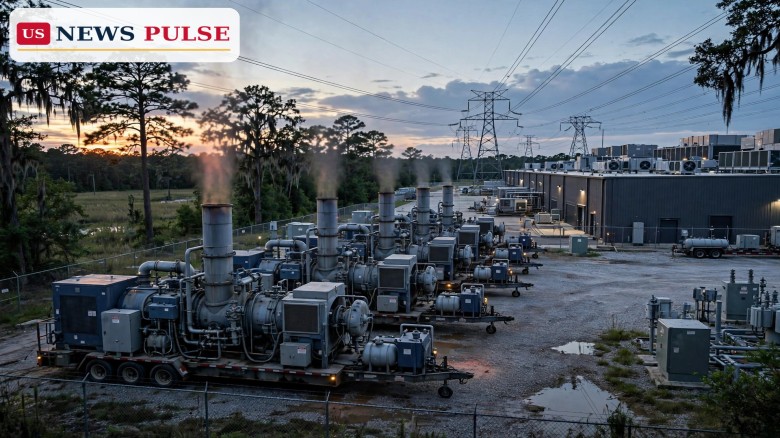
Sources: CNBC reporting, October 31, 2026; Southern Environmental Law Center press release, October 30, 2026; Earthjustice statement, October 30, 2026; NAACP v. X.AI Corp. opinion and order, N.D. Miss., October 30, 2026; Tech Insider, November 1, 2026. The featured image is an illustrative photograph of gas turbines beside a data centre.
Leave a Comment



 | Today's Date: