


 | Today's Date:



Houston Storm Deaths Rise to 8 as Tuesday Severe Outbreak Threatens 25 Million
Eight people have now died in the weekend storm that hit Houston, after the city's fire department announced on Monday that an eighth person had died from carbon monoxide poisoning during the storm. The grim update arrived as forecasters warned that the same unsettled weather pattern was about to deliver a fresh blow: a National Weather Service notice predicts an outbreak of severe thunderstorms on Tuesday across large parts of the Midwest and the western Great Lakes, putting about 25 million Americans in the path of more dangerous weather on Election Day itself.
Key Points
- Houston's weekend storm death toll has risen to eight, with the eighth death attributed to carbon monoxide poisoning and announced by the Houston fire department on Monday.
- The National Weather Service predicts a severe thunderstorm outbreak on Tuesday over the Midwest and western Great Lakes, with the greatest threat over Iowa and nearby states.
- Storms are expected to redevelop on Tuesday afternoon across eastern Nebraska and northern Missouri before moving rapidly north-east towards the Great Lakes.
- From the Ozarks to south Texas, isolated to scattered storms may form near the front and dry line on Tuesday, with hail up to 3 inches wide and locally severe wind gusts possible.
- By Wednesday morning the storm centre is expected to move into southern Canada, with the heavy rain threat easing across the Great Lakes, before threats expand again on Wednesday night towards the mid-Mississippi Valley.
What Happened
The Houston update is the human cost of a weekend storm that turned deadly before the new week had even begun. According to the reports available on Monday, eight people died in Houston over the weekend, and the fire department's Monday announcement added the eighth victim, who died from carbon monoxide poisoning. Carbon monoxide deaths after storms are a grimly familiar pattern: when power fails, people run generators, grills or vehicles in enclosed or poorly ventilated spaces, and the colourless, odourless gas builds up without warning.
The sources checked for this report did not name the victims or give the causes of the other seven deaths, and this article does not speculate about them. What is clear is the sequence: a weekend storm killed people in Houston, and by Monday the toll stood at eight, with the latest confirmed death coming not from floodwater or wind but from the aftermath of the storm itself. That distinction matters, because it points to a second wave of danger that arrives after the rain stops, when households without power improvise heat, light and cooking.
At the same time, the weather system behind the weekend's damage has not finished. A National Weather Service notice summarised in Monday's reporting describes an outbreak of severe thunderstorms predicted for Tuesday over large swathes of the Midwest and the western Great Lakes. The greatest threat is expected over Iowa and parts of nearby states, and the scale of the warning is reflected in the headline figure: 25 million Americans bracing for more severe weather. Tuesday is also Election Day, when millions of voters will be travelling to polling places, which gives the forecast a practical urgency beyond the usual weather warning.
Background and Context
The Houston deaths close a weekend in which the central and southern United States were repeatedly hit by the same slow-moving pattern. Earlier in the cycle, forecasters had already warned of severe storms for Monday across Kansas, Oklahoma and Texas, with damaging winds and a few tornadoes as the main threats, and of flash flooding in the Southwest, including evacuations in Sedona, Arizona, and flood warnings around Las Vegas. The Houston toll is therefore not an isolated incident but the deadliest single-city outcome so far from a multi-day stretch of severe weather that has moved from the Southwest through Texas and into the Plains.
The carbon monoxide death also fits a documented national pattern. According to figures cited by Texas regulators from the US Centers for Disease Control and Prevention, carbon monoxide kills more than 400 Americans each year and causes about 20,000 emergency room visits. After major storms, a share of those deaths comes from portable generators run too close to homes, or from vehicles and grills used for warmth indoors during power cuts.
Houston Storm Deaths: What We Know About the Toll
The verified facts about the Houston toll are narrow, and they should be stated narrowly. Eight people died in Houston's weekend storm. The Houston fire department announced on Monday that an eighth person had died as a result of carbon monoxide poisoning during the storm. The identities of the victims, the circumstances of the other seven deaths, and any official breakdown by cause have not been released in the reporting checked for this article. Readers should treat any more detailed version of the toll circulating online with caution until the fire department or another official source publishes it.
What the toll does establish is that the storm's danger extended beyond its most violent hours. Flood deaths usually dominate the headlines during a storm, but the deaths that follow — from carbon monoxide, from accidents during clean-up, from unsafe heating — can continue for days. That is why emergency officials treat the period after a storm as part of the emergency itself, and why the Houston announcement on Monday, a day after the weekend storm, is a warning as much as a statistic: the risk does not end when the rain stops.
Reactions and Guidance
Forecasters' guidance for the days ahead is unusually specific about where and when the danger will move. The National Weather Service notice behind Monday's reporting puts the greatest Tuesday threat over Iowa and nearby states, with storms redeveloping in the afternoon across eastern Nebraska and northern Missouri and then moving rapidly north-east to the Great Lakes. Further south, from the Ozarks to south Texas, isolated to scattered thunderstorms are expected to form from mid-afternoon into the evening on Tuesday near the front and dry line, with large to very large hail up to 3 inches in diameter and locally severe gusts possible.
For Election Day voters, local forecasters have added practical advice. In Houston itself, forecasters expect storms on Tuesday as a cold front slides through, with widespread heavy rain, strong winds and hail possible, and have advised voters to head to the polls early because the heaviest rain looks likely to arrive from late morning into the evening. The same front is expected to bring damaging winds to parts of the Deep South on Tuesday — Louisiana, Mississippi, Arkansas and Alabama — while rain is likely across parts of Kansas, Nebraska, Iowa, Wisconsin, Minnesota and Michigan, including Minneapolis, Chicago and the Kansas City area.
The standing safety advice for the whole episode is simple and worth repeating. Never drive through flooded roads: floodwater is often far deeper than it looks, and a small amount of moving water can sweep a vehicle away. Stay away from downed power lines, keep generators outdoors and well away from the home, and treat any carbon monoxide alarm as an emergency — get outside immediately and call for help. Anyone who feels dizzy, nauseous or confused after running a generator or a vehicle in an enclosed space should seek fresh air and medical attention at once.
Why It Matters
This story matters for two reasons that go beyond one city's death toll. First, it shows how storm deaths accumulate: not only in the dramatic hours of flooding and wind, but in the quiet hours afterwards, when power is out and people make desperate choices about heat and light. The eighth Houston death, from carbon monoxide, is a reminder that the official response to a storm — restoring power, opening shelters, warning about generators — is itself a life-or-death part of the emergency, and that the toll can keep rising after the weather clears.
Second, the timing could hardly be worse. The Tuesday outbreak coincides with the midterm elections, when tens of millions of people will be on the roads and at polling places across exactly the regions under threat. Severe weather on Election Day does not change who can vote, but it can change who finds it easy to vote: flooded roads, power cuts at polling places and long delays all fall hardest on people with the least flexibility. Election officials in affected states will be watching the same forecasts as everyone else, and voters planning to cast a ballot on Tuesday should check local conditions before they travel.
What Happens Next
The forecast timeline runs through the middle of the week. Tuesday brings the main outbreak: the greatest threat over Iowa and nearby states, redevelopment in the afternoon across eastern Nebraska and northern Missouri, a rapid move north-east to the Great Lakes, and scattered storms from the Ozarks to south Texas with hail up to 3 inches and severe gusts. By Wednesday morning, the storm centre is expected to have moved towards southern Canada, with the heavy rain threat quickly decreasing across the Great Lakes, and cooler, more pleasant air settling in behind the front in Texas and the southern Plains.
The respite may be brief. The threats are then expected to expand on Wednesday night towards the mid-Mississippi Valley, where thunderstorms tend to become slow-moving — the kind of storms that can drop heavy rain over the same place for hours and renew the flooding risk. Forecasters also expect wind gusts of 40 to 50 mph from eastern Kansas and Nebraska through Iowa, Minnesota and Wisconsin on Wednesday, with heavy rain of 1 to 2 inches or more from Texas to Minnesota, and a lower-level excessive-rainfall risk covering a dozen states, with localised flooding possible around Omaha, Des Moines and Minneapolis.
For Houston, the next official update to watch is a fuller account of the weekend toll: names, circumstances and causes, if the families consent to their release, and any statement from the fire department about the carbon monoxide death. For the wider country, the next watch is Tuesday afternoon itself, when the outbreak forecast will be tested against real storms, and when election officials, emergency managers and voters will learn whether the warnings matched the weather.
Frequently Asked Questions
How many people died in the Houston weekend storm? Eight, according to Monday's reporting. The Houston fire department announced on Monday that an eighth person had died from carbon monoxide poisoning during the storm.
What caused the eighth death? Carbon monoxide poisoning during the storm, as announced by the Houston fire department. Details of the other seven deaths have not been released in the sources checked.
Where is the severe weather heading on Tuesday? The National Weather Service predicts an outbreak over the Midwest and western Great Lakes, with the greatest threat over Iowa and nearby states, storms redeveloping across eastern Nebraska and northern Missouri, and scattered storms from the Ozarks to south Texas.
Will the storms affect Election Day voting? They could make travel harder in affected areas. Forecasters in Houston have advised voters to go early, before the heaviest rain arrives from late morning into the evening, and voters elsewhere should check local forecasts and polling-place information before travelling.
How can people stay safe from carbon monoxide after a storm? Never run a generator indoors or in a garage, keep it at least 20 feet from the home with exhaust pointing away, ensure carbon monoxide alarms work, and get to fresh air and call for help immediately if an alarm sounds or anyone feels dizzy or nauseous.
Related coverage: Severe storms and tornadoes possible Monday across Kansas, Oklahoma and Texas, Election Day weather forecast: rain, storms and wind could hit key midterm states and Las Vegas flash flooding: NWS warns of flood risk across Nevada and Arizona.
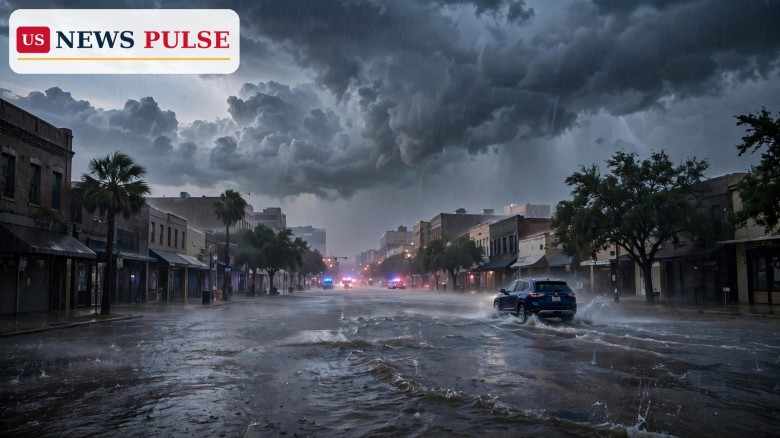
Sources: National Weather Service notice as reported November 2, 2026; Houston fire department announcement, November 2, 2026, as reported; Fox Weather and AccuWeather forecasts via travel reporting, November 2, 2026; Economic Times Election Day weather forecast, November 1, 2026; Fox 26 Houston weather report, November 2026; Texas Department of Insurance carbon monoxide guidance citing CDC figures. The featured image is an illustrative photograph of a flooded city street in a storm, not a photograph of Houston during this weekend's storm. Details of the Houston victims beyond the toll and the carbon monoxide death have not been released in the sources checked.
Leave a Comment