


 | Today's Date:



Carney Says Canada-US Trade Deal Is Making Progress After Long Trump Call
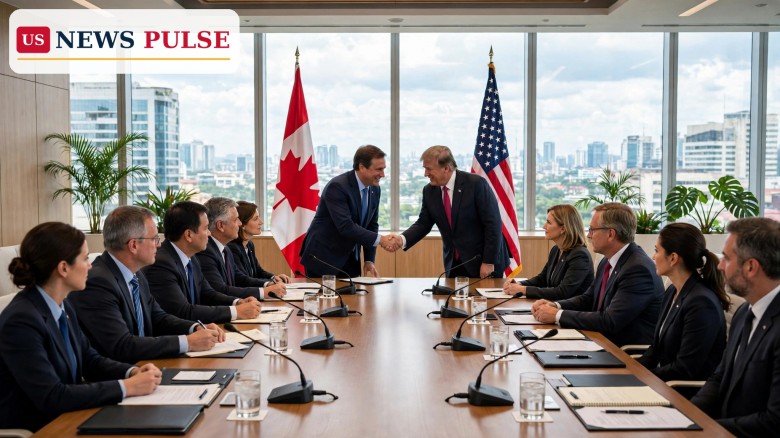
Canadian Prime Minister Mark Carney says trade talks with the United States are finally moving again, telling reporters in Manila that he held a long, substantive call with President Donald Trump and that a bilateral deal is now possible — though the two sides are not there yet.
Carney spoke on Saturday, November 14, 2026, during a trip through Europe and Asia. His message was measured: progress, but no breakthrough. The call also included US Trade Representative Jamieson Greer and Stephen Miller, Trump's new White House chief of staff. For two countries whose trade is worth hundreds of billions of dollars a year, even cautious optimism matters — but the auto industry question is still unresolved.
Key Points
- Progress, not a deal: Carney said he had a "quite a long, substantive conversation" with Trump: "we are making progress. There is the possibility of a deal, a bilateral deal. But we're not yet there."
- Also on the call: US Trade Representative Jamieson Greer and Stephen Miller, Trump's new White House chief of staff.
- The hardest issue: autos. Carney said Canada will not accept a deal that undermines its auto industry, calling it "one of the most challenging issues" in the negotiations.
- How talks got here: negotiations collapsed in August 2026, Washington imposed 50% tariffs on about $20 billion in Canadian goods, and Canada retaliated in September.
- Canada's other deals: in Manila, Carney also announced Canada has substantially concluded free-trade talks with ASEAN, a bloc of nearly 700 million people, and completed separate talks with the Philippines.
What Happened
Carney described the call in Manila on Saturday, saying it had taken place just before he left for his Europe and Asia trip. He called it "quite a long, substantive conversation" — language that, in diplomatic terms, signals a working session rather than a courtesy check-in. Greer and Miller's presence suggests the discussion went into substance, not pleasantries.
His verdict was carefully balanced. "We are making progress," he said. "There is the possibility of a deal, a bilateral deal. But we're not yet there." That is a step forward from only weeks ago. Saturday's remarks go further than his earlier "good" call with Trump two weeks ago: progress is being made, and a deal is possible, even if it is not yet within reach.
Background and Context
The Canada-US trade relationship has been in trouble since the summer. Talks collapsed in August 2026, when Canada suspended negotiations after Washington made last-minute demands Ottawa considered unacceptable. Washington then imposed 50% tariffs on about $20 billion in Canadian goods, and Canada retaliated in September with tariffs of its own.
October brought a slow thaw. Carney said on October 26 that talks had only slightly intensified, with his red lines unchanged since August. Then, on November 1, Carney said he had a "good conversation" with Trump about the future of Canada-US trade, and that negotiating teams would spend the coming weeks working toward a mutually beneficial deal. Saturday's call is the first in which Carney has used the word "progress" to describe the talks.
Canada-US Trade Deal: Autos Are the Hardest Part
Carney was explicit about where the negotiation could still fail. Canada will not accept a deal that undermines its auto industry, he said, calling autos "one of the most challenging issues" in the talks. Cars and parts cross the Canada-US border many times before a finished vehicle rolls off the line, and tariff changes ripple through factories on both sides of the border.
The stakes are highest in Ontario, where the auto industry supports hundreds of thousands of jobs, from assembly plants in Oshawa and Windsor to the parts suppliers spread across the province. The auto question is also where the two sides' interests clash most directly: the United States wants more auto production on its own soil, while Canada wants to protect an industry integrated with the American one for more than half a century.
Reactions and Quotes
Carney's own words on Saturday were the main public record of the call. "We are making progress," he said. "There is the possibility of a deal, a bilateral deal. But we're not yet there." The reference to a "bilateral deal" confirms the two countries are negotiating directly with each other.
On autos, his message was a warning as much as an update. Calling the sector "one of the most challenging issues" in the negotiations, and saying plainly that Canada will not accept a deal that undermines it, sets a public red line before the next round of talks. There was no immediate public response from the White House or from Greer's office.
Why It Matters
A Canada-US trade deal matters far beyond the two countries' capitals. Canada is the largest foreign supplier of goods to the United States, and the United States is by far Canada's biggest trading partner. The 50% tariffs imposed in the summer raised prices for businesses and consumers on both sides of the border.
For Canada, a deal would remove the tariff burden that has weighed on exporters since August and restore predictability to its most important economic relationship. Carney's parallel announcements in Manila add a second layer: by substantially concluding free-trade negotiations with ASEAN — a bloc of nearly 700 million people — and completing separate talks with the Philippines, Canada is reducing its dependence on the American market and gaining leverage in the talks with Washington.
What Happens Next
The next step is for the negotiating teams to turn the leaders' conversation into text. Carney said after the November 1 call that teams would work toward an outcome, and Saturday's update suggests that work is now producing movement. The question is whether Greer and his Canadian counterparts can close the gap on autos — the issue Carney identified as the hardest — .
There is no deadline, and that is deliberate: a rushed deal risks repeating the August collapse, when last-minute demands blew the talks apart. But the pressure is real. Every month without an agreement is another month of tariffs on about $20 billion in Canadian goods.
Frequently Asked Questions
What did Mark Carney say about the trade talks?
Carney said he had a "quite a long, substantive conversation" with President Donald Trump, and that "we are making progress. There is the possibility of a deal, a bilateral deal. But we're not yet there."
Is there a Canada-US trade deal yet?
No. Talks collapsed in August 2026, resumed after Canada's September retaliation to US tariffs, and are now making progress — but no agreement has been reached.
What is the biggest obstacle to a deal?
Autos. Carney said Canada will not accept a deal that undermines its auto industry, calling it "one of the most challenging issues" in the negotiations.
What happened to the talks in August?
Canada suspended talks over last-minute US demands, Washington imposed 50% tariffs on about $20 billion in Canadian goods, and Canada retaliated in September.
What other trade deals did Carney announce in Manila?
Canada has substantially concluded free-trade talks with ASEAN, a bloc of nearly 700 million people, and completed separate talks with the Philippines, to be signed next year and covering over 90% of tariff lines.
Leave a Comment