
Zelenskyy in Berlin Rejects Putin Phone Call and Demands Ceasefire First
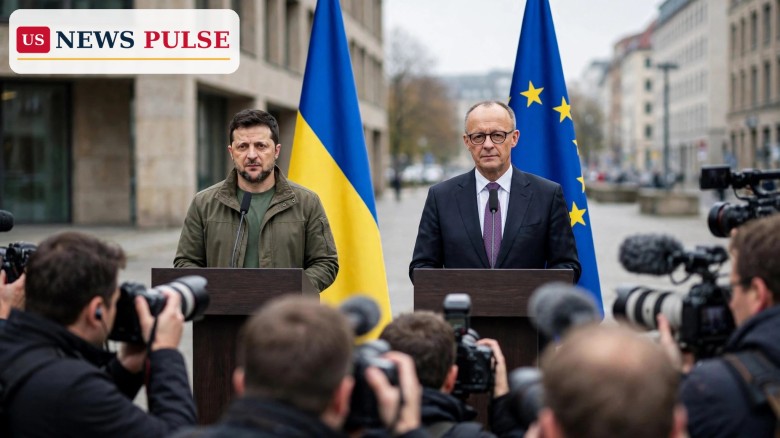
Ukrainian President Volodymyr Zelenskyy rejected a phone call with Russian President Vladimir Putin at a joint press conference with German Chancellor Friedrich Merz in Berlin on Tuesday, November 3, 2026, saying the sides need to sit down and negotiate and that a ceasefire must come first. The Zelenskyy Berlin appearance drew a sharp line between a conversation he described as formal and dry and direct negotiation that could produce real steps to end the war.
Zelenskyy said a phone call would leave him listening once again to a historical lecture rather than discussing real steps to end the fighting. He said a trilateral format could work if it produced de-escalation steps, dismissed a Russian invitation to Moscow as a trap in effect, and said there was no sense inviting Putin to Kyiv because he would not come.
He gave the grim context in Berlin: the Russian strike on a humanitarian aid site in Komyshuvakha, Zaporizhzhia region, killed 33 people, with five rescued and more than 50 possibly still trapped under rubble.
Key Points
- Zelenskyy rejected a phone call with Putin at a joint press conference with Friedrich Merz in Berlin on November 3, 2026.
- He said a call would be formal and dry, dominated by a historical lecture rather than real steps to end the war.
- He said the sides must sit down and negotiate, a ceasefire must come first, and a trilateral format could work if it produced de-escalation.
- He called a Russian invitation to Moscow a trap in effect and said inviting Putin to Kyiv made no sense because he would not come.
- He put the Komyshuvakha toll at 33 killed, five rescued and more than 50 possibly trapped, ahead of Brussels talks on November 4 and Abu Dhabi talks on November 10-11.
What Happened
The Berlin appearance was not a routine photo opportunity. Zelenskyy used it to answer, in public, what kind of contact with Moscow is worth having at this stage. His answer was that a telephone call is not: it would be a performance of diplomacy, he argued, in which history is recited, no commitment is made, no ceasefire is agreed and no civilian is protected.
That framing rejects the idea of a call as a low-cost first step. Zelenskyy argued that only face-to-face negotiation, in a format capable of producing de-escalation, can test seriousness in a meaningful way. A trilateral meeting of Ukraine, Russia and the United States, with Washington as a participant rather than a distant mediator, could in principle turn a meeting into commitments that can be verified.
Background/Context
The war has produced many rounds of indirect contact, mediated proposals and short-lived local truces, but no comprehensive settlement. Ceasefire proposals have repeatedly run into the same problem: each side fears a pause will be used by the other to regroup, and neither trusts the other to keep a commitment without verification and consequences for breaking it. That is why Kyiv insists the order matters, and why a ceasefire is presented as the test of whether talks are real.
Germany is a central stage for that argument. As Europe's largest economy and a major supplier of military and financial support to Ukraine, Berlin carries weight in any discussion of security guarantees, and Merz's presence beside Zelenskyy signalled that Kyiv's position is heard at the highest level in Europe. The Komyshuvakha strike gave that case its most painful illustration: a school turned into an aid hub, where residents had come for help, was hit on November 2.
Zelenskyy Berlin: Why Face-to-Face Talks Matter
The Zelenskyy Berlin position rests on a distinction between talking and negotiating. Talking can be done at any distance and without cost. Negotiating requires people in a room, a text on a table, and a willingness to be held to what is agreed. A phone call, in this view, allows a leader to claim engagement while avoiding the hard trade-offs that only a real negotiation forces into the open.
Face-to-face talks also create accountability a call cannot. When leaders sit together, their words are witnessed by allies, mediators and the press, and any agreement can be written down, checked and backed by the security guarantees allies are discussing in Brussels.
Reactions/Quotes
Zelenskyy's own words in Berlin were the clearest statement of Ukraine's position. He said a phone conversation would be a formal, dry conversation in which he would again listen to a historical lecture rather than discuss real steps to end the war. That sentence captures his objection: not to contact itself, but to contact that rehearses the past instead of changing the future.
Why It Matters
The Berlin remarks matter because they shape expectations for Abu Dhabi before anyone sits down. If talks are judged by whether they produce a ceasefire and de-escalation steps, then a meeting that ends only with a promise to keep talking will be seen in Kyiv as a failure, however warm the language. If they are judged merely by whether contact happened, then almost any outcome can be declared progress.
They also matter for Europe's role. By making the argument beside the German chancellor, Zelenskyy reinforced the idea that European security guarantees, to be discussed in Brussels, are part of the same package as any ceasefire. A ceasefire without guarantees, Kyiv fears, would simply pause the war until Russia is ready to resume it.
What Happens Next
The immediate next step is the security-guarantees meeting in Brussels on November 4, 2026, where allies will discuss what backing for Ukraine could look like in practice. Stronger, more concrete guarantees make a ceasefire easier for Kyiv to accept, because Ukraine would have reason to believe a pause would hold.
Then comes Abu Dhabi on November 10 and 11, where Russian, Ukrainian and American representatives are due to meet in trilateral format. The central question will be whether that meeting can move from general statements to specific de-escalation steps, including a ceasefire, and whether any agreement includes verification.
Frequently Asked Questions
What did Zelenskyy reject in Berlin? A phone conversation with Vladimir Putin, which he said would be formal and dry and dominated by a historical lecture rather than real steps to end the war.
What does Zelenskyy want instead? Face-to-face negotiation, with a ceasefire as the first step, and a trilateral format that produces de-escalation steps.
Why did he call a Moscow invitation a trap? He argued travelling to Moscow would hand Russia a symbolic victory without securing a ceasefire or any concrete step toward peace.
What did he say about Komyshuvakha? That the strike killed 33 people, with five rescued and more than 50 possibly still trapped under rubble.
What happens next? A security-guarantees meeting in Brussels on November 4, 2026, followed by trilateral Russia-Ukraine-US talks in Abu Dhabi on November 10 and 11.
Read more on US News Pulse: Russian bombs kill 26 at Ukraine aid centre school in Komyshuvakha, Kyiv says, Melania Trump to host Russia-Ukraine meeting at White House on November 5, and Ukraine-Russia peace talks set for Abu Dhabi on November 10-11 as US mediates.
© 2026 US News Pulse. All rights reserved.
 Print
 Save