


 | Today's Date:

Russian Bombs Kill 26 at Ukraine Aid Centre School in Komyshuvakha, Kyiv Says
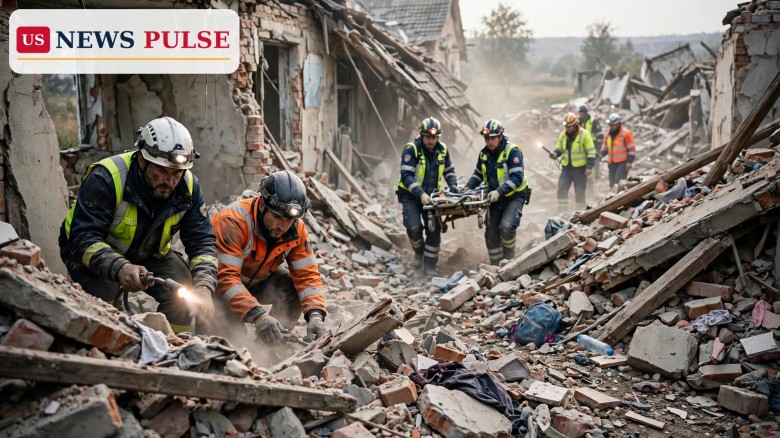
At least 26 people were killed when Russian bombs struck a school being used as a humanitarian aid distribution centre in the Ukrainian village of Komyshuvakha on Monday, in an attack President Volodymyr Zelensky called "utterly horrific". The Russian bombs that killed 26 at the Ukraine aid centre hit just as residents were arriving to collect their weekly aid packages, and a second wave of bombs then struck the shelter where people had taken cover, according to Ukrainian officials. Two rescue workers and four police officers were among the dead, five people were being treated in hospital, and rescuers feared the toll could still rise, with people still trapped under the rubble as night fell and Russian drones continued to attack the area.
Key Points
- At least 26 people were killed and five injured after Russian aerial bombs hit a school used as an aid distribution point in Komyshuvakha, in the Zaporizhzhia region.
- Regional head Mykhailo Semikin said at least nine 3,000kg aerial bombs hit the village, and 27 people were initially reported missing.
- Two members of a rescue crew and four police officers were among the dead, Ukraine's State Emergency Service said.
- President Zelensky said a second strike hit the shelter after the first strike on the school, and that Russia could not have been unaware of the weekly aid gatherings.
- A day of mourning has been declared across the Zaporizhzhia region for Tuesday, and the Russian military has not publicly commented.
What Happened
The attack unfolded on Monday in Komyshuvakha, a village in south-eastern Zaporizhzhia region that lies close to the front line of the four-and-a-half-year-old war. The local school, which no longer holds classes because the village is too close to the fighting, had become a lifeline for the residents who remained: every Monday, they gathered there to receive humanitarian packages. According to Zelensky, the Russians struck first just as people were arriving. "The Russians struck first just as people were arriving — a few aerial bombs," he said in his nightly video address. "Then there was a second strike — more air bombs, this time on the shelter."
Regional head Mykhailo Semikin said at least nine 3,000kg aerial bombs hit the village. Ukraine's State Emergency Service initially confirmed 24 deaths, including two rescuers and four police officers, and said five people were being treated in hospital, including two rescue workers. Zelensky later revised the toll upward in his video address, saying 26 people were now known to have died, after an earlier figure of 18. Regina Kharchenko, secretary of the Zaporizhzhia city council, said 27 people were initially reported missing, and officials warned that people were still under the rubble, so the final toll could rise further.
Background: A Village on the Front Line
Komyshuvakha sits south-east of the regional capital, also called Zaporizhzhia, in territory that has lived with the war at close quarters since Russia's full-scale invasion began in 2022. Villages in this belt have emptied as fighting approached, but some residents stayed, and for them the weekly aid distribution became a fixed point: food, medicine and basic supplies handed out at a known place, on a known day, to people with few other options. That regularity is central to Zelensky's charge. "The Russians could not have been unaware that residents remaining in Komyshuvakha gathered each week to pick up humanitarian packages from the site," he said, arguing that the timing and target left no room for doubt about what the site was.
Russian Bombs Kill 26 at Ukraine Aid Centre: The Toll and the Response
The casualty figures in this story deserve careful reading, because they moved during the day and they come from one side. The toll began at 18 in Zelensky's first account, rose to 24 in the emergency service's confirmed count, and reached 26 in Zelensky's late-night address. The confirmed dead include two rescue workers and four police officers — people killed not only in the first strike but in the second strike on the shelter, and in the rescue effort that followed. Five people were in hospital, including two rescue workers, and 27 were initially reported missing. Those figures have not been independently verified, and the Russian military has not publicly commented on the attack, so the Ukrainian account stands, for now, unchallenged by any Russian statement.
Reactions and Quotes
Zelensky's nightly address provided the fullest official account. "The Russians struck first just as people were arriving — a few aerial bombs," he said. "Then there was a second strike — more air bombs, this time on the shelter." He added that the Russians could not have been unaware that every week, local residents who had remained in Komyshuvakha received humanitarian aid at that very location. The video he posted, showing the crater and rescue teams searching the rubble, was intended as evidence as much as illustration: proof, in his presentation, of the scale and nature of the strike.
Ukrainian officials on the ground filled in the operational detail. Semikin's account of at least nine 3,000kg bombs, and of drones forcing rescuers to pause, painted a picture of an attack that did not end with the bombs themselves. The State Emergency Service's breakdown of the dead — two rescuers, four police officers — underlined that the second strike and its aftermath claimed the lives of the very people sent to save others. Kharchenko's figure of 27 initially missing gave the search its urgency, and the torchlit night search, documented in official photos and video, became the enduring image of the day.
Why It Matters
The attack matters first because of who was killed and where. An aid distribution point is, by definition, a place where the most vulnerable people in a war zone gather — the elderly, the poor, those who could not or would not leave. Striking such a place, twice, as people arrived and then as they sheltered, strikes at the humanitarian infrastructure that keeps front-line communities alive. If aid distributions become targets, the choice for remaining residents hardens: risk the journey to collect food, or go without. That is a humanitarian consequence that extends far beyond one village.
It matters second because of what it says about the war's direction. The expiry of the Oleshky ceasefire, the approach of the Abu Dhabi talks, and the Komyshuvakha bombing together describe a war that is simultaneously negotiating and escalating. For Ukraine's allies, the attack will strengthen the argument that security guarantees and air defences cannot wait for a peace agreement. For Russia, if it chooses to comment, the attack will test its willingness to defend a strike on a site Ukraine says was unambiguously civilian. For the negotiators heading to Abu Dhabi, it is a reminder that every day of talks is also a day of funerals somewhere along the front.
What Happens Next
In the immediate term, the search continues, and the toll may still rise as rescuers reach people trapped under the rubble. Funerals and the regional day of mourning on Tuesday will mark the human cost, while Ukrainian authorities work to identify the dead and support the injured and the bereaved. The village's aid distribution — the weekly gathering that was struck — faces an uncertain future: whether it resumes, where, and under what protection, are questions that will determine whether Komyshuvakha's remaining residents can stay at all.
Frequently Asked Questions
How many people were killed in Komyshuvakha? At least 26, according to President Zelensky's late-Monday address, up from an earlier figure of 18 and the emergency service's confirmed count of 24. Five people were injured, and 27 were initially reported missing.
What was struck? A school in Komyshuvakha that was used as a shelter and as a weekly humanitarian aid distribution point. No classes were held there because the village is too close to the front line.
Was it a single strike or more than one? Ukrainian officials described two waves: a first strike as people arrived, then a second strike on the shelter where people had taken cover, followed by drone attacks that hindered rescue work.
Who were among the dead? Two rescue workers and four police officers were among the confirmed dead, according to Ukraine's State Emergency Service. The full list of victims had not been published at the time of reporting.
Has Russia commented? The Russian military had not publicly commented on the attack at the time of reporting, and the casualty figures rest on Ukrainian official reporting, which has not been independently verified.
Related coverage: Ukraine-Russia peace talks set for Abu Dhabi on Nov 10–11, Ukraine-Russia alert apps hacked with fake nuclear warnings, and Iran leaves Doha talks as draft US deal circulates.
Leave a Comment