
Trump Confirms US Strike on Iran's Qeshm Island, Calling It a 'Minor Attack'
President Donald Trump has publicly confirmed that United States forces struck an anti-aircraft facility on Iran's Qeshm Island, describing the operation as a "minor attack" that "wasn't war". Speaking by telephone to Fox News' Fox & Friends on Tuesday, November 3, 2026, Trump said American forces watched the facility being built for about two months before hitting it, and claimed Iran's air defences have been effectively destroyed. The confirmation is the newest development in the eight-month US-Iran war, and it sits uneasily alongside his October 8 pledge not to attack Iran before the midterms.
Key Points
- Trump confirmed on Fox & Friends on Tuesday, November 3, 2026, that US forces hit an anti-aircraft facility on Qeshm Island in the Strait of Hormuz.
- He called it "just a minor attack" and said "it wasn't war", adding that the facility was struck "very nicely" as soon as it was completed.
- Trump said the US watched the site being built for about two months, and claimed Iran now has "no airplanes" and "no anti-aircraft" left.
- US officials have described the strikes as defensive, aimed at stopping Iran using the facility against commercial shipping in the Strait.
- The confirmation follows his October 8, 2026, pledge that "we will not be attacking Iran at any time prior to the midterm elections".
What Happened
The confirmation came in a telephone interview on Tuesday morning, as Americans voted in the midterm elections. Asked about the reported operation, Trump did not hedge or refer the question to the Pentagon. "They built an anti-aircraft facility. As soon as it was completed, we hit it last night very nicely," he said. "It's just a minor attack. It wasn't war."
Trump went further, claiming Iran's air power has collapsed. "They had 288 airplanes. Every airplane is laying on small little pieces," he said. Those figures have not been independently verified, and no Pentagon assessment backing them was published alongside the interview. The strike itself was first reported by The Wall Street Journal, which described a limited operation; Iranian state agency IRNA reported five explosions in quick succession on Qeshm, with residents seeing two aircraft.
Background/Context
Qeshm is Iran's largest island and a sensitive position at the mouth of the Persian Gulf. The Strait of Hormuz, where it sits, carries a large share of the world's seaborne oil, and commercial shipping there has faced repeated threats since the war began on February 28, 2026.
The strike also landed in a delicate diplomatic moment. Days earlier, Vice President JD Vance had said Washington had made "progress" in talks with Iran and set "no strict deadline" for a deal, while Trump himself said a deal was "coming together very nicely". Qatari mediators have been shuttling between the sides, with both reportedly reviewing mediator suggestions. Military action and negotiation have thus run in parallel — strikes continuing even as diplomats talk — and the Qeshm confirmation fits that pattern.
Trump Qeshm Island Strike Confirmation
The significance of the Trump Qeshm Island strike confirmation lies less in the military details, which remain sparse, than in who said it and when. On October 8, 2026, Trump wrote on Truth Social: "We will not be attacking Iran at any time prior to the midterm elections." The Qeshm operation, by his own timeline — a facility watched for about two months, then hit "last night" — appears to have taken place shortly before that Election Day interview, raising an obvious question about how pledge and strike fit together.
Trump's framing offers one answer: by calling it a "minor attack" that "wasn't war", he drew a distinction between a limited defensive strike and the major resumption of hostilities his pledge was understood to rule out. Critics are likely to argue that a strike is a strike, and that the distinction will be lost on Tehran, on shipping insurers, and on voters who took the October pledge at face value.
Reactions/Quotes
The most important reaction so far is Trump's own, and his words are the story. "They built an anti-aircraft facility. As soon as it was completed, we hit it last night very nicely," he told Fox & Friends. "It's just a minor attack. It wasn't war." On Iran's remaining capabilities, he said: "They had 288 airplanes. Every airplane is laying on small little pieces." Those remarks are now the official public record of the operation, unless the Pentagon or White House issues a fuller account.
US officials, speaking before the confirmation, had described the strikes as defensive, aimed at stopping Iran using the facility against commercial shipping. Iranian state media, through IRNA, reported the explosions but Tehran has not, in the reporting available, issued a detailed official response to Trump's confirmation itself. No casualty figures or damage assessment tied directly to the confirmation had been published at the time of reporting, and Qatari mediators have not publicly commented.
Why It Matters
This confirmation matters for three reasons. First, it settles the factual question: until Tuesday the Qeshm strike rested on a newspaper report and Iranian accounts of explosions; now the president has confirmed it himself. Second, it tests the credibility of presidential pledges in wartime — if voters and allies conclude such pledges carry an unstated exception for "minor" strikes, future assurances to Tehran will be read with greater scepticism. Third, it matters for Hormuz itself, where every incident moves oil prices and insurance rates.
What Happens Next
What follows depends on Tehran's response — denunciation, a military signal, or a return to the negotiating track — and on whether the Pentagon corroborates Trump's claims about the facility and Iran's air capabilities. With the midterms under way, the political constraint Trump imposed on himself in October falls away, and attention turns to whether Qatari-mediated talks advance toward a verifiable nuclear commitment, the priority Washington has named.
Frequently Asked Questions
What did Trump confirm about Qeshm Island?
That US forces struck an anti-aircraft facility on Qeshm Island, hitting it as soon as construction finished after watching it for about two months.
When did Trump confirm the strike?
On Tuesday, November 3, 2026, in a telephone interview with Fox News' Fox & Friends, as Americans voted in the midterms.
Why did he call it a "minor attack"?
He framed it as a limited, defensive operation against one facility, saying "it wasn't war" — a distinction his officials have echoed.
Does this contradict his pre-election pledge?
On October 8 he pledged no attacks before the midterms. The administration's implied position is that a limited defensive strike differs from a renewed campaign, but it has not reconciled the two in detail.
What happens next in the US-Iran talks?
Attention turns to Tehran's response, any Pentagon account, and whether mediated negotiations advance toward a verifiable deal on Iran's nuclear programme and Hormuz shipping.
Related: the original report of the Qeshm Island strikes; Tehran's latest warning that a deal remains far off; Washington's approval of the Qatar-presented draft deal.
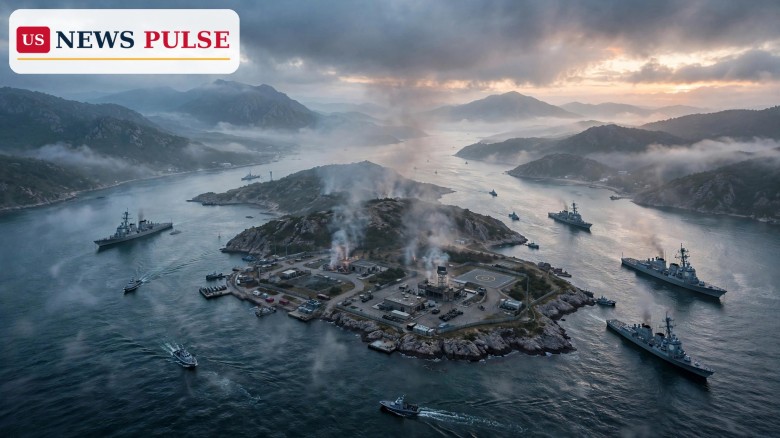
Illustrative image: an aerial view of a strategic island strait with naval vessels. This is a generated illustration for this report, not a photograph of the Qeshm Island strike itself.
© 2026 US News Pulse. All rights reserved.
 Print
 Save