
Kennedy Heirs Sue Trump to Stop 250-Foot Arch Casting Shadow Over JFK Grave
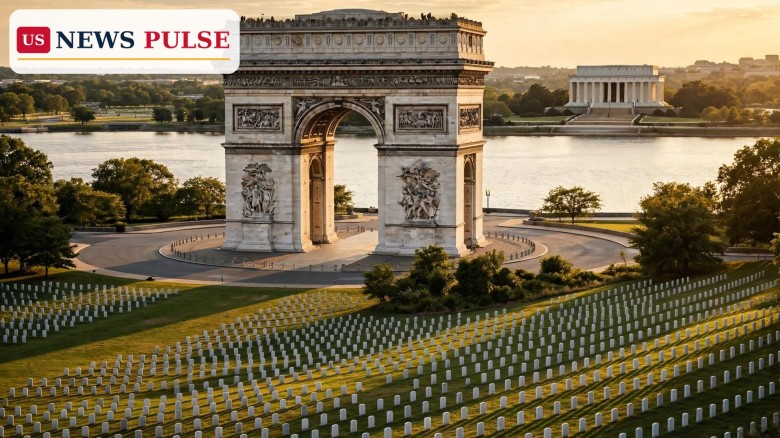
Nine members of the Kennedy family have gone to court to stop President Donald Trump from building a 250-foot triumphal arch on the Virginia side of the Potomac River, arguing it would cast a permanent shadow over the graves of President John F. Kennedy and two of his brothers at Arlington National Cemetery. Filed Tuesday, November 10, 2026, in Washington, D.C., it joins the crowded legal fight over the arch, temporarily blocked by a federal judge last week. Kerry Kennedy, daughter of Robert F. Kennedy, is among the plaintiffs. "Vanity should never stand in the way of valor," she said.
Key Points
- Nine Kennedy family members, including Kerry Kennedy and Edward M. Kennedy Jr., filed in Washington, D.C., to join the case against Trump's proposed 250-foot triumphal arch.
- The suit says Trump is "attempting to unlawfully erect a massive arch" that would "permanently cast shadows over and damage historically significant sightlines" to the Kennedy graves at Arlington.
- The arch, in the style of Paris' Arc de Triomphe, would stand between the Lincoln Memorial and Arlington, topped by a 60-foot gold winged figure holding a flame.
- A federal judge blocked construction through November 19 in a separate suit by Washington and Virginia, which says Trump needs Congress's approval.
- A May poll found 52 percent oppose the project, 41 percent strongly, against 21 percent in support.
What Happened
The nine family members filed on Tuesday, seeking to join the court case against the arch before construction begins. Alongside Kerry Kennedy, the plaintiffs include Edward M. Kennedy Jr., son of the late Senator Edward "Ted" Kennedy. John F. Kennedy, Robert F. Kennedy and Ted Kennedy are all buried at Arlington — the heart of the case.
The filing says the arch would "permanently cast shadows over and damage historically significant sightlines" to the Kennedy gravesites and memorials, including the Eternal Flame, and to the memorials of hundreds of thousands of fallen heroes at Arlington.
At 250 feet tall, the arch would rise on the Virginia side of the Potomac between the Lincoln Memorial and Arlington. Trump has championed it for the nation's 250th anniversary celebrations, and on November 2 he said it could house drones and snipers, calling it "the most beautiful arch in the world."
Background and Context
The arch has been one of the most contested projects of Trump's second term since its announcement about a year ago. The National Park Service found it would harm the historic landscape, and a Washington Post model found its shadow would touch burial sites on 284 days a year and pass over more than 75,000 graves, with the Eternal Flame in shadow on 18 days a year.
On October 30, Judge Tanya Chutkan heard arguments from Vietnam veterans and a historian seeking an injunction before the planning commission's final review on November 5, questioning the administration's national-security case. On November 5, Chutkan temporarily blocked construction for 14 days, through November 19. A day earlier, the District of Columbia and Virginia sued, calling the arch "flagrantly unlawful" and arguing the administration bypassed Congress and the arch would nearly double the capital's 130-foot height limit.
Kennedy Family Sues Trump Arch: What the Lawsuit Argues
The Kennedy filing adds a voice no other plaintiff can offer — the family of the men buried in the ground the monument would shadow. The states' suit turns on congressional authority and the height limit; the veterans' case on national security and planning. The Kennedy case turns on the graves themselves — on the claim that a president may not lawfully erect a massive monument that darkens the resting places of fallen service members and breaks the sightlines of a national cemetery.
The lawsuit speaks of the memorials of hundreds of thousands of fallen heroes, framing the arch as a threat to the cemetery as a whole, not one family's graves. Kerry Kennedy's line — "Vanity should never stand in the way of valor" — says it in a single sentence.
Reactions and Quotes
Kerry Kennedy put the family's objection in the starkest terms. "Vanity should never stand in the way of valor," she said. Her decision to join the case personally shows how seriously the family takes the threat.
The lawsuit is unsparing. It accuses Trump of "attempting to unlawfully erect a massive arch" and warns it would "permanently cast shadows over and damage historically significant sightlines" to the Kennedy gravesites and the memorials of hundreds of thousands of fallen heroes. The word "permanently" does much of the work: once built, the family argues, the damage cannot be undone.
Trump has shown no sign of backing down. On November 2, he said the arch could house drones and snipers and called it "the most beautiful arch in the world." His administration calls it a lawful exercise of executive authority.
Why It Matters
Arlington is the most hallowed burial ground in the United States, and the sightline between the Lincoln Memorial and the cemetery is one of the capital's most deliberate designs — an axis tying the monument to the president who preserved the Union to the ground where the nation's war dead rest. A 250-foot arch in the middle of that axis would change it forever.
The case also tests presidential power over federal land. Washington and Virginia argue Trump needs Congress's approval; the Kennedy family argues he has no lawful authority to build the arch at all. If the courts agree, the ruling would constrain future presidents from reshaping the capital's monumental core by executive action.
What Happens Next
The immediate question is what happens when Judge Chutkan's temporary block expires on November 19. The courts must decide whether to extend it while the lawsuits — from the states, the veterans and now the Kennedy family — proceed. A judge may consolidate them, since all turn on the same project and ground.
The planning commission's review of the final plans, scheduled for November 5, remains key, and the administration's timetable — excavation first, above-ground work not before May 2027, a 33-to-39-month build costing at least $100 million — leaves time for the courts to act before the arch rises. But the administration wants a fast start, and the states warn that once ground is broken the harm is very hard to undo.
Frequently Asked Questions
Who sued Trump over the triumphal arch?
Nine members of the Kennedy family, including Kerry Kennedy and Edward M. Kennedy Jr.
Where would the arch be built?
On the Virginia side of the Potomac, between the Lincoln Memorial and Arlington National Cemetery, at Memorial Circle. It would stand 250 feet tall, in the style of Paris' Arc de Triomphe.
Why do the Kennedys object?
They say it would "permanently cast shadows over and damage historically significant sightlines" to the Kennedy gravesites at Arlington, including the John F. Kennedy Eternal Flame.
Is construction stopped?
Yes, temporarily. Judge Tanya Chutkan blocked construction for 14 days on November 5, through November 19, while the lawsuits proceed.
How big would the arch be?
250 feet tall, topped by a 60-foot gold winged figure holding a flame and flanked by gold flying eagles. Cost: at least $100 million; construction: 33 to 39 months.
© 2026 US News Pulse. All rights reserved.
 Print
 Save