
SS United States Sunk a Day Early as World's Largest Artificial Reef Off Florida
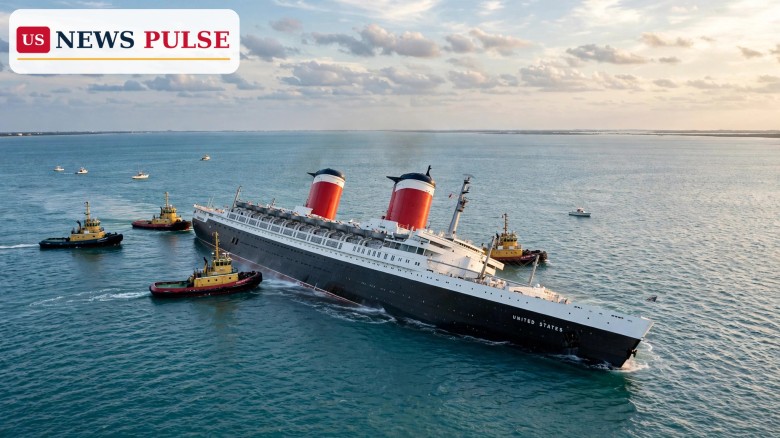
The fastest ocean liner ever built went down a day early. The SS United States, the 990-foot record-holder that carried four American presidents, was deliberately sunk off the Florida Panhandle on Wednesday, November 11, 2026, after forecast heavy winds and unsafe marine conditions forced Okaloosa County to move the historic deployment up by a day.
Crews began flooding the ship at 1 p.m. CT, opening valves connected to the liner’s original seawater intake pipes. The controlled sinking was expected to take about 45 minutes, sending the vessel to the seabed about 22 nautical miles southwest of Destin-Fort Walton Beach, Florida, where it becomes the world’s largest artificial reef.
Key Points
- The SS United States was sunk on Wednesday, November 11, 2026, a day earlier than the planned Thursday date, because of forecast heavy winds and unsafe marine conditions.
- Crews began flooding the 990-foot liner at 1 p.m. CT by opening valves connected to its original seawater intake pipes; the controlled sinking was expected to take about 45 minutes.
- The ship will rest upright in about 180 feet of water, its upper deck 55 to 60 feet below the surface, about 22 nautical miles southwest of Destin-Fort Walton Beach, Florida.
- It becomes the world’s largest artificial reef and the 21st and largest vessel on the Florida Panhandle Shipwreck Trail, taking the title from the former aircraft carrier USS Oriskany.
- Recreational divers are expected to be able to visit the wreck from dawn Thursday, November 12, after dive teams survey its resting position.
What Happened
The liner had been towed from Mobile, Alabama, on Monday, November 9, to the sinking site, where it sat partially flooded while crews prepared the final operation. Some of the vessel’s 128 tanks were already filled with water before the flooding began.
Public watch parties began at noon in Pensacola, at Seville Quarter, and in Destin, at AJ’s Seafood and Oyster Bar, while thousands of people followed the sinking on a livestream carried by the Pensacola News Journal and TheSSUS.com. A sendoff ceremony that had been scheduled for 1:30 p.m. was cancelled after the schedule change.
A Coast Guard safety zone kept spectator vessels at least one nautical mile from the deployment site, at coordinates 30° 07.148′ N, 86° 46.755′ W, about 32 nautical miles southeast of Pensacola Pass and 12 nautical miles from the Oriskany reef.
Background and Context
When the SS United States entered service in July 1952, it was a showcase of American post-war engineering. On its maiden voyage it crossed the Atlantic from New York to Europe in just under three days and 11 hours, at about 42 miles per hour — a speed record for a passenger liner that still stands.
Its passenger list reads like a roll call of mid-century America: four US presidents — Harry Truman, Dwight Eisenhower, John F. Kennedy and Bill Clinton — and stars including Marilyn Monroe and Marlon Brando. The ship was retired in 1969, after less than two decades in service, as jets took over the Atlantic route.
After retirement the liner spent about 30 years docked in Philadelphia while preservation groups searched for a way to save it. Okaloosa County bought the ship in October 2024 and had it towed 1,800 miles to Mobile, where hazardous materials were stripped out. Before the tow, workers removed the ship’s two iconic red funnels and other salvaged artifacts, which the SS United States Conservancy plans to use in a land-based museum in Florida.
The sinking was nearly stopped in court. The SS United States Preservation Foundation sued on November 3, 2026, alleging the US Army Corps of Engineers had approved the project without adequate environmental and historic-preservation review, citing hexavalent chromium in the ship’s coatings. On Friday, November 6, US District Judge M. Casey Rodgers denied the emergency request for a temporary restraining order, and the deployment went ahead.
SS United States Sinking: Why the Date Moved a Day Early
The plan had always been Thursday, November 12, with deployment starting at 10 a.m. local time. But a forecast of heavy winds and unsafe marine conditions changed everything on Wednesday morning. County officials decided there was no reason to risk the operation, the crews or the spectator fleet by waiting.
Okaloosa County Commission Chairman Trey Goodwin said: “Safety is always a top priority in Okaloosa County. There is simply no reason to take an unnecessary risk when adjusting the schedule will allow us to carry out this historic deployment safely and smoothly.” The county moved the flooding up to 1 p.m. CT on Wednesday instead.
Reactions
Thousands tuned into the livestream before the flooding began, and the comments mixed farewell with regret that the ship could not have been saved. One viewer wrote: “Bon voyage, SS United States. You sailed into history, and today you sail into eternity. Fair winds and following seas.”
Why It Matters
The sinking closes one of the longest preservation sagas in American maritime history. For 30 years the ship sat rusting in Philadelphia while supporters argued it could still be saved. The judge’s ruling settles the question: its future is on the seabed, not in a dry dock.
It also matters for the Gulf coast. At 990 feet, the liner is more than 100 feet longer than the RMS Titanic and far longer than the 888-foot Oriskany, which has held the largest-reef title for two decades. A wreck this size gives fish and coral a vast new structure to colonise and is expected to draw divers from around the world.
What Happens Next
The Coast Guard and the Florida Fish and Wildlife Conservation Commission were expected to stay at the site through the evening after the sinking. Dive teams from Destin-Fort Walton Beach and the Woods Hole Oceanographic Institution will survey the wreck to confirm it settled upright as planned.
Recreational divers should be able to visit from dawn on Thursday, November 12, provided the deployment went as planned, though officials said divers should look for an official announcement before making plans. Marine biologists will track how quickly life colonises the wreck.
Frequently Asked Questions
When was the SS United States sunk?
Wednesday, November 11, 2026, a day early. Crews began flooding the ship at 1 p.m. CT, and the sinking was expected to take about 45 minutes.
Where was the ship sunk?
About 22 nautical miles southwest of Destin-Fort Walton Beach, Florida, and 32 nautical miles southeast of Pensacola Pass, at coordinates 30° 07.148′ N, 86° 46.755′ W.
How deep will the wreck sit?
About 180 feet of water, with its upper deck 55 to 60 feet below the surface, within reach of recreational divers.
Why was the sinking moved up a day?
Forecast heavy winds and unsafe marine conditions made Thursday too risky.
Can divers visit the wreck?
Yes, from dawn Thursday, November 12, after dive teams survey the wreck’s resting position.
Read more on US News Pulse: The SS United States was to become the world’s largest artificial reef on Nov. 12, NASA’s $10 billion Moon base plan, announced at Kennedy Space Center, Florida and Florida’s 27th District heads to machine recount.
© 2026 US News Pulse. All rights reserved.
 Print
 Save