


 | Today's Date:





NASA Moon Base Contracts: $10 Billion Plan and Nuclear PROMISE Rover for 2028
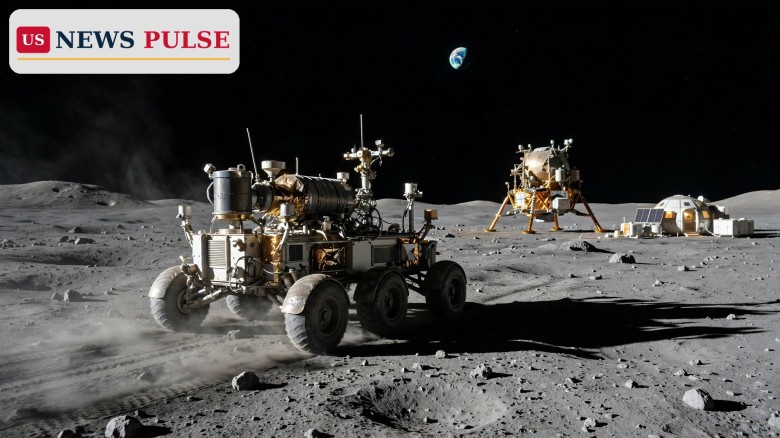
NASA has unveiled a $10 billion package of NASA Moon Base contracts and confirmed it is moving ahead with PROMISE, a nuclear-powered rover that will land at the Moon's South Pole in late 2028. Announced on Saturday at the MAX POWER expo at Kennedy Space Center in Florida, the package puts eight companies — including SpaceX and Blue Origin — in competition to deliver cargo to the Moon under a new 10-year contract called CLPS 2.
Key Points
- NASA picked eight firms for CLPS 2, a 10-year lunar delivery deal worth up to $10 billion, and raised CLPS 1.0 to $4.2 billion.
- PROMISE, a six-wheeled nuclear-powered rover, will land at the lunar South Pole in late 2028 to map the surface and scout landing sites.
- Blue Origin won $94 million, plus a $140 million option, to deliver PROMISE on its Blue Moon Mark 1 lander, flight Sirius 105.
- Six launch and transport orders worth about $1.3 billion will test orbital transfer vehicles, lunar drones and cislunar links.
- NASA chief Jared Isaacman confirmed Artemis III is set for early 2027 and Artemis IV in 2028 to return humans to the Moon.
What Happened
NASA announced the awards on Saturday, November 7, at the MAX POWER expo at Kennedy Space Center. The centrepiece is the next phase of the Commercial Lunar Payload Services programme (CLPS), under a new framework called CLPS 2. Eight companies can compete for lunar delivery missions: Blue Origin, Firefly Aerospace, Intuitive Machines, ispace-U.S., Lockheed Martin Space, Northrop Grumman Space Systems, SpaceX and Voyager Technologies. They will manage, build and operate landers carrying NASA science and infrastructure payloads to the Moon.
CLPS 2 is a 10-year, multiple-award contract worth up to $10 billion. NASA also raised the existing CLPS 1.0 contract from $2.6 billion to $4.2 billion. Alongside the cargo deals, NASA confirmed it is moving forward with PROMISE — the Polar Rover for Observation, Mapping, and In-Situ Exploration — built by NASA's Jet Propulsion Laboratory from spare parts of the Curiosity and Perseverance rovers.
Background: From Artemis to a Permanent Outpost
The announcement builds on a plan revision NASA set out in late October, reshaping Artemis around a 2028 return of astronauts to the lunar surface. Under it, Artemis III became a 2027 low Earth orbit docking test, and Artemis IV would send two astronauts to the South Pole for two short moonwalks. The November 7 awards turn that plan into hardware orders: cargo landers, a rover, power systems and the transport network linking Earth to the Moon.
No astronaut has walked on the Moon since Apollo 17 in 1972, and Artemis is designed to return crews to stay. That needs cargo delivered ahead of them, power and communications in place, and detailed maps — above all at the South Pole, where water ice in shadowed craters could one day become drinking water, air and rocket propellant.
NASA Moon Base: The PROMISE Rover and Its Nuclear Heart
PROMISE is the most striking item in the package. The rover will carry a drill to extract regolith from about one metre below the surface to characterise ice and other resources, plus spectrometers, temperature and radiation sensors, and cameras. It will also test a next-generation radiation-tolerant computer and advanced autonomy sensors. NASA aims to launch PROMISE in late 2028 for 18 months.
PROMISE runs on a flight-spare multi-mission radioisotope thermoelectric generator, the same kind of nuclear unit that has kept NASA's Mars rovers running for years. A lunar night lasts about two Earth weeks, and shadowed regions near the South Pole never see sunlight. A solar rover would go dark; PROMISE can keep working through the long nights and inside the shadowed craters where the science is. Proven Mars hardware cuts cost and shortens the schedule, and Blue Origin will deliver the rover on its Blue Moon Mark 1 lander.
Reactions: What NASA's Leaders Said
NASA Administrator Jared Isaacman called it the start of construction, not a study. "We are building the Moon Base mission by mission," he said. "Today's announcements expand nearly every part of that campaign... When our astronauts return to the Moon, they will arrive with the first elements of the Moon Base already waiting for them on the surface."
Moon Base Program manager Carlos García-Galán said the pace has quickened since the Ignition phase began. "In the eight months since Ignition, we've made incredible strides in accomplishing the near impossible: establishing a permanent outpost on the lunar surface," he said. "We've consolidated numerous efforts into a streamlined program... Most importantly, we've taken action, awarding new contracts and forging new partnerships to accelerate development."
Why It Matters
The package turns a decade of planning into orders industry can build to. The $10 billion CLPS 2 ceiling, the $1.3 billion in launch and transport orders, and the $94 million PROMISE delivery deal give eight companies a predictable set of missions — and give NASA a cargo network it does not have to own outright. The commercial model, proven with flights to the International Space Station, is now being applied to the Moon. Scientifically, PROMISE will answer the question the whole outpost depends on: how much usable water ice is there, and where. Strategically, the Moon is the proving ground for Mars: NASA says it will build an enduring human presence there as the foundation for the first crewed mission to Mars.
What Happens Next
Work on the new awards is expected to begin within months. NASA plans to buy commercial parts for a Mini-Communications and Solar Tower, known as miniCAST, combining solar arrays, batteries and wireless power transfer. Engineers at NASA's Marshall Space Flight Center in Huntsville, Alabama, will assemble and test the systems. In space, the six VADR orders will test orbital transfer vehicles, MoonFall drones to scout the surface before astronauts arrive, and communications links — including a SpaceX mission to launch communications satellites aboard a Starship to cislunar space in 2028. The sequence then runs through Artemis III in early 2027, Artemis IV and the first crewed landing in 2028, and PROMISE's own launch late in 2028.
Frequently Asked Questions
What is NASA's PROMISE rover?
PROMISE — the Polar Rover for Observation, Mapping, and In-Situ Exploration — is a six-wheeled, nuclear-powered rover that will land at the Moon's South Pole in late 2028 to assess resources such as water ice over 18 months.
How much are the NASA Moon Base contracts worth?
CLPS 2 is worth up to $10 billion over 10 years. NASA also raised CLPS 1.0 to $4.2 billion and awarded about $1.3 billion in launch and transport orders.
When will astronauts return to the Moon?
Artemis III is set for early 2027, Artemis IV in 2028, and PROMISE is targeted to launch in late 2028.
Why is the rover nuclear-powered?
A lunar night lasts about two Earth weeks, and shadowed craters near the South Pole never see sunlight. PROMISE's radioisotope generator keeps it working through long nights and inside those craters.
Read more: NASA's revised Artemis plan for a 2028 Moon landing, NASA's new X-70 Fractal jet, and Blue Origin's New Glenn return to flight in January 2027.
Leave a Comment