
Seven Killed in Gaza Strikes as Ceasefire Violations Continue in Gaza City
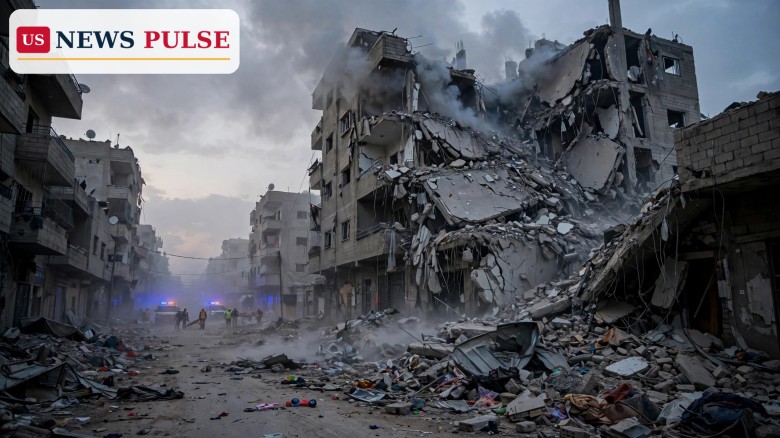
Seven Palestinians were killed across the Gaza Strip on Tuesday, November 10, in Israeli airstrikes and gunfire — the latest deadly Gaza strikes to test a ceasefire that has held on paper for more than a year while violence on the ground has never fully stopped. Among the dead were a father and his 13-year-old son, killed together by a strike on the roof of their shelter in Gaza City.
Health officials and medics reported the deaths through the day. The Israeli military said it had struck militants in two locations but gave no details.
Key Points
- At least seven Palestinians were killed in Gaza on Tuesday, November 10, 2026, health officials and medics said.
- Fadi Rajab and his 13-year-old son Abubakr died when an airstrike hit a displacement shelter in Gaza City’s Zeitoun neighbourhood.
- Strikes also hit a school area in Daraj and a foundry in Sabra; a man was shot dead in Khan Younis.
- Israel’s military said it struck militants in Zeitoun and Daraj but gave no further details.
- The UN has verified 1,076 deaths in Gaza since the October 10, 2025 ceasefire, including 268 children and 126 women.
What Happened
The deadliest incident came in Zeitoun, in eastern Gaza City, where medics said Fadi Rajab and his son Abubakr were killed when an airstrike hit the roof of a displacement shelter for displaced families.
A third Palestinian was killed in a strike near a school in Daraj, health officials said. Israeli gunfire killed a man in Khan Younis, and later an airstrike on a metal foundry in Sabra killed three more, taking the day’s toll to at least seven.
Details remained limited, and the other victims were not immediately named. The military did not explain the Khan Younis shooting, the Sabra strike, or why a shelter was hit. In the West Bank the same day, Israeli forces shot dead 14-year-old Moutaz Eyad Daghlas in Burqa, northwest of Nablus, Palestinian officials said, with Israel saying it was responding to stone-throwing.
Background: A Ceasefire Under Strain
The killings came more than a year after a US-brokered ceasefire took effect on October 10, 2025, ending the heaviest phase of a war that displaced most of Gaza’s two million residents. The truce was meant to open the way to reconstruction, but negotiators have failed to agree on terms for Hamas to disarm or for Israel to withdraw.
Most of the population still lives in tent camps, and infrastructure remains shattered. The UN reported in October that it had verified 1,076 deaths in Gaza between the ceasefire announcement and the end of July 2026, including 268 children and 126 women. Violence has also risen in the West Bank, where B’Tselem said Israeli forces killed at least 241 children or teenagers between October 7, 2023 and late June this year. Hamas disarmament has stalled, while Israel has approved the first 250 foreign troops for the Gaza stabilisation force, whose mandate remains unsettled.
Gaza Strikes and the Rising Death Toll
Tuesday’s deaths fit the pattern of the ceasefire period: large-scale bombing has stopped, but lethal strikes and shootings continue almost daily, and together they have killed more than a thousand people since the truce was announced, the UN says.
Children have borne a heavy share: 268 of the 1,076 verified deaths were children and 126 were women. Tuesday’s killing of a 13-year-old beside his father, on a shelter roof, showed how little protection the ceasefire offers civilians in packed neighbourhoods such as Zeitoun, Daraj and Sabra.
Reactions and Statements
The Israeli military said it had struck militants in Zeitoun and Daraj but gave no further details, and did not identify the people killed or explain the other deaths.
UNICEF said Israel had rejected equipment needed to repair a water basin in Gaza, warning it could overflow and endanger residents through flooding and disease.
James Elder, a UNICEF spokesperson, said the agency had worked for a year with Israeli authorities and President Donald Trump’s Board of Peace on a $3 million plan to repair the sewage-contaminated Sheikh Radwan basin in Gaza City. “Toxic sewage could flow into the streets and tents of Gaza City, forcing children and families from their makeshift homes once more, and grossly increasing the threat of disease,” he told reporters in Geneva. “Let’s do the rehabilitation before this becomes another entirely preventable killer of girls and boys in Gaza.”
WHO spokesperson Christian Lindmeier told the same briefing that nearly one million displaced people faced medium or high flood risk from flooding, poor sanitation and weak health services. Heavy rain has already flooded tens of thousands of tents, and a sandbank collapse killed a mother and three children as a storm flooded 70,000 tents.
Why It Matters
Tuesday’s killings matter first because of who died: a father and his 13-year-old son, sheltering with other displaced families, are the kind of victims a ceasefire is supposed to protect. When a truce still leaves more than a thousand dead in nine months, the word itself starts to lose meaning.
They matter second because the truce was built on a sequence — fighting halted, then disarmament, withdrawal and reconstruction — and every step after the first has stalled. They matter third because winter is arriving: the strikes came in the same week rain flooded tens of thousands of tents and a sandbank collapse killed four people, including three small children. With water systems destroyed and nearly a million people at flood risk, the next killer in Gaza may be flooding and disease, not a strike.
What Happens Next
Attention now turns to whether Israel gives a fuller account of Tuesday’s strikes, and whether any investigation follows. None had been given by Tuesday evening. The UN will keep updating its verified death toll, and aid agencies will watch whether Israel reverses its rejection of the basin-repair equipment before the winter rains worsen. The political questions remain: disarmament, withdrawal, and the stabilisation force.
Frequently Asked Questions
Who were the victims of Tuesday’s strikes in Gaza?
Seven Palestinians, health officials said, including Fadi Rajab and his 13-year-old son Abubakr, killed in a strike on a displacement shelter in Zeitoun. Others died in Daraj, Khan Younis and Sabra.
What does Israel say about the strikes?
The Israeli military said it had struck militants in Zeitoun and Daraj but gave no further details, and did not identify the people killed.
How many people have died in Gaza since the ceasefire?
The UN verified 1,076 deaths in Gaza from the ceasefire announcement on October 10, 2025 to the end of July 2026, including 268 children and 126 women. The true toll may be higher.
Is the ceasefire still in effect?
Yes. The US-brokered ceasefire that took effect on October 10, 2025 remains formally in place and large-scale bombardment has stopped, but lethal strikes continue and negotiators have not agreed on disarmament or withdrawal.
What is the humanitarian situation in Gaza now?
Most of Gaza’s more than two million residents still live in tent camps, with water and sanitation in ruins. Heavy rain has flooded tens of thousands of tents, and the WHO says nearly one million displaced people face medium or high flood risk.
© 2026 US News Pulse. All rights reserved.
 Print
 Save