
Moscow Car Bomb Wounds Ex-Ukrainian PM's Spokesman in Second Attack in Two Days
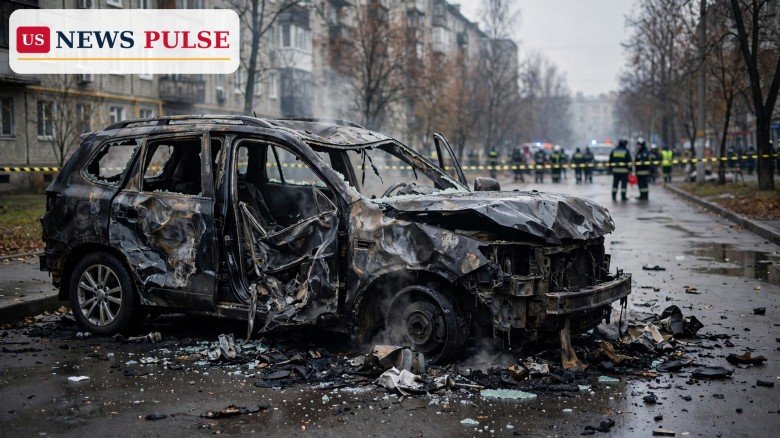
A Moscow car bomb seriously wounded Sergei Zavorotny, the former spokesman for exiled former Ukrainian prime minister Mykola Azarov, when his SUV exploded on a residential street in southern Moscow on Friday morning, Russian media reported.
The blast tore through the black Toyota Fortuner about 200 metres after it pulled out of a courtyard on Kirovogradskaya Street, in the capital's Chertanovo district, blowing the 72-year-old driver onto the road. It was the second car bombing in Russia in two days, coming less than 24 hours after a Russian air defence colonel was killed by a bomb under his car in St. Petersburg.
Zavorotny survived, but with grave injuries. Bystanders gave him first aid before an ambulance took him to hospital, where doctors treated a brain contusion, fractured ribs, an open fracture of his lower leg and shrapnel wounds. He lost his left arm in the blast and was in serious condition, according to Russian media.
Russia's Investigative Committee has opened a criminal case, reported as attempted murder. No group has claimed responsibility, and no official attribution has been established.
Key Points
- A black Toyota Fortuner driven by Sergei Zavorotny, 72, exploded on Kirovogradskaya Street in Moscow's southern Chertanovo district on Friday morning, November 13, 2026.
- Zavorotny lost his left arm and suffered a brain contusion, fractured ribs, an open leg fracture and shrapnel wounds. He was hospitalised in serious condition.
- Russian media reported an improvised explosive device under the driver's seat; Kommersant said it was likely a magnetic mine.
- Russia's Investigative Committee opened a criminal case, reported as attempted murder. It is the second car bombing in Russia in two days.
- Zavorotny was press secretary to former Ukrainian prime minister Mykola Azarov, fled to Russia in 2014 and now works as a pro-Kremlin journalist.
What Happened: The Moscow Car Bomb
The explosion struck on Friday morning as Zavorotny drove along Kirovogradskaya Street, a residential road in Chertanovo in southern Moscow. The SUV had travelled only about 200 metres from a courtyard when the device went off, hitting the driver's side and blowing out the left-side doors. The force of the blast threw Zavorotny from the vehicle onto the road.
Bystanders rushed to help him and began first aid before emergency services reached the scene. He was taken to hospital, where doctors treated him for the traumatic loss of his left arm, a brain contusion, fractured ribs and an open fracture of his lower leg, along with shrapnel injuries to his chest and back.
Early reports differed on the device. Several Russian outlets said an improvised explosive device had been planted under the driver's seat and detonated while the vehicle was moving. Kommersant said it was likely a magnetic mine. Authorities have not officially confirmed his identity, although Telegram channels and Kommersant named him. No other casualties have been reported.
Background: Who Is Sergei Zavorotny?
Zavorotny, 72, served as press secretary and spokesman for Mykola Azarov, who was Ukraine's prime minister from 2010 to 2014 under President Viktor Yanukovych. When Yanukovych was ousted following the Euromaidan Revolution in 2014, Azarov and his circle fled to Russia, and Zavorotny has lived there ever since, working as a Russian journalist and political commentator.
In Russia he became a well-known pro-Kremlin voice, opening his own media outlet and writing a book, "Yanukovych Surrendered, the State Department Accepted: How Russia Lost Ukraine," arguing that the Euromaidan Revolution was a coup orchestrated by Western intelligence agencies. Azarov also fled to Russia in 2014 and founded the Ukraine Salvation Committee, a group presenting itself as a Ukrainian government-in-exile.
That history makes Zavorotny a prominent figure in Moscow's exiled pro-Russian Ukrainian circle - and a symbolic target.
A Second Car Bombing in Two Days
The Moscow blast came a day after a Russian air defence colonel was killed on Thursday, November 12, when a remote-detonated bomb under his car exploded on Kolpinskoye Highway in Shushary, St. Petersburg. Russian media identified the dead officer as the chief navigator of the 6th Air Force and Air Defense Army, although officials confirmed only that a serviceman had died. Read our full report: St Petersburg Car Bomb Kills Russian Air Defence Colonel in Second Attack.
That killing was itself the second deadly car bombing in the same St. Petersburg neighbourhood since August 27, when Major Sergey Sechkov was killed about half a kilometre away and his wife was seriously injured. No one has claimed responsibility for either attack, and Kyiv has not commented.
Reactions and Claims
Azarov claimed the bombing bore a "100% Ukrainian signature" but provided no evidence. No group has claimed responsibility, and no official attribution has been established. Kyiv has not commented on the Moscow blast.
The attack came in a week of intense diplomacy. US envoys Steve Witkoff and Jared Kushner met Russian President Vladimir Putin in Moscow this week, days after US-mediated talks in Abu Dhabi produced agreement on a major prisoner exchange. For the latest on those talks, see our report: Kushner Says US Working Toward Largest Prisoner Exchange of Ukraine War.
Why It Matters
Two car bombings in two days, in two of Russia's biggest cities, point to a sustained campaign reaching deep inside Russia, not a one-off attack. The Moscow blast also widens the target set: Zavorotny is a civilian propagandist and former official, not a serving officer, which raises the question of who else in Moscow's exiled Ukrainian circle could be at risk.
It also lands at a sensitive moment, with US envoys shuttling between Moscow, Kyiv and Abu Dhabi while a prisoner exchange is agreed.
What Happens Next
Russia's Investigative Committee will lead the criminal investigation, with forensic teams examining the wreckage to establish the type of device and how it was placed. Investigators will likely review surveillance footage and look for links to Thursday's St. Petersburg bombing.
Watch for any claim of responsibility, any comment from Kyiv, and any arrests in the coming days.
Frequently Asked Questions
Who was injured in the Moscow car bomb?
Sergei Zavorotny, 72, former press secretary to ex-Ukrainian prime minister Mykola Azarov. He lost his left arm and suffered a brain contusion, fractured ribs, an open leg fracture and shrapnel wounds. He was hospitalised in serious condition.
What caused the explosion?
Russian media reported an improvised explosive device planted under the driver's seat of his black Toyota Fortuner. Kommersant said it was likely a magnetic mine. The exact device has not been officially confirmed.
Was anyone else hurt?
No other casualties have been reported. Bystanders gave Zavorotny first aid at the scene before an ambulance arrived.
Who is blamed for the bombing?
No group has claimed responsibility and no official attribution has been established. Azarov claimed a "100% Ukrainian signature" but gave no evidence. Kyiv has not commented.
Was this the first car bombing in Russia this week?
No. It was the second in two days. On Thursday, November 12, a Russian air defence colonel was killed when a bomb under his car exploded in St. Petersburg.
Related: Zelenskyy Says Starshield Speed Cap Is Back, Slowing Ukraine Drone Defence.
© 2026 US News Pulse. All rights reserved.
 Print
 Save