
Europe Wins a Seat at Ukraine Peace Talks as EU Agrees E5 Team for Negotiations
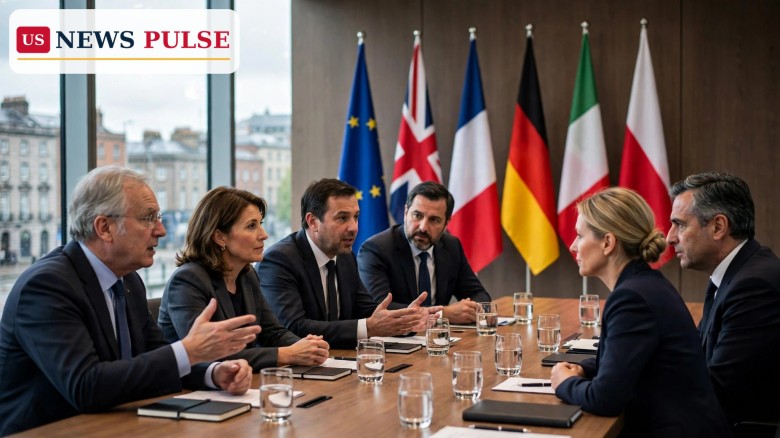
Europe has won a seat at the Ukraine peace talks. European Council President Antonio Costa announced on Friday, November 13, 2026, that Europe will be represented by the EU institutions and the E5 nations — the United Kingdom, France, Germany, Italy and Poland. The move ends nearly two years in which Europe was shut out of United States-Russia talks on the war in Ukraine.
The announcement came at the end of a meeting of EU leaders in Dublin, a day after American envoys Steve Witkoff and Jared Kushner met President Vladimir Putin in Moscow. Ukrainian President Volodymyr Zelenskyy welcomed the decision at once.
Key Points
- Costa announced on Friday, November 13, 2026, in Dublin that Europe will be represented by the EU institutions plus the E5: the United Kingdom, France, Germany, Italy and Poland.
- It follows the meeting of US envoys Steve Witkoff and Jared Kushner with President Vladimir Putin in Moscow on Thursday, November 12; Witkoff said there had been "progress."
- Ukrainian President Volodymyr Zelenskyy welcomed the move: "next time, next meeting, Europe will be on the negotiating team... They will have a voice."
- The Kremlin hedged: spokesman Dmitry Peskov said Europe must first show its "willingness to contribute to the peace process."
- EU foreign policy chief Kaja Kallas said "without us, any agreement that is there cannot be implemented."
What Happened
The decision was settled at the Dublin summit on Friday, after days of open argument among the Europeans about how they should be represented. For most of the week the debate was whether Europe should send a single envoy or a team. French President Emmanuel Macron had said on Thursday that "without Europeans, there is no support for Ukraine" and that there was "no more U.S. support."
Costa cut through that argument with a formula giving both the EU institutions and the five biggest European powers a place at the table. "Europe must speak with one clear voice and united voice in all discussions that shape the future of Ukraine," he said. The E5 covers the five states most involved in arming and financing Ukraine; the EU institutions bring the bloc's sanctions power and its hold over frozen Russian assets.
The timing was set by Washington. On Thursday, Witkoff and Kushner met Putin in Moscow and emerged saying the talks had made "progress," then said Europe would join the next rounds — the first time the Trump administration has said so in public.
Background and Context
Europe's exclusion has been a running sore for nearly two years. The Trump administration's direct channel to Moscow, led by Witkoff and Kushner, has negotiated over Ukraine's head and Europe's head alike. The Moscow meeting on Thursday restarted the talks, and the envoys have been shuttling between the parties in Abu Dhabi.
On Thursday, EU leaders were still split between a single envoy and a team, with the leading candidates Costa, Kallas and Finnish President Alexander Stubb. The E5 formula settles it for now by sending a team, not one person. In Abu Dhabi, Russia has revived its demand that NATO pull back to its 1997 borders, which NATO chief Mark Rutte has rejected.
Europe's E5 Team at the Ukraine Peace Talks: What It Means
The E5 arrangement is a compromise. A single envoy would have given Europe one voice, which is what Kushner has pressed for — he warned that Europe identifying one person to speak on its behalf "would be a bigger achievement than getting the Russians to include them in the negotiation." A team of five plus the EU institutions is messier, but it keeps the biggest players inside the tent.
The five were not chosen at random. Britain and France are Europe's two nuclear-armed states and its largest military spenders. Germany is the biggest economy and the largest European donor to Ukraine. Italy and Poland bring the southern and eastern flanks: Poland is the main hub for Western military aid. The EU institutions add the levers no single capital controls — the sanctions regime and the frozen Russian assets.
Reactions and Quotes
Zelenskyy's welcome was the warmest reaction of the day. "Next time, next meeting, Europe will be on the negotiating team," he said. "They will have a voice." For Kyiv, a European presence is the best guarantee a settlement will not trade Ukrainian territory for a quick deal.
Kallas made the practical case. "Without us, any agreement that is there cannot be implemented," she said. Even if Moscow and Washington agree a text, the money and enforcement run through Brussels, London, Paris, Berlin, Rome and Warsaw.
The Kremlin's answer was a hedge. Peskov said Europe must show its "willingness to contribute to the peace process" before any decision on letting the Europeans join, and Russia's Foreign Ministry said it knew of no agreement.
Why It Matters
The settlement being discussed will shape Europe's security for a generation, and the people who must enforce it — and pay for it — were not in the room. Europe has supplied the bulk of the money keeping Ukraine's government and army running and holds the frozen Russian assets likeliest to fund reconstruction. A deal made without Europe would still need Europe to work. The hard positions have not moved either: Russia wants territory it does not hold, while Ukraine will not surrender land it still defends.
What Happens Next
The next test comes at the next round, where the European team is expected to take its seats for the first time. The practical questions are immediate: who chairs the European side, whether the five nations and the EU institutions speak as one delegation, and whether Moscow accepts them. The Abu Dhabi track continues in parallel, and the envoys are also working on a major prisoner exchange. Putin meets President Donald Trump next week in Shenzhen, where the European question is now likely to be on the agenda.
Frequently Asked Questions
Who makes up the E5 team? The E5 are the United Kingdom, France, Germany, Italy and Poland. With the EU institutions, they will represent Europe at the talks, under the formula Costa announced in Dublin on Friday, November 13, 2026.
Why was Europe not at the talks before? For nearly two years the US-Russia channel ran largely without Europe. After the Moscow meeting on Thursday, November 12, the US envoys said Europe would join future rounds.
What did Zelenskyy say about the decision? He welcomed it, saying: "Next time, next meeting, Europe will be on the negotiating team... They will have a voice."
Has Russia accepted Europe joining the talks? Not yet. Kremlin spokesman Dmitry Peskov said Europe must first show its "willingness to contribute to the peace process," and Russia's Foreign Ministry said it knew of no agreement.
What happens next in the talks? The European team is expected at the next round, while the Abu Dhabi track continues and Putin meets President Donald Trump next week in Shenzhen.
© 2026 US News Pulse. All rights reserved.
 Print
 Save