
Rubio Says 'People Are Struggling' and the Economy Is Not the Stock Market
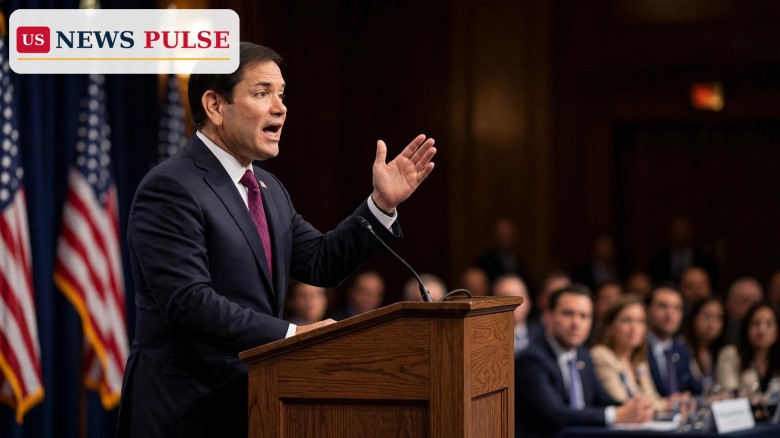
WASHINGTON — Secretary of State Marco Rubio acknowledged on Friday that Americans are struggling, telling fellow conservatives the health of the economy "has nothing to do with the stock market" and everything to do with whether families can afford what they need. The admission came in his first prepared remarks since Republicans were routed in the November 3 midterms, breaking with President Donald Trump's habit of citing rising share prices as proof the economy is doing well.
Rubio spoke to the Federalist Society in Washington on Friday evening, November 13, 2026, on the cost of living and the war in Iran. His blunt language on household budgets marked the night.
Key Points
- Rubio: "I think we have to recognise that people are struggling. There's no doubt about it."
- He said the economy's health "has nothing to do with the stock market" but whether people can afford necessities.
- It was his first prepared speech since Republicans were routed on November 3 over economic pain.
- Rubio defended the Iran war as necessary to stop a nuclear weapon, but admitted it has pushed up petrol prices.
- He warned America risks becoming "the first generation to leave the next worse off".
What Happened
Rubio spoke to fellow conservatives at the Federalist Society's gathering in Washington, his first set-piece speech since the midterm defeat. He did not soften the message. "I think we have to recognise that people are struggling. There's no doubt about it," he said. "The health of our economy has nothing to do with the stock market. The health of their economy is whether they have enough money to be able to afford the things they need."
The line was a direct challenge to the White House's talking points. Trump often points to the stock market as evidence the economy is doing well. Rubio, by contrast, said share prices mean little to a family weighing grocery bills, rent and fuel. He warned prosperity is "not self-perpetuating" but "an enormous undertaking that requires years and decades and is not accomplished election cycle to election cycle."
Background: A Midterm Verdict on Affordability
The speech landed ten days after voters delivered massive losses to Rubio's Republican Party in the November 3 midterms, handing Democrats control of Congress. Economic pain was a core issue: voters angry over higher costs blamed Trump for his tariffs, his war in Iran and his unfulfilled promise, made two years ago, to bring down prices.
That verdict is the backdrop to everything Rubio said. The midterms were fought on kitchen-table questions — food, fuel and housing — and the party in power lost ground almost everywhere. His speech was the first public acknowledgement from a senior administration figure that the voters had a point.
Rubio: "People Are Struggling" — the Economy Is About Necessities
Rubio's core argument was that the economy should be judged by household reality, not by Wall Street. "The health of our economy has nothing to do with the stock market," he said. "The health of their economy is whether they have enough money to be able to afford the things they need."
He was equally candid about the costs of the administration's own choices. Rubio defended the Iran war as necessary to stop Tehran obtaining a nuclear weapon, but acknowledged the unpopular conflict has driven up gasoline prices. "It's not easy to address these things because it's not popular to address them," he said. "It's difficult. And oftentimes it inflicts, you know, pain, economic pain and otherwise. So we recognise that."
Rubio closed the economic passage with a generational warning. "That's the challenge before us now, because I do think there's a legitimate fear that we will be the first generation to leave the next worse off, and that can't happen. That's un-American," he said.
Reactions and Quotes
Rubio's remarks carried the overtones of a campaign speech, though the former Florida senator has consistently refused to discuss whether he will seek the presidency in 2028, in a race that could pit him against Vice President J.D. Vance.
In the same address, Rubio also hit back at critics of Trump administration policies, including deadly strikes on alleged drug-smuggling boats in Latin America, the January capture of then-Venezuelan President Nicolas Maduro and strict immigration policies. He accused other countries and international organisations of trying to stymie the United States by invoking international law, describing it as "the weaponization of international law." His attack on the International Criminal Court in the same speech is covered in full in our companion report.
Why It Matters
A secretary of state publicly splitting with the president's economic message is rare, and it matters for two reasons. First, it signals that the administration knows affordability is now its central vulnerability — the issue that cost it Congress. When the country's top diplomat tells a friendly audience that the stock market is not the economy, the White House's framing has been publicly corrected from inside.
Second, it sets the terms of the debate to come. Democrats now control Congress, and they will use Rubio's words against the administration at every turn. For Republicans, the speech is a warning that voters will not accept market statistics as a substitute for cheaper living — and an opening for a figure like Rubio to present himself as the candidate who heard them.
What Happens Next
The immediate question is whether the White House adjusts its message. Trump has shown no sign of abandoning the stock market as his preferred measure of success. Watch for the president's next remarks on prices and wages — and for whether other cabinet members echo Rubio's affordability language.
Longer term, Rubio's speech will be read as an early move in the 2028 race. He has refused to say whether he will run, but a speech that redefines the economy around ordinary families, delivered to the conservative movement's most influential legal audience, is the kind of marker ambitious politicians leave. Democrats won control of the House in the 2026 midterms, and talks with Iran continue even as the war's costs rise at home.
Frequently Asked Questions
What did Marco Rubio say about the economy?
Rubio said "people are struggling" and that "the health of our economy has nothing to do with the stock market" — it is whether families can afford the things they need.
Why does it matter that Rubio said it now?
It was his first prepared speech since Republicans were routed in the November 3 midterms, when voters cited economic pain, and it contradicts Trump's habit of citing the stock market as proof the economy is doing well.
Did Rubio criticise the war in Iran?
No. He defended the war as necessary to stop Tehran obtaining a nuclear weapon, but admitted it has driven up gasoline prices and other costs for Americans.
What did Rubio say about the next generation?
He warned there is "a legitimate fear that we will be the first generation to leave the next worse off, and that can't happen. That's un-American."
Is Rubio running for president in 2028?
He has consistently refused to discuss whether he will seek the presidency in 2028, in a race that could pit him against Vice President J.D. Vance.
© 2026 US News Pulse. All rights reserved.
 Print
 Save