
Trump Claims 'Very Big' US-Philippines Trade Deal, the Biggest Ever, as Manila Stays Silent
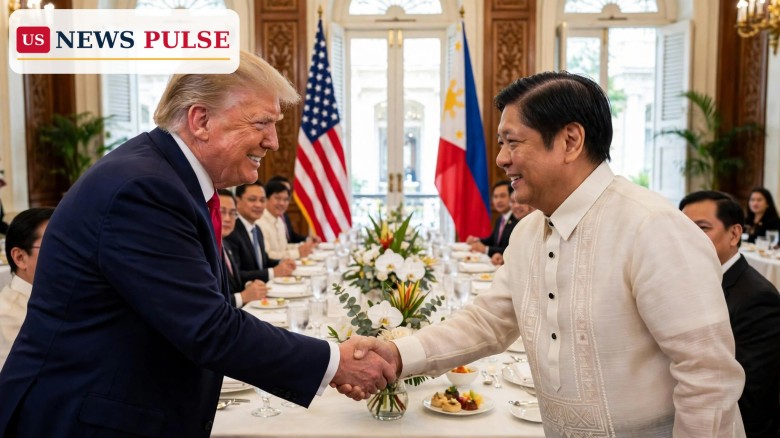
President Donald Trump announced on Wednesday, November 18, 2026, that the United States has concluded what he called a "very big trade deal" with the Philippines, announced at a state luncheon in Manila while the Philippine government said nothing at all about any agreement.
"We just concluded a 'very big trade deal' with the Philippines," Trump told guests at the luncheon at the presidential palace, describing it as "the biggest trade deal we've ever made so far" and "a fair deal for both countries." He added that it had come together quickly: "We didn't know that was going to take place, but it took place very quickly and it's a magnificent deal for both."
Key Points
- President Donald Trump said on Wednesday, November 18, 2026, in Manila that the US has concluded a "very big trade deal" with the Philippines.
- Trump called it "the biggest trade deal we've ever made so far" and "a fair deal for both countries" — but gave no details of what the deal contains.
- Manila announced no agreement, and there was no immediate comment from the office of Philippine President Ferdinand Marcos Jr or from the Philippines' ambassador to the United States.
- Trade talks were in no schedule released by either country before the meeting.
- The same day, Trump said Washington is expanding defence cooperation with Manila and the two countries will probably do "something big" on nuclear power.
What Happened
The announcement came at a state luncheon at the Philippine presidential palace in Manila, where Trump was a guest of Marcos Jr. Trump presented the deal as already done, not as a negotiation still under way.
What he did not do was say what the deal actually covers. There was no mention of tariff levels, of which goods or sectors are included, of any timetable, or of when a signed text might appear.
That silence from Manila is the other half of the story. The Philippine government announced no agreement of its own, and neither Marcos Jr's office nor the Philippines' ambassador to the United States offered any immediate comment. Trade negotiations had not been mentioned in any of the schedules released by either country.
Background: A Visit Built Around Summits, Not Trade Talks
Trump is in Manila for a run of summit diplomacy. The Philippines holds the rotating chair of the Association of Southeast Asian Nations, and the city has hosted the ASEAN summit and the first Quad leaders' summit in two years, bringing together the United States, Japan, Australia and India.
Trade was not billed as part of the Manila programme: the published schedules made no mention of trade negotiations, and the morning's assumption was that the Trump-Marcos bilateral had ended with no deal and no tariff decision. Trump's luncheon announcement reversed that expectation in a single sentence.
It was Trump's second trade announcement in two days: on Tuesday, November 17, he said Thailand would scrap all tariffs on US imports under a deal to be finalised in the coming weeks. The Philippines is one of Washington's oldest treaty allies in Asia.
US-Philippines Trade Deal: What We Know, and What We Do Not
What is known is narrow: the president of the United States said, in Manila, that a very big trade deal with the Philippines has just been concluded, that it is the biggest trade deal the United States has ever made, and that it is fair to both countries. He also said defence cooperation is expanding and the two governments will probably do something big on nuclear power.
What is not known is everything else. There is no published text, no tariff list, no figure for the trade covered, no signing date, and no confirmation from Manila that an agreement exists as Trump described it. Until Manila speaks, or a document appears, the announcement rests on the president's word alone.
Trade deals are normally announced jointly, with both governments describing the same terms at the same time; a one-sided announcement, with the other capital silent, is unusual. The scale of the claim also invites scrutiny: America's largest trade agreements cover hundreds of billions of dollars a year, yet no number was given and no product was named.
Reactions and Quotes
Trump's own words are, for now, the whole public record. "We just concluded a 'very big trade deal' with the Philippines," he said at the luncheon. "The biggest trade deal we've ever made so far. A fair deal for both countries. We didn't know that was going to take place, but it took place very quickly and it's a magnificent deal for both."
From the Philippine side, there was no reaction to report. Marcos Jr's office issued no statement about a trade deal, and the Philippines' ambassador to the United States made no immediate comment. That silence is itself the most important reaction so far.
Why It Matters
If the deal is real and as large as Trump described, it would be a significant moment for both countries. For the Philippines, a major trade agreement with the United States would be a vote of confidence from its closest ally. For Washington, it would be another piece of a fast-moving trade agenda in Asia, a day after the Thailand announcement.
The defence and nuclear remarks matter too: the Philippines sits at the centre of the South China Sea disputes, and expanded defence cooperation with Manila is a signal to Beijing as much as to the Philippines.
What Happens Next
The first thing to watch is Manila: a statement from Marcos Jr's office or the Philippine trade department would confirm whether the government regards a deal as concluded, and on what terms.
The second is paper: a deal of the size Trump described would normally produce a joint statement, a fact sheet or a signed text, with tariff schedules, product lists and a timetable. The third is the rest of the trip: Trump meets Xi Jinping in China on Thursday, November 19, then holds the first-ever three-way meeting with Xi and Vladimir Putin.
Frequently Asked Questions
What did Trump announce?
At a state luncheon in Manila on Wednesday, November 18, 2026, he said the US has "just concluded a 'very big trade deal'" with the Philippines, "the biggest trade deal we've ever made so far" and "a fair deal for both countries."
What are the terms of the deal?
None: Trump mentioned no tariff levels, products, figures or timetable, and no document has been released.
Has the Philippines confirmed the deal?
Not so far: Manila announced no agreement, and neither Marcos Jr's office nor the Philippines' ambassador to the US commented.
Was a trade deal expected from this visit?
No. Trade talks were not in any schedule released by either country, and the expectation was that the Trump-Marcos bilateral had ended with no deal or tariff decision.
What else did Trump say in Manila?
He said Washington is expanding its defence cooperation with the Philippines and that the two countries will probably do "something big" on nuclear power — again without details.
Read our earlier report on the US-Thailand trade deal announced in Manila, the Quad summit in Manila, and the Trump-Xi-Putin trilateral meeting in Shenzhen.
© 2026 US News Pulse. All rights reserved.
 Print
 Save