

 | Today's Date:

US-Thailand Trade Deal Signed in Manila as Bangkok Scraps US Tariffs - US News Pulse
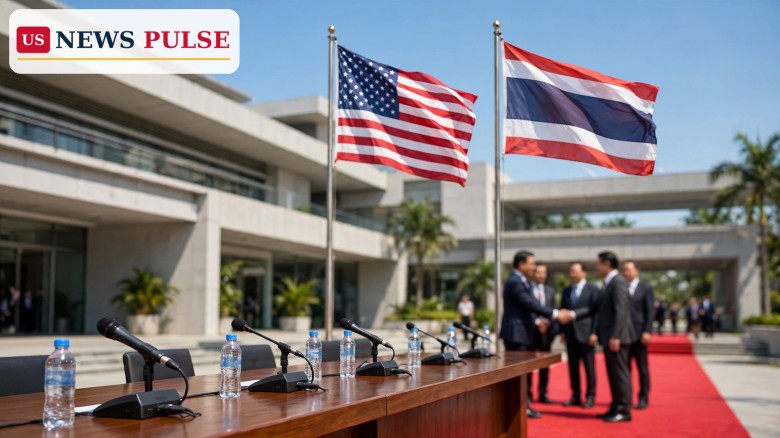
The United States and Thailand have signed a joint statement confirming a reciprocal trade deal, with Bangkok agreeing to scrap all tariffs on American exports, President Donald Trump announced in Manila on Tuesday, November 17, 2026. Thailand will also buy an estimated $2.6 billion in additional American farm products.
The formal agreement is expected to be finalised and signed in the coming weeks, after Thailand completes a public consultation and the legal procedures its system requires. For American exporters, the headline is simple: a market of about 70 million people is about to open up on far better terms than any they have enjoyed before.
Key Points
- Trump and Thai Prime Minister Anutin Charnvirakul signed a joint statement in Manila on November 17, confirming substantial conclusion of an Agreement on Reciprocal Trade.
- Thailand will eliminate all tariffs on United States exports and remove "substantial" nontariff barriers on American cars, medical devices, pharmaceuticals, ethanol and poultry.
- Thailand will buy an estimated $2.6 billion in additional American agricultural products.
- The formal deal is expected in the coming weeks, after a public consultation and legal procedures in Thailand.
- The United States is Thailand's largest export market, taking 24.6 percent of its exports so far this year.
What Happened
The signing took place in Manila, where Trump was attending the first Quad leaders' summit in two years with the leaders of India, Japan and Australia. The trade announcement came as the summit closed with agreements on critical minerals, a new maritime patrol exercise and a first Business Leaders Forum in 2027.
Under the joint statement, Thailand has agreed to eliminate all tariffs on goods exported from the United States. Trump also said Bangkok will remove "substantial" nontariff barriers on automobiles, medical devices, pharmaceuticals, ethanol and poultry, rules that often matter as much as tariffs because they decide whether a product can actually be sold. On agriculture, Trump said Thailand will buy an estimated $2.6 billion in additional American farm products.
Background: How the Deal Was Reached
The road to Manila began with a threat. In 2025, Thailand initially faced a threatened United States tariff of 36 percent, later lowered to 19 percent, on exports that include electronics, automotive parts and food. In October 2025, the two countries announced a preliminary framework under which Thailand would eliminate tariffs on about 99 percent of American goods, setting the shape of the final deal.
Thailand's interest is clear: the United States is its largest export market, taking 24.6 percent of everything it sells abroad so far this year, and a settled rate removes the uncertainty clouding investment decisions since the tariff threat first appeared. The deal was also announced during Trump's Asia trip, which has already produced the Quad summit outcomes in Manila and a planned first three-way meeting with China's Xi Jinping and Russia's Vladimir Putin at the APEC summit in Shenzhen.
US Thailand Trade Deal: What the Agreement Covers
The heart of the deal is tariff elimination, going slightly further than the 99 percent figure in the October 2025 framework. For American manufacturers, products will enter Thailand without the import taxes that previously made them dearer than goods from countries with their own Thai trade deals.
The $2.6 billion in farm purchases gives the deal an immediate payoff. Thailand is a major food importer, and the commitment covers grains, meat, dairy and processed foods. But the timetable is not yet set: until the formal agreement is signed and enters into force, the 19 percent tariff and existing nontariff rules remain in place.
Reactions
Trump presented the deal as a clear win for American exporters, saying Thailand had agreed to eliminate all tariffs on United States exports and remove "substantial" nontariff barriers on the five named sectors. The emphasis reflected the industries that had pressed hardest for Thai market access.
Anutin was more measured, saying there is "a little more to do" before the formal agreement can be signed, reflecting the public consultation and legal steps still ahead in Bangkok. Across the region, other governments are watching: the terms Thailand accepted set a benchmark for their own negotiations with Washington.
Why It Matters
The deal matters first for American exporters. A zero-tariff market of about 70 million people, in a country where the United States is already the biggest foreign customer, is a rare combination, and removing tariffs and nontariff barriers gives competitive American producers a genuine chance to grow sales.
It also matters as a signal. Signed in Manila during a week of intense United States diplomacy in Asia, it shows Washington building its economic relationships one bilateral deal at a time, even as the larger United States-China trade questions remain unresolved.
What Happens Next
Officials will turn the joint statement into a final text in the coming weeks, and Thailand will run its public consultation and complete its legal procedures. Only then will the two leaders sign the formal document and set a date for it to enter into force. Watch for the details the statement does not contain: the schedule for the farm purchases, the precise nontariff changes in each sector, and any transition periods for sensitive products.
Frequently Asked Questions
What did the United States and Thailand agree?
They signed a joint statement in Manila on November 17, 2026, confirming substantial conclusion of an Agreement on Reciprocal Trade. Thailand will scrap all tariffs on United States exports, cut nontariff barriers on five sectors, and buy $2.6 billion more farm goods.
When will the deal be formally signed?
In the coming weeks, after Thailand completes a public consultation and legal procedures. Anutin said there is "a little more to do" first.
Which American products benefit most?
Cars, medical devices, pharmaceuticals, ethanol and poultry, plus farm goods covered by the $2.6 billion purchase commitment.
What tariff did Thailand face before?
A threatened 36 percent United States tariff in 2025, later lowered to 19 percent. An October 2025 framework already proposed scrapping Thai tariffs on about 99 percent of American goods.
Why does the deal matter?
Thailand is a market of about 70 million people, and the United States is its largest export market, taking 24.6 percent of its exports this year.
Related US news: the Quad summit in Manila ended with critical-minerals deals and a new patrol exercise, and US retail sales rose 0.2% in October to $748.2 billion.

The US News Pulse newsroom covers breaking news across the United States and the world, working from wire services, official statements and on-the-record sources. Every story is reviewed against our editorial standards before publication. Corrections and tips: info@usnewspulse.com
About our newsroomLeave a Comment