
Israel Launches New Gaza Ground Offensive Beyond the Yellow Line in Central Gaza
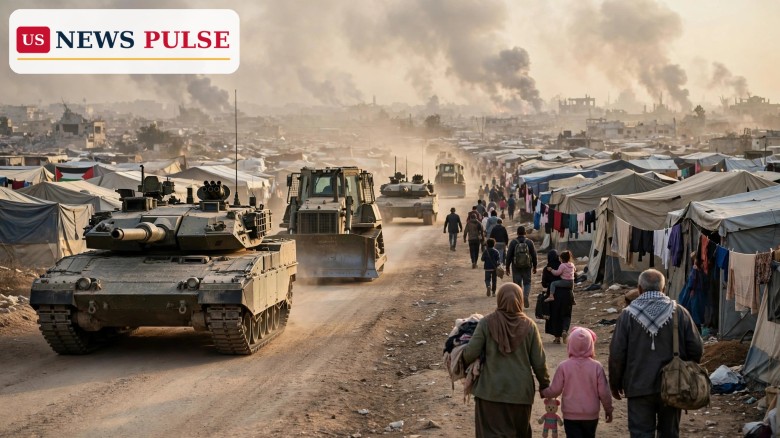
Israel's military launched a new ground offensive in central Gaza on Wednesday, November 18, 2026, sending tanks and bulldozers beyond the Yellow Line for the first time since the October 2025 ceasefire. Three Palestinians were killed in the first hours, hospital officials said, as families fled the northern part of the Nuseirat refugee camp.
Key Points
- Israel's military said it has begun a "concentrated operation" in three areas of central Gaza west of the Yellow Line, around the Al-Bureij and Al-Nuseirat refugee camps.
- The operation covers blocks 660, 661 and 666, and residents were told to leave in an Arabic-language notice from COGAT, the Israeli military coordination body.
- Tanks and bulldozers advanced east of Al-Bureij under artillery shelling and gunfire, and sections of Salah al-Din Road, Gaza's main north-south highway, were closed.
- Three Palestinians were killed, hospital officials said, including one in an airstrike on al-Mughraqa, north of Nuseirat.
- Hamas called the operation a "flagrant violation of the ceasefire agreement" and urged mediators to intervene immediately.
What Happened
The operation began on Wednesday morning, when COGAT published an Arabic notice telling residents of the three blocks to leave. Shortly afterwards, Israeli tanks and bulldozers moved east of Al-Bureij, backed by artillery shelling and gunfire. Sections of Salah al-Din Road were closed as the advance continued.
Hospital officials said three Palestinians were killed in the first hours. One died in an airstrike on al-Mughraqa, north of Nuseirat. Families left the northern part of the Nuseirat camp, carrying what they could, as shelling continued. The Israeli military said the operation aimed at "terrorist infrastructure" and at eliminating a threat to its forces.
The three blocks sit west of the Yellow Line, the boundary marking the limit of Israel's deployment in Gaza since the ceasefire took effect on October 10, 2025. Until Wednesday, Israeli forces had not advanced beyond that line in central Gaza, and there had been no large-scale ground operation in the area since the ceasefire began.
Background and Context
The ceasefire that took effect in October 2025 ended two years of war, but it has never held cleanly. Both sides have accused each other of violations, and the killing has continued at a slower but steady pace. Gaza's Health Ministry said on Monday, November 16, that 1,650 Palestinians have been killed and 5,975 wounded by Israeli violations since the ceasefire began. Israel still occupies around 70 percent of Gaza.
The weeks before Wednesday's operation were already full of warnings that the truce was fraying. On November 12, an Israeli strike hit the surgery ward of Nasser Hospital in Khan Younis, killing six people. On November 14, a drone strike killed two Palestinians near the Abu Sharkh roundabout in Jabaliya. On November 15, Israel killed senior Hamas commander Samir Abu Younis in a drone strike in Al-Mawasi.
On Wednesday itself, the Board of Peace headed by President Donald Trump issued its second report to the UN Security Council, faulting both Israel and Hamas for failing to meet their commitments. It warned that "a ceasefire that delivers nothing visible cannot be sustained indefinitely."
Israel Gaza Ground Offensive: Crossing the Yellow Line
The Yellow Line is more than a line on a map. Drawn when the ceasefire was agreed, it marked how far Israeli forces would pull back, and where they would stay. Crossing it in force, with tanks and bulldozers rather than a patrol or a single strike, changes the meaning of the line itself. If it can be crossed for a "concentrated operation" in three blocks, residents and mediators will ask what stops it being crossed again.
Central Gaza is also where the strip is at its most crowded. Al-Bureij and Al-Nuseirat are refugee camps, dense neighbourhoods of families already displaced several times. An operation there forces civilians to move again, along roads that are themselves being closed. Salah al-Din Road is the spine of Gaza, the route aid convoys, ambulances and fleeing families all depend on.
Reactions and Quotes
Hamas condemned the operation in the strongest terms, calling it a "flagrant violation of the ceasefire agreement" and urging mediators to intervene immediately. The group has repeatedly accused Israel of using security claims to justify operations that, in its view, break the terms of the truce.
Israel's military said the operation targets "terrorist infrastructure" and aims to "eliminate a threat" to its forces. COGAT's Arabic announcement told residents of blocks 660, 661 and 666 to leave. No statement from the United States or the other ceasefire mediators had appeared in the sources reviewed, and the Israeli military gave no timetable for the operation.
Why It Matters
The operation tests whether the October 2025 ceasefire still exists in any real sense. A truce that permits one side to launch a large-scale ground offensive across its own agreed boundary, while the other side calls it a flagrant violation, is a truce in name only.
It also matters for the people of central Gaza. The camps around Al-Bureij and Al-Nuseirat hold families who have already fled their homes more than once, and who have nowhere safe left to go. Every new operation means another displacement, another stretch of road closed, another night in a tent. The Health Ministry's toll, 1,650 killed since the ceasefire, is a reminder that the truce has not meant safety for civilians.
What Happens Next
The immediate question is how far the operation goes. If Israeli forces pull back to the Yellow Line after clearing the three blocks, mediators may present it as a limited action. If the advance widens, or the operation drags on for days, the ceasefire will be harder to defend, and pressure on the mediators to act will grow.
Hamas has asked the mediators to intervene immediately. The Board of Peace is due to present its report to the Security Council at the end of November, and Wednesday's operation will now be part of that discussion.
Frequently Asked Questions
What happened in central Gaza on Wednesday?
Israel's military began a "concentrated operation" west of the Yellow Line around Al-Bureij and Al-Nuseirat, with tanks and bulldozers under artillery shelling. Three Palestinians were killed, hospital officials said.
What is the Yellow Line?
The boundary marking the limit of Israel's deployment in Gaza since the October 2025 ceasefire. Wednesday was the first time Israeli forces advanced beyond it in central Gaza.
How many people have been killed since the ceasefire?
Gaza's Health Ministry said on November 16 that 1,650 Palestinians have been killed and 5,975 wounded by Israeli violations since the ceasefire began.
What did Hamas say?
Hamas called it a "flagrant violation of the ceasefire agreement". Israel says it targets "terrorist infrastructure".
What happens next?
The operation's length and scope are unclear. The Board of Peace reports to the UN Security Council at the end of November, and mediators must decide how to respond.
Read more: Trump's Board of Peace Faults Israel and Hamas Over Gaza War | UK Sanctions 8 Israeli Settlement Firms and Gaza Aid Group Tzav 9 | Israeli Drone Strike Kills Two in Jabaliya as Gaza Ceasefire Toll Hits 1,643
© 2026 US News Pulse. All rights reserved.
 Print
 Save